





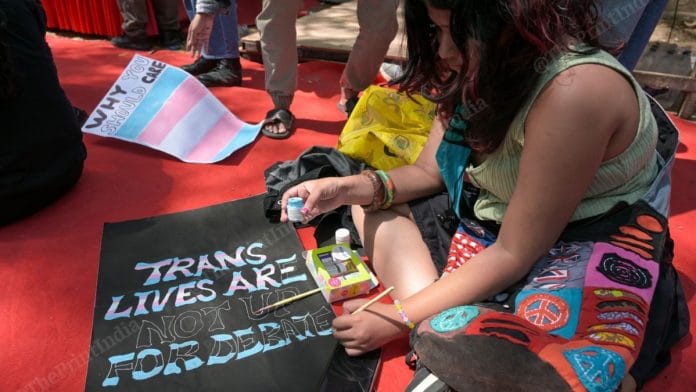



New Delhi: Activists and members of the National Council for Transgender Persons (NCTP) have moved the Supreme Court, challenging constitutional validity of the Transgender Persons (Protection of Rights) Amendment Act, 2026 with the central argument that it “inflicts irreparable constitutional injury” on fundamental rights.
The petition was filed on 3 April by Laxmi Narayan Tripathi and Zainab Javid Patel, both transgender women who serve as nominated members of NCTP, a body formed in 2020 under the Ministry of Social Justice and Empowerment to advice the government on policies affecting transgender persons.
It challenges the law on the grounds that it violates Articles 14, 15, 19, and 21 of the Constitution, which guarantee equality before the law, prohibition of discrimination, six fundamental freedoms, and the right to life and personal liberty, respectively.
The amendment was passed by Parliament on 25 March and received presidential assent on 30 March.
Passage of the amendment sparked outrage and criticism from across sections of the society. Some called it an undoing of hard fought progress for the transgender community, and two NCTP members resigned from their statutory posts, rejecting the Act and demanding its repeal.
The central question
At the heart of the 886-page petition is the repeal of the principle of self-identification—a right the Supreme Court’s landmark NALSA judgment of April 2014 had elevated to the status of a fundamental right.
The petition asks: “Whether the State, through the instrument of legislation, may define who a person is, and in so doing, substitute its own biological or socio-medical classification for the lived, autonomous, and self-perceived identity of a human being.”
The petitioners note that while the original Transgender Persons (Protection of Rights) Act of 2019 had preserved this right, the 2026 amendment “dismantles that right section by section”.
The petitioners seek a declaration that the Act is unconstitutional, ultra vires (beyond one’s authority, and null and void ab initio (void from its very inception).
They also filed an application for interim relief, requesting an immediate stay on the mandatory registry and the impersonation offence—two contested provisions of the amendment—to prevent “profound, daily, and irreversible harm” to the transgender community pending the hearing.
Identity, dignity, medical gatekeeping
The petition specifically challenges the substitution of the definition of “transgender person” under Section 2(k), arguing that the new definition replaces a model based on subjective experience with a “biologized and medically conditioned classification” that violates the right to identity and dignity under Article 21.
It strongly condemns a new proviso that excludes persons with “self-perceived sexual identities” from the definition of transgender persons, calling it a “head-on collision between parliamentary legislation and a binding constitutional judgment”.
A major point of contention is what the petition terms the re-introduction of “medical gatekeeping” through Section 4, which now requires a District Magistrate to issue identity certificates to transgender people based on a recommendation from a “medical body”.
The petition describes this as “a regression of the most direct and egregious kind”, noting that the NALSA judgment had explicitly held that “requiring surgery as a prerequisite for changing one’s legal gender is a violation of the right to privacy and dignity”.
Section 7(1A), which mandates that medical institutions furnish surgical details of transgender persons to government authorities without their consent, is further challenged as a violation of the fundamental right to privacy and bodily autonomy.
Criminalisation and reservations
The petitioners also target the new Section 18A, which criminalises “impersonation of transgender identity”. They argue the provision is unconstitutionally vague and broad, and warn that it “will be weaponised as a tool of police harassment and create a chilling effect on gender expression”.
The petition further highlights what it describes as a “continuing constitutional default”—the state’s failure to provide reservations in education and employment for transgender persons, a directive issued by the Supreme Court in the NALSA judgment twelve years ago that remains unimplemented in the new Act.
Also Read: UN body criticises India’s new transgender law, says it ‘risks setting back hard-won rights’