





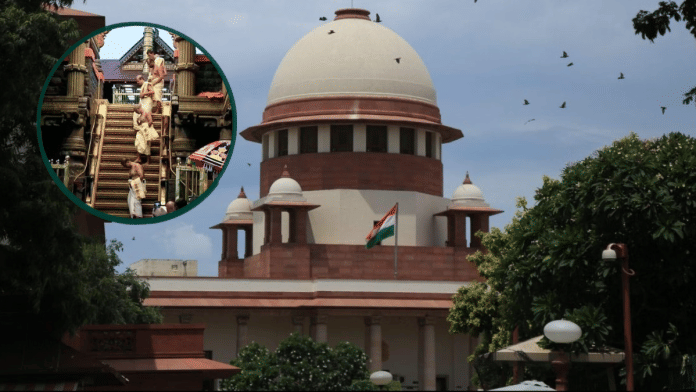



New Delhi: In the ongoing Sabaramala case, the central government has told the Supreme Court that it’s time to end the use of the Public Interest Litigation (PIL), saying that the mechanism had created a “PIL culture” that had become a vehicle for “agenda-driven litigation”.
Arguing for the government, Solicitor General Tushar Mehta submitted before a nine-judge bench that PILs as a jurisdictional exception should be removed and the ordinary principles of locus standi should be restored instead.
PILs are an exception that allows the court to hear cases filed in the public interest by those not directly involved, while locus standi requires a petitioner to have a personal stake in a case.
The PIL framework was judicially strengthened in 1981 in the landmark S.P. Gupta v. Union of India case, which allowed “any member of the public” acting in good faith to approach the court on behalf of those who were “by reason of poverty, helplessness or disability… unable to approach the Court for relief”.
The Supreme Court relaxed the traditional locus standi rule to ensure that fundamental rights reached the “weaker sections”, who didn’t have the means to approach the courts personally.
Mehta, in written submissions, argued that while the PIL jurisdiction was born to provide access to justice for those unable to reach the courts due to poverty or disability, it had instead become a vehicle for institutional overreach.
He said that the PIL culture had “metastasised into a general licence for ideological, political, and denominationally hostile litigation”.
His submission noted that India’s current position—where any member of the public can challenge any law without demonstrating personal injury and in the public interest—is a “global constitutional anomaly” not found in any other major democracy.
The top court is hearing petitions challenging a landmark 2018 Sabrimala verdict by a five-judge bench allowing women of menstruating age (10-50 years) into the shrine of Lord Ayyappa.
One of the seven questions the bench will answer is whether a person not belonging to a religious denomination or a religious group can question a practice of that religious denomination or religious group by filing a PIL.
The original 2006 petition in this case was filed by the Indian Young Lawyers Association, among others.
The Centre described it as a prime example of misuse as it was “a PIL filed by persons with no personal stake, representing no identifiable class of inaccessible victims, against a practice they did not follow, in respect of a deity they did not worship”.
The Centre is now calling for the removal of the PIL jurisdiction and a return to strict principles of locus standi, saying that landmark cases rarely focused on concrete victims, such as bonded labourers in far-off quarries or underpaid construction workers for the Asian Games, who could not reach the Supreme Court in New Delhi.
It said that the exception had “swallowed the rule”, and the jurisdiction had evolved from representing specific, disadvantaged classes into a broad “open-standing rule” used by urban professionals, NGOs, and activists.
It added that the PIL culture had expanded to include environmental monitoring, challenges to government economic policies, and even the creation of quasi-legislative norms like the Vishaka Guidelines.
The government said that this evolution has led to a “catastrophic expansion” of the docket, with PIL filings jumping from roughly 25,000 in 1985 to over 70,000 in 2019.
This surge is increasingly dominated by “busybody or meddlesome interloper” petitions filed for “notoriety or cheap popularity”, often at the behest of political or business rivals.
Also Read: ‘Party has opinions, decisions need consensus’—How Kerala’s LDF is justifying its Sabarimala stand
Why PIL culture needs change
A primary justification for the Centre’s call to remove PILs is that the conditions of the 1980s no longer exist.
The government said that the “factual premise of mass structural inaccessibility” has diminished over the past five decades due to a surge in literacy, the development of a robust statutory legal-aid framework under the National Legal Service Authority (NALSA), and the technological revolution of e-courts.
With 1,228.94 million telephone subscribers and nearly 1,018 million internet users as of 2025, the Centre argued that “physical remoteness is no longer a universal barrier” to the justice system.
As a result, the government said that the PIL doctrine had “outlived the factual conditions” of its birth.
It also quoted Justice Indu Malhotra’s lone dissent from the 2018 Sabrimala verdict: “Permitting PILs in religious matters would open the floodgates to interlopers to question religious beliefs and practises, even if the petitioner is not a believer of a particular religion, or a worshipper of a particular shrine.”
“The perils are even graver for religious minorities if such petitions are entertained…In matters of religion and religious practises, Article 14 can be invoked only by persons who are similarly situated, that is, persons belonging to the same faith, creed, or sect.”
She added that the petitioners did not state that they were Ayyappa devotees who are “aggrieved by the practises followed in the Sabarimala Temple”.
“The worshippers of this temple believe in the manifestation of the deity as a ‘Naishtik Brahmachari’. The devotees of this temple have not challenged the practises followed by this temple,” she added.
(Edited by Sugita Katyal)