





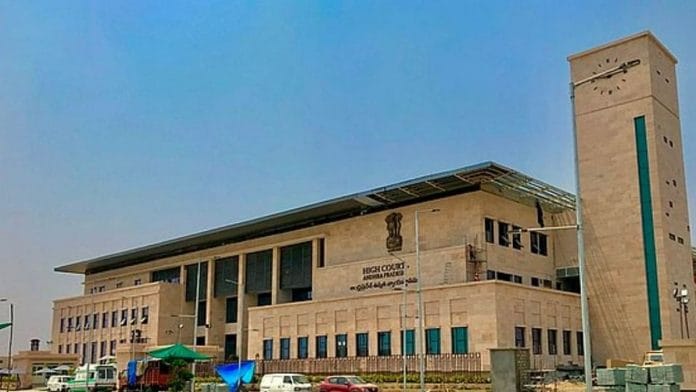



New Delhi: It took all of 11 years, but a group of 39 contractual workers who had worked on the Andhra Pradesh government’s Telugu Ganga Project Division for extremely long durations spanning over a decade have won their battle for regularisation and proper benefits before the Andhra Pradesh High Court.
Pulling up the Andhra Pradesh government for employing workers on an ad hoc or contractual basis for decades, the high court has ruled that such practices amount to “nothing but exploitation” and are “opposed to good conscience”. More importantly, the court noted that off-late there has been a trend in “several cases” where the state government engages “educated and qualified persons” on a contractual basis, utilises their services for many years, and then pays them meagre wages.
Significantly, the court directed the Andhra government to regularise the workers’ services within two months. The court added that the least the state government could do was consider their claim for regularisation, after exploiting them for a “pittance”.
“Their cry for regularisation cannot be hanging fire, without any positive action in sight at the hands of the State. The idea of welfare state is realised only when the citizens are treated fairly, equally and without any exploitation,” the court ruled, pointing out that due to their increasing age, these workers also cannot sit for the regular selection process.
Pointing out how these workers endured such “unfair treatment” only with a hope that at some point of time their claim for regularisation could be considered, the court said, “The petitioners cannot be allowed to languish as daily rated employees for indefinite period and be denied of the regular benefits of the Government employees forever.”
These observations were made by a two-judge bench of Justices Battu Devanand and Subhendu Samanta acting on a plea filed by different workers engaged in different departments of an Andhra Pradesh project called the Telugu Ganga Project Division. This is a major irrigation and water supply project that intends to irrigate 5.75 lakh acres of land in drought-prone areas.
“It is settled law that as and when the work has been extracted from these petitioners on full time basis, day in and day out, and keeping them as daily rated employees is unfair and opposed to good conscience,” the court noted.
Granting respite to these workers, some of whom were engaged on an ad-hoc basis for over two decades, the court ordered the state government to regularise their services, along with the consequential benefits attached. Regularisation is the process of converting temporary, or contractual employment into permanent, regular employment with job security and benefits.
Underlining that the workers were appointed for sanctioned posts and there were existing vacancies in the department, the court noted that these workers had served the Andhra Pradesh government for more than two decades without regularisation. Significantly, the court frowned upon the practice of extracting work equivalent to that of full-time employees from ad hoc workers while paying them meagre wages and refusing regularisation and benefits.
“Without taking steps to fill the sanctioned vacancies on permanent basis by following proper selection procedure, (the Andhra government) utilised the services of the petitioners for all these years by paying meager remuneration,” the court said, adding that this amounted to exploitation.
Such a scenario does not show the welfare state in good light, the court noted while adding that otherwise it would amount to the government being “robbed” of its constitutional obligation under Article 21 of the Constitution to provide adequate livelihood.
By way of its 19-page ruling, the court made clear that despite there being existing vacancies in the Irrigation & CAD Department, the case of the petitioners was not even considered to accommodate these workers. In doing so, it quashed a tribunal order relying on Supreme Court rulings in cases like Dharam Singh vs. State of Uttar Pradesh, dealing with workmen who been discharging their duties for the last 28 years, holding that since the workers were engaged in essential duties, they “could not be relegated to a state of perpetual uncertainty”.
The court pointed out that whenever these workers sought to regularise their services, the Andhra Pradesh government would start raising grounds like their appointments not being aligned with proper procedure, or the posts being unsanctioned. “Utilising their services and extracting work for them for more than decades” is not allowed, the court said.
The case
The case dates back to over a decade when 39 workers approached the Andhra Pradesh Administrative Tribunal at Hyderabad, seeking regularisation after having worked for the state government for 10 to 20 years.
One of the petitioners was a work inspector, who worked on the Telugu Ganga Project for more than 20 years, while the other worked as a typist from August to November, 1987. The third petitioner was a time-scale employee, who was appointed in 1989.
However, despite putting in 10-20 years of service, their plea was rejected on the ground that they did not complete five years of service by 25 November, 1993, which was the cut-off date, according to the state government order dated 22 April, 1994.
The plea also pointed out that in February 2021, the Andhra Pradesh government had regularised the services of other “similarly-situated persons” through a government order. However, the Andhra Pradesh Administrative Tribunal, after hearing both sides, held that the workers were not entitled to regularisation of their services, and dismissed their plea in May 2017.
On the other hand, the Andhra Pradesh government had argued that the workers were not entitled for regularisation of their services in light of the Andhra Pradesh Act, 1994, which disallows the regularisation of services for daily wage employees and temporary employees who were appointed and continuing before the law’s passage.
(Edited by Nardeep Singh Dahiya)