





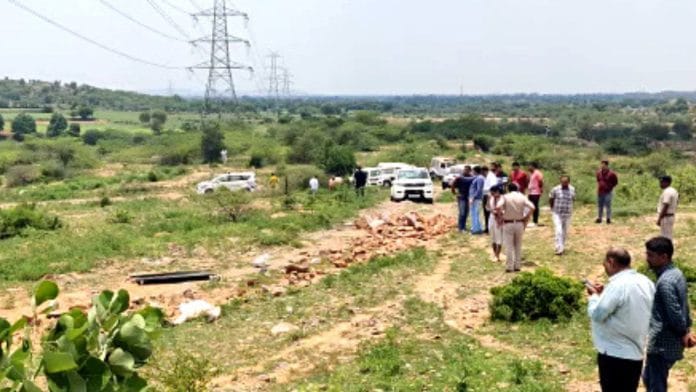



Gurugram: The Punjab and Haryana High Court has directed the Haryana chief secretary to file an affidavit detailing the government’s plan to address what the court described as the “vast extent of environmental plundering” at village Pichopa Kalan caused by large-scale, allegedly illegal stone mining on hillocks in the Charkhi Dadri district.
In a 24-page order pronounced on 31 January, the division bench of justices Ashwani Kumar Mishra and Rohit Kapoor has also ordered the sealing of the entire mining area with videography within 48 hours.
Anurag Rastogi is currently the Chief Secretary of Haryana. In February 2025, he took over the position from Vivek Joshi and has since been extended through 30 June.
According to the high court bench, the share of responsibility of not only private individuals but also officials entrusted with enforcing the law who have defaulted must be appropriately determined, and these persons must be dealt with in accordance with the law.
“The state authorities, however, have to be first given an opportunity to take stock of the situation and to take necessary steps as may be warranted in law,” the court said, directing the chief secretary to examine the matter.
The direction is based on the court-appointed Advocate Commissioner Kanwal Goyal’s detailed report, following his inspection of the mining site. The court appointed Goyal to file the report after a petition alleged that state authorities sought repeated adjournments to hearings in the matter only to cover up violations and remove evidence from the mining site.
During an inspection on 6 December 2025, Goyal found three out of nine boundary pillars marking the mining lease area missing; a deep pit filled with water, with a visible depth of 47 metres and spanning one hectare; and the signs of mining extending on the terrain of the hillock far beyond the approved site. His report has documented ground fissures, unstable slopes, and the absence of proper benching required under any mining plan.
Upon reading the report and seeing drone survey footage from the site, the court remarked that what the naked eye saw was not only disturbing but also bewildering. “It prima facie appears to be a case of blatant violation of environmental norms contained in the environmental clearance certificate as well as the mining plan, causing loot and plunder of natural resources.”
Environmental damage & a ‘missing’ road
The court has directed the state to suggest ways and means to ensure that such rampant looting of natural resources in the name of mining is checked. Moreover, noting worsening air quality and a depleting water table, the court has held that the records indicate environmental damage in the pretence of mining. “The mechanism contemplated to contain destruction and damage to the environment has prima facie failed to check the menace,” the court has said.
The bench has pointed out that the environmental clearance certificate, dated 23 May 2017, mandated the annual planting of 600 trees and that that should have resulted in at least 6,000 trees planted over the lease period. But apart from some fresh saplings near certain pillars, no plantation was visible at the site. A proper bench formation was also not visible, the court has said, noting only cliffs, in place of step-wise mining, and slamming the lack of topsoil preservation or land reclamation.
The mining plan mandated operations three metres above the groundwater table, without specifying the level, the court has said. Thereby, it has been observed, “Preservation of groundwater from contamination and depletion of the water table thus cannot be ensured.”
On the disappearance of a metalled road that petitioners claimed existed in the mining area, the court has made other sharp observations.
Earlier, the petition submitted that Right To Information (RTI) documents showed that the Haryana State Agricultural Marketing Board (HSAMB) constructed a road in the area in 2012 for Rs 67.02 lakh and, recently in 2021, strengthened it for Rs 23 lakh. Saying that the road spanned 286 metres, the petitioners asked about its purpose. The Haryana mining department, however, has denied the existence of such a road.
Commenting on this matter, the court said the HSAMB siphoned off crores, or else the mining department was telling a blatant lie. “Either of the exigencies is most disturbing,” it added.
Expressing concerns, the court has pointed out the callousness of state authorities in the discharge of their duties. “At this stage, we cannot rule out connivance on the part of the responsible officers who were entrusted with the duty to ensure compliance with laws,” the bench has observed.
An official letter, but no mention of breaches
The court has also noted that the district mining officer recommended cancellation of the mining lease on 1 October last year, citing accidents and lack of adherence to environmental norms. However, the primary reason it cited was economic unviability of further mining, noting that mining was becoming increasingly less feasible at the site—both economically and technically.
The court, however, said that despite that letter, no action at the director-general level followed. “It appears that the office of the director general, mines and geology, Haryana, has turned a blind eye to rampant violations committed in the mining area,” it has observed.
The mining officer’s letter had referred to two accidents in January and July 2025 when pillars were reportedly lost during landslides. It cited regular instances of clay sliding into mine pits, particularly during the monsoons, and conditions that increased safety risks to workers. It had also noted that the mine was developed without adopting systematic bench formation and failed to comply with the conditions of environmental clearance.
Dated 11 December 2025, the letter recommending the mine’s closure, prima facie, appeared to be nothing but a cover-up, the bench has held, noting that the order contained overwriting on the date, had not been brought on record despite ongoing hearings, and that the state mining engineer passed it on on behalf of the director general. “By omitting to refer to the breach of EC conditions/mining plan, the order virtually condones all illegalities and endeavours to legalise it by enforcing the mine closure plan,” the bench has observed.
With that said, the bench has directed Charkhi Dadri’s deputy commissioner to seal the entire mining area within 48 hours and get the process videographed. It has also restrained parties from altering the status quo on the site. It has directed the chief secretary to summon the entire record of the mining operations and to send a copy to the court registrar general within a week in a sealed cover.
The court has also included the Union Ministry of Environment, Forest and Climate Change as a respondent. It has further ordered the director of the Haryana Space Application Centre to submit year-wise satellite imagery of the mining site, beginning in 2016.
Warning that it might even consider an investigation by an appropriate independent agency—if it’s not satisfied with the state government’s response—the court has said the issue required a deeper probe. “These prima facie findings persuade us to probe deeper into the matter,” the bench has said, noting that both private parties appeared responsible for causing damage to ecology and had been suitably assisted by state machinery.
The mining lease had been granted to M/s Jai Dada Dohla Stone Mines in 2016, following an e-auction for the extraction of stone and associated minor minerals from over 11 hectares in Khasra numbers 109 and 110, recorded as “gair mumkin pahar (non-cultivable hill)” in revenue records. The petitioners—residents of the village and surface right holders—had approached the court, charging the state with allowing indiscriminate “illegal” mining in areas far beyond the approved site while denying them the outstanding rent and compensation that has exceeded Rs nine crore. The court has listed the matter for further hearing on 25 February 2026.
(Edited by Madhurita Goswami)
Also Read: What happens to Haryana real estate agents now? Govt agency HSVP to act as broker, take commissions