





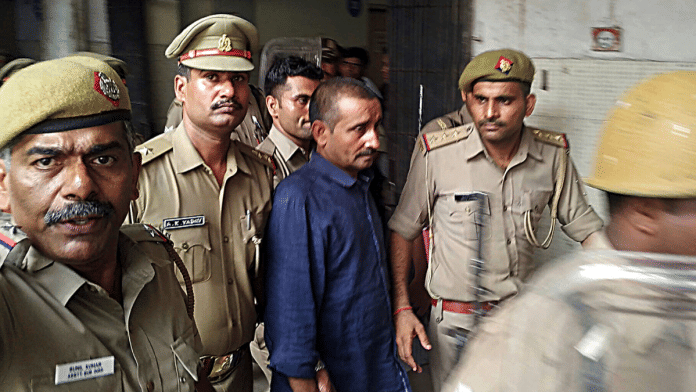



New Delhi: In its plea challenging the suspension of former BJP MLA Kuldeep Singh Sengar’s life sentence in the 2017 Unnao rape case before the Supreme Court, the CBI has argued that the Delhi High Court failed to read the common purpose of the Prevention of Corruption Act and the Protection of Children from Sexual Offences (POCSO) Act.
Both laws, the agency argued, share a “common legislative purpose”—penalising the “abuse of authority”.
“Both Acts target people in positions of trust or public duty, impose enhanced accountability where position is misused, and adopt a purposive interpretation of ‘public servant’ or ‘person in authority’ to advance the object of public protection,” the CBI’s Special Leave Petition (SLP) stated.
On 23 December, the Delhi High Court had suspended Sengar’s sentence on the grounds that the POCSO Act does not explicitly include an MLA in its definition of a ‘public servant’, therefore its definition under the Prevention of Corruption Act was of “no use” in this case.
Banking on this observation, the Division Bench of the High Court concluded that Sengar’s culpability did not fall under section 5 of the POCSO Act, therefor he was not liable for the maximum punishment under it—jail for the remainder of his life.
Responding to the court’s logic, in its SLP, the CBI has pointed out that offences under section 5 of the POCSO Act were of “greater gravity” than acts of corruption, as the former involve direct abuse of children, triggering severe physical, psychological and moral harm compared to the latter, which only undermines governance.
The comparison and interpretation of these two acts form the bulk of the agency’s SLP filed before the apex court, as judicial proceedings in the case have relied heavily on them. An SLP is a special mechanism available to the aggrieved party to challenge a lower court’s decision before the apex court.
“…the Hon’ble High Court failed to appreciate that a Member of Legislative Assembly performs duties in discharge of which state, public or community at large have an interest. An elected MLA undertakes public duties, which are inseparable from his position, and at the core of it is a constitutional position of trust, authority and service,” the agency argued in its SLP before the Supreme Court on the suspension of Sengar’s sentence.
“…a harmonious and constructive reading (of the Prevention of Corruption Act and the POCSO Act) ensures that misconduct by persons holding official or authoritative positions is fully actionable under the respective statutes,” the agency said.
“The legislature has therefore provided for stringent mandatory penalties, protective procedural safeguards, and enhanced liability for persons in positions of trust or authority, reflecting the higher societal interest in protecting the vulnerable over abstract institutional harm.”
The rape survivor in this case and her mother have been protesting against the suspension of Sengar’s sentence, and on 24 December, went to meet Congress leader and Lok Sabha Leader of Opposition Rahul Gandhi. The hour-long meeting took place at the 10 Janpath Road, the residence of Sonia Gandhi, who was also present at the meeting.
(Edited by Viny Mishra)
Also read: Is justice in Unnao case back on 2018 track? ‘Rights’ for Sengar, ‘kaal’ for victim