





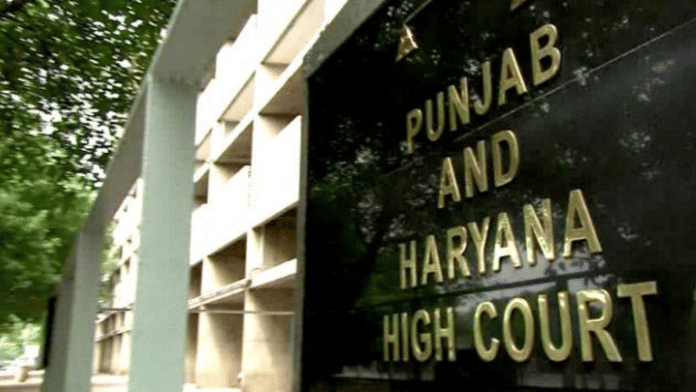



Gurugram: The Punjab and Haryana High Court has denied emergency parole to a life convict whose wife died and instead allowed him to perform the last rites under the watch of the police.
Earlier, on 23 December, the Jail Superintendent, Hisar, rejected the request by Virender alias Molad for emergency parole. Virender is serving life imprisonment in a murder case registered in 2006 at the Agroha police station in Hisar.
Under the Haryana Good Conduct Prisoners (Temporary Release) Act, 2022, a “hardcore convicted prisoner” falls into multiple categories: those convicted of serious crimes including robbery, dacoity, kidnapping for ransom, murder or attempt to murder for extortion, rape with murder, gang rape, sexual offences against children below 16, serial and contract killings, sedition, immoral trafficking involving minors, escaping from lawful custody among others.
The High Court’s tough posture comes at a time when Dera Sacha Sauda chief and rape-murder convict Gurmeet Ram Rahim got 15th parole in eight years. This time, he will be out for 40 days.
While advocate K.D.S. Hooda appeared on behalf of the petitioner, Additional Advocate General Jasmine Gill represented the Haryana government.
The convict, the judge noted, has not completed the mandatory five-year period required under the 2022 Act for being considered for parole.
What went against the convict was a case lodged against him in June last year under the Narcotic Drugs and Psychotropic Substances Act and the 2022 Act. This was after he was found in possession of 620 contraband tablets when he returned to jail at the end of a 10-week parole period.
Under Section 6(3) of the 2022 Act, a hardcore convict can avail emergency parole only after completing five years from the date of his latest offence. Since the NDPS case was registered barely six months ago, Virender was not eligible for the temporary release.
“Perusal of the aforesaid provision, it makes clear that a hardcore prisoner can be released on temporary basis or on furlough after completion of 5 years of imprisonment but he cannot be released on emergency parole in case he has not completed requisite 5 years period of his imprisonment after the date of his latest offence,” Justice Rathor wrote in his judgement delivered 1 January.
“In the present case, a fresh FIR under NDPS Act was registered against the petitioner on 04.06.2025 and as such, he has not completed 5 years of imprisonment after the subsequent offence was committed by him and as such, he cannot be released on emergency parole.”
However, showing judicial compassion, Justice Rathor allowed the convict to be taken out under police guard on 3 and 4 January for allowing him to carry out the last rites of his wife.
The expenses for the arrangement will be borne by the petitioner himself, the judge said. The high court directed the jail superintendent to make necessary arrangements for the police-escorted visit.
(Edited by Tony Rai)
Also Read: Delhi HC says furlough not an absolute right. A look at the rules of conditional release from jail