





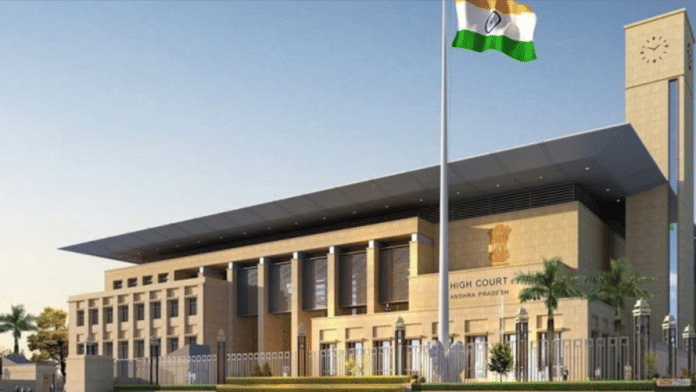


New Delhi: After a clip of a young lawyer purportedly being threatened with custody by an Andhra Pradesh High Court judge went viral, top legal bodies including the Bar Council of India (BCI) and the Supreme Court Bar Association (SCBA) demanded action, prompting Chief Justice of India Surya Kant to seek a report from the chief justice of the high court.
The episode transpired Monday during the hearing of a petition that challenged a Look Out Circular against a litigant, and the impounding of his passport. The court had indicated it was inclined to defer the proceedings to a later date.
Disagreement arose during arguments when the advocate continued to press his point despite the judge referring to an existing judgment, according to a former member of the state Bar Council who spoke on the condition of anonymity.
The situation may have worsened when the lawyer accidentally dropped a paper, which the judge allegedly interpreted as a gesture of defiance, he said.
Addressing the young counsel, Justice Rao remarked, “Have I said I will dismiss your petition? Judges usually follow their own orders. Do you think you are a great senior advocate? Call the police. You may go and file an appeal.”
Subsequently, the young lawyer begged the judge for his grace with folded hands. “Sorry. I am begging for your grace, your lordship.”
In a letter to the Chief Justice of India, the BCI described the episode as a “deeply disturbing incident”, pointing to the viral video in which the judge appears to direct that a young advocate be sent to judicial custody for 24 hours.
The move, it said, shook confidence of the Bar and raised serious questions about courtroom conduct and proportionality.
The SCBA, in a separate representation to the CJI, also expressed “deep concern and shock”, noting that such incidents undermine the foundational values of restraint, fairness, and compassion that define judicial strength. It added that the episode particularly disillusioned younger lawyers, who look up to the Bench not just for adjudication but also for guidance.
Also Read: Why district judges almost never make it to India’s Supreme Court
Call for balance
The incident prompted mixed reactions among lawyers, reflecting a broader debate on judicial conduct and systemic pressures.
Senior advocate Rebecca John called for immediate corrective action, stating that judges, especially constitutional court judges, must remain measured in their responses. “To threaten a young lawyer with incarceration is a terrible thing to say and does not behove the high constitutional office of a judge,” she said.
Senior advocate Vikas Pahwa emphasised the importance of both discipline and due process. While acknowledging that courtroom decorum is essential, he said the approach must remain proportionate. “Young lawyers require guidance and constructive correction rather than intimidation. The courtroom must remain a space for learning as much as adjudication,” he told ThePrint.
Pahwa also underlined that the power to send an advocate to jail cannot be exercised casually. In cases of alleged misconduct, he said, the appropriate course would be to refer the matter to the Bar Council or initiate contempt proceedings with due process, including issuing a show-cause notice.
Senior advocate Karuna Nundy placed the incident within a broader systemic context, pointing to patterns of abuse of power disproportionately affecting younger, less privileged, women or non-English-speaking lawyers. “This is the opposite of what the position requires. With such power comes the responsibility of constitutional equality,” she said.
At the same time, she cautioned against drawing definitive conclusions without the full context, noting that judges cannot respond publicly and can only speak through their orders.
Nundy also pointed to structural challenges, including India’s low judge-to-population ratio and heavy workloads, which place immense pressure on judges. However, she stressed that systemic issues cannot justify the power of the bench being wrongfully deployed against lawyers and litigants.
She called for a zero-tolerance approach backed by judicial training, workshops, and clear accountability mechanisms led by High Court and Supreme Court Chief Justices.
What the letters say
According to the BCI’s letter, the video shows the young lawyer repeatedly seeking pardon and explaining that he had no intention of disrespecting the court. Despite this, the judge allegedly directed court officials and police personnel to take him into custody.
The matter before the court reportedly involved the production of an order copy, which the lawyer did not have, leading to a sharp rebuke in open court.
The BCI said it found nothing prima facie wrong with the young advocate’s conduct. “While an advocate may be corrected or proceeded against in accordance with law, sending a young lawyer to judicial custody in such a manner appears grossly inappropriate and damaging to the confidence of the Bar,” the letter stated.
It emphasised that the relationship between the Bench and the Bar is founded on mutual respect and institutional balance. The BCI urged the CJI to call for the video recording of the proceedings and examine the surrounding circumstances. It also suggested administrative measures, including withdrawal of judicial work or transfer of the judge.
The SCBA echoed similar concerns, warning that actions creating fear or humiliation among lawyers can adversely impact the independence of the Bar and the justice delivery system as a whole.
Ground-level perspectives
Lawyers familiar with court practice in Andhra Pradesh offered additional context, suggesting the situation may have escalated due to a misunderstanding.
Advocate Dheeraj Reddy Karumanchi said that while judges differ in temperament, the issue could have been handled without jeopardising a young lawyer’s career. “This could have been addressed through counselling or guidance rather than escalation,” he told ThePrint.
The former member of the state Bar Council quoted above said, “Judges cannot lose temper on the Bench. Juniors can make mistakes, but they should be corrected gently.”
Advocate-on-Record Talha Abdul Rahman urged caution in forming conclusions without full facts but reiterated that restraint is a core judicial value. He also pointed to systemic pressures, including heavy caseloads, which may affect judicial temperament.
Recalling former Supreme Court judge Justice J.S. Khehar, Rahman noted how he would avoid passing orders when angry. “Anger prevents dispassionate decision-making. It reflects poorly on the institution,” he said.
A deeper institutional concern
Former civil judge Bharat Chugh described the incident as symptomatic of a deeper institutional problem of unchecked judicial arbitrariness. “For decades, sections of the Bar have responded to judicial excess with silence or deference. The result is a culture where young lawyers bear the brunt,” he said.
Chugh warned that such incidents can have a chilling effect on young advocates, undermining their confidence and discouraging fearless advocacy. “A lawyer who is afraid cannot effectively represent a client,” he said, adding that compassion towards junior lawyers is essential for the health of the profession.
Shrey Sharawat, Member Executive, Delhi High Court Bar Association, termed the court’s action “indefensible”, stressing that lawyers and judges are equal stakeholders in the justice system. “Sending a lawyer to custody over such circumstances is both preposterous and perverse,” he said.
Advocate Areeb Uddin highlighted the psychological impact, stating that early-career lawyers look to the Bench for mentorship, not intimidation. “Courtroom discipline should not become a tool for humiliation,” he said.
As the controversy continues to unfold, the focus now shifts to the Chief Justice of India and whether the judiciary will take institutional steps to address concerns over courtroom conduct, accountability, and the balance of power between the Bench and the Bar.
(Edited by Ajeet Tiwari)
Also Read: Judging a joke: How courts are navigating free speech space in age of social media