





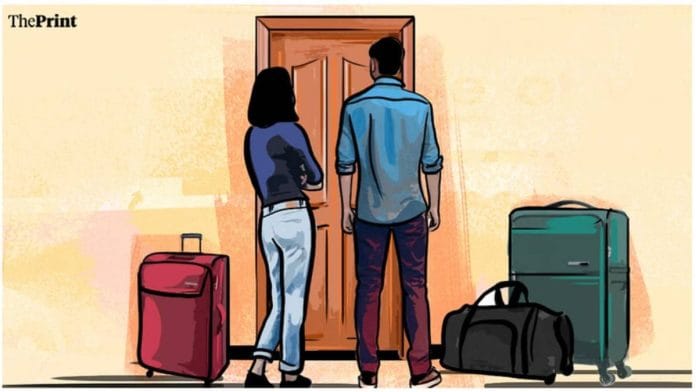



New Delhi: The Allahabad High Court Wednesday granted police protection to 12 live-in couples, ruling that such relationships may not be acceptable to all but cannot be deemed illegal or constitute an offence just because they did not adhere to larger social traditions.
In a 17 December ruling, Justice Vivek Kumar Singh held that once an adult has chosen a partner, “it is not for any other person, be it a family member, to object and cause a hindrance to their peaceful existence”.
The court emphasised that the State has a constitutional obligation to protect the life and liberty of all citizens.
“Right to human life is to be treated on a much higher pedestal, regardless of a citizen being minor or major, married or unmarried,” the judge noted, adding that being unmarried would not deprive the petitioners of their fundamental right to life.
“This court has no hesitation to hold that the fundamental right under Article 21 of the Constitution of India stands on a much higher pedestal. Being sacrosanct, under the constitutional scheme, it must be protected, regardless of the solemnisation of marriage or even the absence of any marriage between the parties,” the judge said.
Justice Singh was hearing a clutch of 12 petitions filed by the live-in couples who had sought protection on the grounds that they were being threatened.
Also Read: Indian couples keep lying about how they met. Dating app stigma is real
State government’s position
In its 27-page ruling, the high court rejected the UP government’s contention that live-in relationships cannot be accepted at the cost of the country’s social fabric, as either partner can walk out as and when they like.
The state had argued that a live-in relationship is a contract renewed daily and can be terminated by either party without the other’s consent, leaving the status of children born from such unions undetermined.
The counsel for the couples, however, argued that an adult has a right to marry someone of their choice or to live with someone out of wedlock.
Justice Singh also rejected UP government’s reliance on the Kiran Rawat vs State of UP case, in which the Allahabad high court had denied protection to a live-in couple in 2023. The court, refusing to interfere in disputes related to private parties, had said such relationships were a “social problem” that needed to be uprooted.
Justice Singh said the 2023 judgment was “not in consonance” with earlier rulings by the Supreme Court and “the facts of the present cases” were “entirely different” from the Kiran Rawat case.
Instead, the court said that Supreme Court rulings cited in the present case showed that the top court had consistently respected the liberty of individuals who attained the age of majority.
“An individual, on attaining majority, is statutorily conferred a right to choose a partner, which if denied would not only affect his/her human rights but also his/her right to life and personal liberty, guaranteed under Article 21 of the Constitution of India,” the court said.
‘Cannot restrain’
Underlining the settled legal position as expounded by the Supreme Court in Lata Singh, S. Khushboo, Indra Sarma and Shafin Jahan cases, the court said that life and liberty of individuals must be protected, except according to procedure established by law, as mandated by Article 21.
Consenting adults are free to live with anybody and “cannot be restrained from doing so”, the judge said.
In its order, the court said that even under the Protection of Women from Domestic Violence Act, 2005, a woman who is in a ‘domestic relationship’ has been provided protection and maintenance. “The word ‘wife’ has not been used under the said Act,” the court noted.
Referring to Section 114 of the Indian Evidence Act, which is now Section 119(1) of Bhartiya Sakshya Adhiniyam, 2023, the court said that if couples live together for a significant time as husband and wife, they are presumed to be married. Courts routinely apply this presumption to protect the rights of parties in a live-in relationship, including women and children born from them.
Directing police protection for the petitioners, Justice Singh said that if the couples were facing “disturbance”, they can approach the police commissioner/SSP/SP with a copy of the court’s order. “…and the police officer, after being satisfied that the petitioners are major and willingly living together, will provide immediate protection to the petitioners,” the order said.
The court added that if the couple is educated, they may produce educational certificates or other certificates admissible under law to prove they have attained the age of majority and are living together of free will, so that police do not take action against them. If the parties are illiterate and lack documentary proof of age, police can subject them to an ossification test to verify their correct age.
Also Read: Game theory in modern Indian relationships. First person to demand more loses