








New Delhi: In an era when judicial restraint often means silence, Justice Ujjal Bhuyan has displayed a different instinct—to return, with conviction, to first principles. Whether on the Bench or at the lectern, whether in majority, concurrence or dissent, his voice has in recent weeks focused on a single theme: That the Constitution is not merely a promise, but a living moral code.
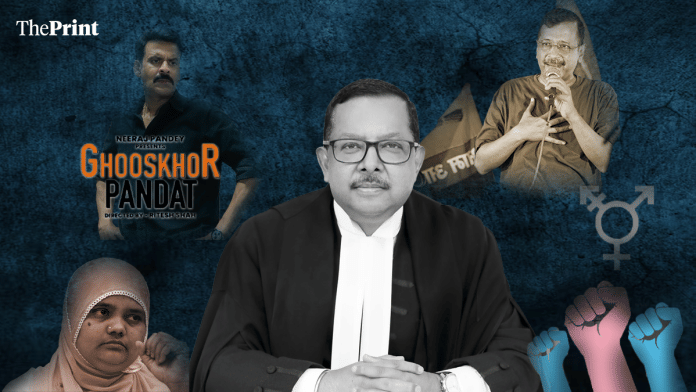
On 19 February, the Supreme Court heard the matter concerning the film Ghooskhor Pandat. In a separate verbal opinion, Justice Bhuyan underscored first principles of constitutional morality. Though the matter was resolved and needed no adjudication, he “felt it necessary to restate the first principles, lest there remain any lingering misconception”, talking about the constitutional meaning of fraternity and the limits of vilification in public discourse.
Then, on 21 February, in a public address that has since travelled far beyond, on ‘Constitutional Morality and the Role of the District Judiciary’, he turned from adjudication to articulation, reflecting on the discrimination faced by minorities and the ethical responsibilities of judges at every level. He spoke candidly of discrimination, of barriers before women in the district judiciary, and of the quiet prejudices that survive constitutional prohibition.
Elevated to the Supreme Court of India in 2023, Justice Bhuyan has been part of several constitutionally significant decisions. His instinct—to return to the constitutional text when the moment demands clarity—runs through his judicial career.
In his most talked about speech recently at a seminar organised by the Telangana Judges Association and the Telangana State Judicial Academy, Justice Bhuyan struck a critical note over Supreme Court’s recent judgment that restored a three-year experience mandate for fresh law graduates to apply for entry-level posts in judicial service.
“But there is a flip side too. The initial years at the Bar are both demanding and financially uncertain, particularly for those who do not come from established backgrounds or those who come from the mofussil. It may also have implications for women judicial aspirants, especially those hailing from rural areas and small towns, who may face career interruptions due to societal constraints or family pressure for marriage,” he said.
At the same event, Justice Bhuyan touched upon religious discrimination that continues to persist, despite constitutional prohibition. The judge spoke about how his daughter’s friend, a Muslim girl pursuing a Ph.D programme at a private university in Noida, was not taken in as a tenant by a landlady owing to her religion.
He cited another incident that reeked of caste discrimination: Parents at a government school were outraged when they found that a Dalit woman was preparing their children’s mid-day meal.
‘Fraternity and democracy’
Justice Bhuyan’s opinion in the Ghooskhor Pandat case was telling. Though the issue technically required no adjudication, since the film makers had agreed to do away with the “objectionable” title and release the movie under a fresh one, Justice Bhuyan chose to put his thoughts “on ink and paper”.
In his 30-page opinion, he wrote on the idea of fraternity and Ambedkar’s vision of democracy. Without making any references to the current political climate, he said: “It is therefore constitutionally impermissible for anybody, be it the state or non-state actors, through any medium, such as, speeches, memes, cartoons, visual arts, etc., to vilify and denigrate any community.”
“It will be violative of the Constitution to target any particular community on the basis of religion, language, caste or region by whosoever he or she may be. This is particularly true for public figures occupying high constitutional office who have taken the solemn oath to uphold the Constitution,” he wrote.
He further stated: “This court held that the effect of the spoken or written words will have to be considered based on standards of reasonable, strong minded, firm and courageous individuals and not based on the standards of people with weak and oscillating minds. The effect of the spoken or written words cannot be judged on the basis of the standards of people who always have a sense of insecurity or of those who always perceive criticism as a threat to their power or position.”
“If organised groups threatening such freedom are not restrained, there is a real danger that art and literature would become victims of intolerance. This cannot be countenanced in a free society,” he wrote.
Whether questioning the structural impact of new eligibility norms for women entering the judiciary, warning against executive influence in judicial transfers, or striking down colonial laws that stigmatise marginalised communities, Justice Bhuyan has positioned himself as a jurist committed to following Constitutional principles.
Constitutional morality and district judiciary
In January 2026, speaking at the Principal G. V. Pandit Memorial Lecture at ILS Law College, Pune, he said: “When the collegium itself records that a transfer is being made at the request of the Central Government, it reveals a striking intrusion of the executive into a process that is constitutionally meant to be independent and immune from executive and political influence.”
“Why should a judge be transferred from one high court to another high court just because he had passed certain inconvenient orders against the government? Does it not affect the independence of the judiciary?” Justice Bhuyan asked.
In an interview with SCC Times in September 2020, he said “The biggest challenge or loophole in contemporary legal education is the wide disparity in the quality of students and quality of teaching in different law colleges. This issue needs to be addressed as otherwise it will have a telling impact on the district judiciary where bulk of the litigation is fought.”
The early years
Born on 2 August 1964 in Guwahati, Justice Bhuyan is the son of senior advocate Suchendra Nath Bhuyan, a former Advocate General of Assam. After studying at Kirori Mal College in Delhi and completing his higher law degrees in Assam, he enrolled as an advocate in 1991. His early years at the Bar were marked by extensive tax and constitutional practice before the Gauhati High Court.
He was elevated to Additional Judge of the Gauhati High Court in 2011 and appointed a permanent judge in 2013. In 2019, he was transferred to the Bombay High Court, before moving to the Telangana High Court in October 2021. On 28 June 2022, he was sworn in as Chief Justice of the Telangana High Court.
Eighteenth on the ranking list amongst SC judges currently, he is set to retire in August 2029 without holding the Chief Justice’s office.
In the Supreme Court
On 18 November 2025, the Supreme Court, by a 2:1 majority, recalled its judgment in the Vanashakti case, which had barred the Union government from granting post-facto environmental clearances (ECs). The earlier ruling—delivered 15 May 2025 by Justices Abhay S. Oka and Ujjal Bhuyan—had restrained the Centre from issuing retrospective ECs.
The larger November bench led by Chief Justice of India B. R. Gavai, along with Justice K. Vinod Chandran, overturned that view, allowing the review petition filed by the Builders Association of India (BAI). The bench held that the earlier judgement that prohibited post facto or retrospective ECs was a “gross illegality” and an “anathema”. The court stressed that enforcing the earlier ruling could have had “devastating effects” on public infrastructure.
Justice Bhuyan—who was part of the earlier bench and this one too dissented, reiterating that retrospective clearance “is derogatory to the environment” and that such clearance is an “anathema”, adding definitively, “anathema means a curse”.
In his dissenting opinion in the November bench, he said, “I would like to painfully observe that the deadly Delhi smog reminds us everyday about the hazards of environmental pollution. Supreme Court as the highest constitutional court of the country has the duty and obligation under the Constitution of India and the laws framed thereunder to safeguard the environment. It cannot be seen backtracking on the sound environmental jurisprudence that has evolved in this country, that too, on a review petition filed by persons who have shown scant regard for the rule of law.”
In 2024, he was part of the bench that struck down the Gujarat government’s controversial orders allowing the early release of 11 men convicted in the Bilkis Bano gangrape case of 2002. The Bench held that the Gujarat government had no jurisdiction and termed it a “usurpation on jurisdiction” as the crime happened in Maharashtra. Thus, the Bench ordered the convicts back to jail to resume their life sentences.
Bail to Kejriwal
In September 2024, while granting bail to Delhi Chief Minister Arvind Kejriwal in the CBI case on the AAP liquor policy, Justice Bhuyan observed that the agency cannot justify Kejriwal’s arrest on the ground that he gave “evasive replies” and noted that CBI’s arrest “raises more questions than it seeks answers”.
Justice Bhuyan was part of the bench led by then Justice Surya Kant. The two judges were unanimous in granting bail to Kejriwal, but held divergent views on the legality of his arrest. While Justice Surya Kant held that CBI complied with the conditions of arrest, Justice Bhuyan doubted the intent behind the timing of the arrest, observing it raised more questions than providing answers.
In 2025, the division bench of Abhay S. Oka and Ujjal Bhuyan dealt with a case in which an appellant, denied maternity leave for a third child following her remarriage, challenged that decision. The Bench held that she was entitled to maternity leave. The Court noted that although she had two biological children from her earlier marriage, both were born prior to her joining service. It observed that the two-child norm aimed at population control and the objective of granting maternity benefits to women employees are not inherently conflicting. Rather, both must be interpreted and balanced in a purposive and rational manner to further the broader social objective.
In another 2025 decision, he set aside the Armed Forces Tribunal’s denial of disability pension, holding that if no disability was noted at entry into service, it must be presumed attributable to military service.
He was also part of a nine-judge Constitution Bench in 2024 which held that royalty paid by mining operators to the central government is not a tax and that states have the power to levy cess on mining and mineral-use activities.
In a suo motu case of a 2023 decision of the Calcutta High Court, in which a series of advisories were issued to male and female adolescents on respecting women, safeguarding self-worth, dignity, privacy, and bodily autonomy (and wherein female adolescents were advised by the high court of a supposed duty to control sexual urges on the premise that society views them as the “loser” if they yield to brief sexual pleasure) a Division Bench of Justices Abhay S. Oka and Ujjal Bhuyan set aside the ruling.
Prima facie, the Supreme Court observed that while delivering judgments in such appeals, judges are not expected to voice personal opinions or engage in moral preaching. The court held that certain portions of the high court’s decision were objectionable, wholly unwarranted, and in clear violation of the adolescents’ rights guaranteed under Article 21 of the Constitution.
In Telangana, Bombay and Gauhati HC
Long before his elevation to the Supreme Court, similar themes marked his tenure across three high courts.
In April 2023, Justice Bhuyan, serving as Chief Justice of the Telangana High Court, along with Justice N. Tukaramji, made strong observations while hearing a suo motu PIL concerning the custodial death of a 32-year-old auto-rickshaw driver who had been arrested on suspicion of theft.
During the proceedings, Justice Bhuyan remarked that lower-level police officers must be sensitised and emphasised that the use of third-degree methods (torture) was not warranted during investigation. He stated that the individual had died as a result of such third-degree treatment and that this must be recorded, describing the death as “unacceptable”.
In a landmark judgment delivered in July 2023, he invalidated a colonial-era statute that criminalised transgender persons for dancing, singing, or merely being present in public spaces, holding it unconstitutional as it infringed the fundamental rights to life, privacy, and equality. The law, which was called the Telangana Eunuchs Act, had also permitted the arrest of transgender persons without a warrant.
Acting on a PIL instituted in 2018 by transgender rights activist Vyjayanti Vasantha Mogli, along with Sayantan Datta and K. M. V. Monalisa, then Chief Justice Ujjal Bhuyan and Justice C.V. Bhaskar Reddy struck down the Act, marking a significant legal victory for transgender rights in Telangana.
In November 2022, a full Bench led by him ruled that purchasers of land from an Inamdar (landholder) cannot claim Occupancy Rights Certificates under the Andhra Pradesh (Telangana Area) Abolition of Inams Act, 1955.
At the Bombay High Court in 2021, he held that a wife’s wish to stay abroad could not amount to cruelty or desertion when she was already well settled there.
Relief to Arnab Goswami
In 2020, he granted relief to Republic TV Editor-in-Chief Arnab Goswami. On a division bench with Justice Riyaz Chagla, the court said, “Prima facie, it appears that petitioner as a media journalist had questioned the response or rather the alleged non-response of the Congress party and its President Smt. Sonia Gandhi…”
Further stating, “Seventy years into our republic we cannot be seen to be skating on thin ice… we cannot have the spectacle of a Damocles’ sword hanging over the head of a journalist while conducting a public debate.”
In November 2017, a Division Bench of the Gauhati High Court comprising Justices Ujjal Bhuyan and Paran Kumar Phukan observed that branding an individual a witch and engaging in a witch-hunt constitutes an extremely dehumanising practice and amounts to one of the gravest forms of human rights violations.
The Bench also noted that the Assam Witch Hunting (Prohibition, Prevention and Protection) Bill, 2015 was still awaiting the assent of the President of India and emphasised the need for its early enactment. The court described witch-hunting as a socio-legal menace that must be addressed urgently. These observations were made while hearing an appeal against a Sessions Court judgment that had sentenced a man to jail for murder.
Justice Ujjal Bhuyan said: “Witch-hunting as a phenomenon is not only confined to the state of Assam; it has affected large parts of the country. It is rooted in flawed quasi-religious beliefs, antiquated socio-cultural traditions blended with extreme superstitions practices.”
(Edited by Viny Mishra)