





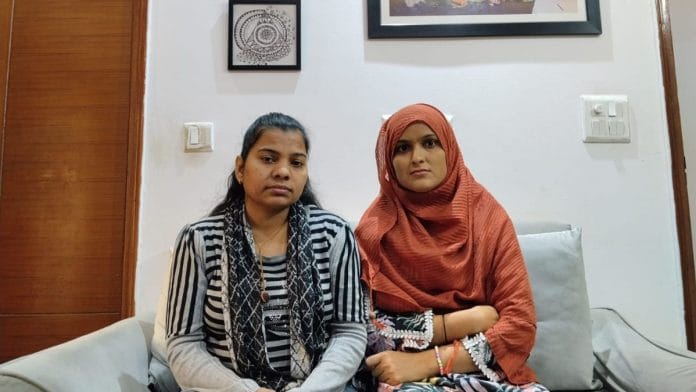



New Delhi: As Rashmi Bhatia stands in a courtroom in Rohini, six years after the man who forced her to ingest acid and attempted to kill her got bail, her ‘disability’ is invisible. There are no scars on her face or burn marks that immediately announce violence.
Yet, since August 2019, Rashmi’s life has been all about liquid diets, feeding tubes, repeated hospitalisations, and a justice system that she says has tested her endurance as much as the acid she was forced to swallow.
Rashmi is among the survivors, whose lived experiences have now travelled from police stations and trial courts to the Supreme Court, where a public interest litigation (PIL) is now seeking recognition for victims of forced acid ingestion under the Rights of Persons with Disabilities (RPwD) Act, 2016.
“Whatever has happened is in the past, we can’t change that but we have a life ahead, I have a son. He will have a career…which is why I want a disability card to be made so that we can also benefit,” she says.
While the law currently recognises acid attack survivors as Persons with Disabilities, it does so narrowly—limiting coverage to those who suffer disfigurement due to acid being thrown at them. Survivors who were made to ingest acid, causing devastating internal injuries, remain excluded from statutory disability benefits, identity cards, and long-term state support.
Last week, the Supreme Court urged the Union government to consider amending the law. The stories of women like Rashmi lay bare why this legislative gap has real, lifelong consequences.
Also Read: For son who can’t walk, Delhi HC brings BSF ASI home—PWDs’ caregivers entitled to transfer exemption
‘Police asked if I drank it myself’
Rashmi was 23, a college student in Sonipat, Haryana at the time of her marriage in 2016. What followed, she says, was a steady escalation of dowry-related violence. By 2019, then living in Delhi with her husband, a doctor, the abuse continued even during her pregnancy. On the morning of 14 August, 2019—on the eve of Raksha Bandhan—an argument over money took a horrible turn.
“He thought I would go home and tell everyone,” Rashmi recalled. “He picked up the acid bottle from the bathroom and made me drink it.”
Barely conscious, beaten up through the night and later strangled, Rashmi managed to stumble out onto the street, where a neighbour saw her and rushed her to hospital.
What followed was a cascade of institutional failures. She was turned away from multiple government hospitals. At Dr Ram Manohar Lohia Hospital, she alleges, her husband and in-laws spoke to doctors to prevent her admission. Only after the change of staff and intervention by her father’s governmental contacts was she finally admitted, she says.
Her food pipe had been completely destroyed. For days, she had to survive on glucose alone. But no FIR was registered.
“When the police first came, they asked my father if I had drunk the acid myself, or if my husband did it,” she says. The FIR was finally registered only after Rashmi’s father approached the police commissioner through official channels. Her husband was arrested weeks later. But he spent nine months in jail, and has been out on bail since.
Six years on, Rashmi says, her testimony is still incomplete. “Sometimes, the judge is on leave, sometimes his lawyer doesn’t come. He keeps changing lawyers. You get tired, defeated,” she adds. “But I think of my father. He is over 60. He fought for me when I couldn’t.”
Living without recognition
Unable to eat solid food, Rashmi lived with a feeding tube attached to her stomach for over two and a half years. Multiple surgeries followed. During the Covid-19 lockdown, her condition worsened. Applications for assistance went unanswered until she reached a women’s helpline that connected her to Shaheen Malik, founder of the Brave Souls Foundation shelter home.
Today, Rashmi splits her time between her parental home and the shelter, returning home whenever her young son calls for her.
Despite being enrolled under the Prime Minister’s National Relief Fund (PMNRF), she has not received compensation. “They say my face doesn’t show an acid attack,” she said. “How do I show them my insides?”
Every explanation, she says, revives the trauma. “We have to keep telling people what happened. Each time, it feels like it’s happening again.”
A disability card, Rashmi believes, would not erase the past, but would secure her son’s future.
‘They told everyone I drank it out of anger’
The story of another survivor, Ruman, now in her early 30s, follows a similar arc of domestic violence, institutional silence and delayed justice. Married in 2016 in Uttar Pradesh, she endured years of abuse over dowry demands and her husband’s alcohol addiction. On 5 March, 2019, after being beaten up throughout the night, she begged for water as she was starting to lose consciousness. “They gave me acid instead,” she said.
Ruman woke up in a hospital, unable to speak. Her in-laws, she alleges, informed doctors and police that she had consumed acid out of anger. Her husband remained by her bedside, controlling access, while her family was initially kept away.
Doctors eventually advised that she would not survive. Her father forcibly intervened and moved her to other government hospitals. Eventually, through the Mahila Aayog, she too reached out to Shaheen Malik, who facilitated her long-term treatment at Apollo Hospitals.
For two years, Ruman lived with a stomach pipe, surviving on liquids. Even today, doctors have told her that the damage to her intestines is permanent. Every three months, she requires hospitalisation for endoscopies and monitoring—spending nearly half the year in medical care.
In court, Ruman says, her initial testimony was compromised because she was unaware of what had been recorded. “When I got better, I told the police the truth.”
Her total compensation so far stands at Rs 3 lakh. “What happens with three lakh rupees?” she asked. “My father has lost everything.”
The question of dignity
The PIL before the Supreme Court argues that excluding survivors of forced acid ingestion from the disability framework violates the Constitution’s guarantees of equality and dignity. The top court’s recent observations signal a recognition that disability is not always visible, and that law must keep pace with lived realities. Chief Justice of India Justice Surya Kant remarked that perpetrators who force women to drink acid are “worse than animals”, and that such “ruthless and brutal” acts demand an “iron hand” approach. “If the National Capital cannot respond to these challenges, then who will? This is a mockery of the system.”
For Rashmi and Ruman, the legal battle is not just about compensation or certificates. It is about being believed, recognised, and spared the burden of repeatedly proving their pain.
“Acid destroys everything it touches,” Ruman says quietly. “Whether it falls on you or goes inside you—nothing is spared.”
As the Supreme Court considers whether the law should finally reflect that truth, their voices remain the strongest argument for change.
(Edited by Mannat Chugh)
Also Read: What drove a paraplegic 9-yr-old to Uttarakhand HC—‘will railways quarter provide all this?’