





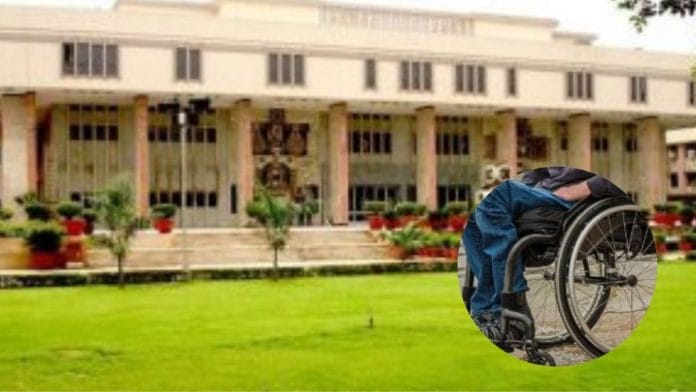



New Delhi: In a ruling which could significantly enhance the rights of persons with disabilities (PwDs), the Delhi High Court recently ruled that as long as a child or a dependent continues to suffer from disability, they would be entitled to the benefit of a caregiver in proximity.
The 18 November ruling, which was uploaded this weekend, came on a plea filed by advocates Rahul Bajaj, Amritesh Mishra and Sarah, in the case of an assistant sub-inspector, Shambhu Nath Rai, who was posted in the 171st Battalion of the Border Security Force, at Silchar, Assam. His son, Satyendra Kumar, who was diagnosed with muscular dystrophy, lived 2,107 kms away in Delhi.
In his plea, Shambhu said that his son Satyendra suffered from the muscular dystrophy in his lower limbs and needed assistance, even for normal daily activities, and sought to be relocated to Delhi or posted to a place where treatment was available for his son. Shambhu even suggested that he be posted to Kolkata or Bangalore, if not Delhi.
A journey which began three years ago in 2022, at the Delhi High Court, with Shambhu challenging his transfer to Silchar, culminated now with relief for his family.
However, in September 2024, the same court had declined to interfere with his transfer order, though it did extend the time he was given to relocate to Silchar to the end of January. The court had also allowed him the liberty to come back if he found any policy that could justify his request.
Earlier, Shambhu had relied on two office memoranda issued by the Ministry of Home Affairs in 2017 and 2018, which provided that government servants who were caregivers of a disabled child or a disabled dependent, could be exempted from the routine exercise of transfer or rotational transfers, subject to administrative constraints. But the court rejected this, until his lawyer told the court that they would be willing to move even to Bangalore or Kolkata. But in April this year, the BSF rejected this request of Shambhu too. This is what led Shambhu to approach the court once again with his transfer plea.
Setting aside the transfer order, a bench of Justices C. Hari Shankar and O.P. Shukla directed the Centre to relocate Shambhu to Delhi, if possible. “In case it is not possible to locate the petitioner to Delhi, for administrative constraints… a reasoned order citing such constraints would be issued,” the court ruled while adding that even if the Centre had justification for not posting Shambhu back to Delhi, it would have to post him to one of the five places where super speciality facilities were available, including Jalandhar, Delhi, Bangalore, Kolkata or Siliguri. Among these, the court said, it would be preferable to send him to Bangalore or Kolkata, if not Delhi.
Speaking to ThePrint, advocate Rahul Bajaj who represented Shambhu Nath in this case said that the ruling is mindful of practical realities. “It is a landmark judgment for caregivers of persons with disabilities. When we talk about a statute like the Rights of Persons with Disabilities Act, it’s just as important to protect the rights of PwDs, as it is to protect the rights of their caregivers or guardians through whom they often exercise their rights.”
Relying on the 2018 MHA office memorandum, the court said that this executive order was specifically intended to cater to persons with disabilities, and the issue of transfer and the posting of such persons has to abide by the same, and not by another circular which was issued by the BSF in April 2024, much after Shambhu had approached the court.
In 2010, a two-judge bench of the Delhi High Court in Syed Shahid Wahid v. Union of India had ruled that “a government servant who is also a caregiver of disabled child/dependents may be exempted from the routine exercise of transfer/rotational transfer subject to the administrative constraints”. This served as the basis for the 2018 MHA order too, the court noted.
The constraint must also be of sufficient importance and significance as would justify compromising the interest of the disabled child or dependent, the court said while recalling the 2021 ruling in Rajive Raturi vs. Union of India.
(Edited by Viny Mishra)
Also read: What drove a paraplegic 9-yr-old to Uttarakhand HC—‘will railways quarter provide all this?’