





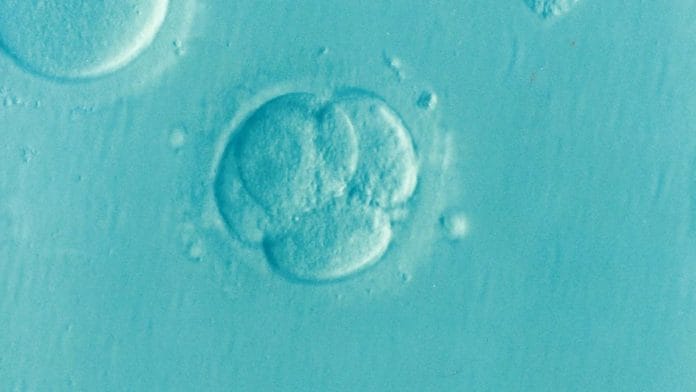



New Delhi: In a second round of litigation, the Delhi High Court Wednesday sought responses from the Centre and the Ministry of Health and Family Welfare on a public interest litigation (PIL) challenging provisions of the Assisted Reproductive Technology (Regulation) Act, 2021, which impose a prohibition on embryo adoption in India.
A division bench of Chief Justice D.K. Upadhyaya and Justice Tejas Karia issued notice to the central government as well as the National ART and Surrogacy Board under the Ministry of Health & Family Welfare.
The challenge has been mounted by Mumbai-based IVF specialist Dr Aniruddha Narayan Malpani, who has been practicing for over three decades and established India’s first sperm bank in 1991. He also initiated Infertility Friends, India’s first support group for infertile couples.
The petitioner is represented by Senior Advocate Menaka Guruswamy in the high court, with the petition being filed through Advocate Mohini Priya.
The petition also mentions that the present challenge follows an earlier petition disposed of by the Delhi HC in September 2024. The earlier petition too, was filed by Dr Malpani and on similar grounds.
The high court disposed of the earlier petition, with liberty granted to make a detailed representation to the ministry. Without entering into the merits of the matter, it observed that issues raised pertained to the policy domain.
However, the representation submitted to the ministry on 28 November 2024 went unanswered. The petitioner then sent a subsequent email reminder to the ministry on 1 December 2025. The ministry thereafter issued a response the same day rejecting the representation.
Explaining what prompted him to return to the high court, the petitioner states that the ministry’s response “neither engages with nor addresses the substantive legal, constitutional, and policy concerns raised by them in the Writ Petition and amounts a mechanical reiteration of the existing statutory position, without any application of mind to the issues flagged or the liberty granted by this Hon’ble Court”.
‘Strikes at heart of Article 14’
At the heart of the challenge lies Section 29 of the ART Act, 2021, which places a clear restriction on the sale, transfer or use of gametes, zygotes and embryos, or any part thereof, or information related thereto, directly or indirectly to any party within or outside India.
The provision deems such acts prohibited except in the limited case of transfer of one’s own gametes and embryos for personal use, and only with the permission of the National Board. Read together with Sections 25(2), 27(5), 28(2) of the Act and Rule 13(1)(a) of the ART Rules, the statutory framework effectively prohibits the donation or adoption of pre-existing frozen embryos, even on an altruistic and voluntary basis.
As stated in the petition, “The challenge is directed against Sections 25(2), 27(5), 28(2), 29 of the ART Act, 2021 and Rule 13(1)(a) of the ART Rules, which collectively prohibit even altruistic, voluntary, and consent-based donation of pre-existing frozen embryos by a commissioning couple for adoption by another infertile couple, where both partners suffer from infertility.”
The plea argues that this prohibition results in unequal and discriminatory treatment between similarly placed infertile couples.
According to the petitioner, while the law permits double-donor IVF (where both gametes originate from unrelated donors) it denies infertile couples the option of embryo adoption, even though both reproductive options are functionally and ethically equivalent.
In the words of the petition, the “blanket exclusion of pre-existing frozen embryo donation results in unequal and discriminatory treatment between similarly placed infertile couples, those permitted to access double-donor IVF and those denied embryo adoption, without any intelligible differentia or rational nexus to the object sought to be achieved”.
“Such arbitrariness,” it says, “strikes at the heart of Article 14.”
It asserts embryo adoption is, “in substance and effect, indistinguishable from double-donor IVF, wherein neither intending parent shares a genetic link with the child, yet parentage is clearly vested in the recipient parents.”
On this basis, the petition claims that the differential treatment lacks any rational nexus with the object of the Act and is liable to be struck down as arbitrary and discriminatory under Article 14 of the Constitution.
Drawing parallel with adoption law
The petition also notes that the stated objective of the ART Act is to prevent exploitation, commercialisation and misuse of assisted reproductive technologies, particularly in third-party arrangements involving donors or surrogates.
“Embryo adoption, however, involves no commissioning couple, no surrogate mother, and no commercial or altruistic gestational arrangement. The woman seeking embryo adoption herself carries the pregnancy and assumes full gestational, legal, and parental responsibility from implantation onwards,” it adds.
Consequently, the petition argues that embryo adoption does not fall within the mischief sought to be regulated under either the ART Act or the Surrogacy (Regulation) Act, 2021.
Drawing a parallel with adoption law, the petition submits that embryo adoption is conceptually indistinguishable from child adoption, with the only difference being the developmental stage at which parental responsibility is assumed.
As stated in the plea, “To prohibit embryo adoption while permitting child adoption creates an unreasonable and manifestly arbitrary classification based solely on developmental stage, in violation of Article 14 of the Constitution.”
Filed on 7 January and heard Wednesday, the petition reiterates that embryo adoption and double-donor IVF are functionally identical in legal effect, as in both cases neither intending parent has a genetic link to the child, yet parentage is unequivocally vested in the recipient parents.
The differential treatment, despite identical safeguards, is asserted to be manifestly arbitrary, it submits.
Benefits of embryo adoption
The plea also alleges a disproportionate infringement of a woman’s reproductive autonomy and decisional privacy under Article 21, stating that once an embryo is implanted, the child is gestated entirely within the intending mother’s womb.
The petition highlights the medical, social, and ethical benefits of embryo adoption, stating that it enables recipient mothers to experience pregnancy and prenatal bonding, serves as a cost-effective alternative to repeated IVF cycles or traditional adoption, and significantly shortens the timeline to parenthood.
It further raises constitutional questions concerning reproductive autonomy, arguing that denial of access to a medically established and globally recognised reproductive option causes grave psychological, emotional, and social harm to infertile couples.
In the present proceedings, the petitioner ultimately “seeks the establishment of a legislative framework to permit a regulated, one-time, altruistic donation of a cryopreserved embryo from a donor couple to a recipient couple,” contending that such a framework would be consistent with the ART (Regulation) Act’s existing recognition of double-donor embryos.
(Edited by Amrtansh Arora)
Also Read: In light of Delhi HC ruling on reproduction after death, here’s how different countries handle it