





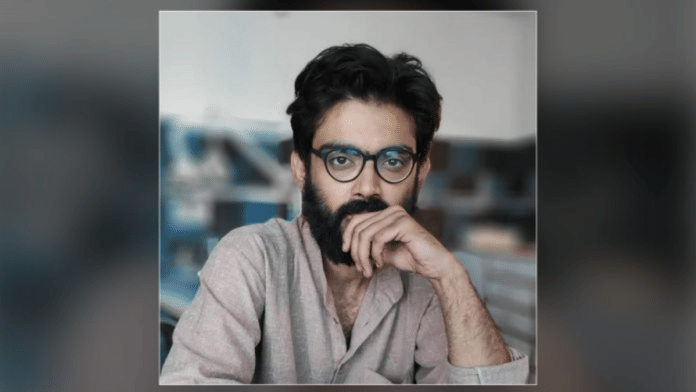



New Delhi: Booked in the 2020 Northeast Delhi riots, former JNU scholar Sharjeel Imam has been granted a 10-day interim bail to attend his younger brother’s wedding and take care of his ailing mother.
Additional Sessions Judge Sameer Bajpai of the Karkardooma Court of Delhi Monday granted him interim bail from 20 to 30 March on a personal bond of Rs 50,000 with two sureties—after verification of the facts mentioned by Imam’s counsel.
The court has also directed that during this period, Imam can interact only with family members, relatives and friends, and can’t use social media or contact the media.
In February 2020, there were violent widespread protests against the Citizenship (Amendment) Act (CAA) and the National Register of Citizens (NRC), which reportedly left at least 53 dead and 700 injured. Sharjeel Imam is one of the several accused of a wider conspiracy in the riots, which, according to the Delhi Police, were not spontaneous but part of a “premeditated, well-orchestrated conspiracy” to destabilise the government.
Before the interim bail on Monday, Sharjeel was denied regular bail thrice before.
First, he was denied bail in March 2022 by the sessions court, then in September 2025 by the Delhi High Court and then his bail application was denied again this year by the Supreme Court in January.
The charges against Sharjeel Imam in the case of the larger conspiracy in the Delhi riots case are yet to be framed, even though he has been booked under a series of acts including the UAPA for inflammatory speeches that allegedly instigated the riots a month after he was arrested in January 2020.
The Delhi Police say that Imam was a “central and formative” figure who worked closely with co-accused Umar Khalid to plan and execute the riots. A key part of the charges involves Imam’s call for a ‘chakka jam’ (roadblock) at the ‘Chicken’s Neck’—the narrow corridor connecting Northeast India to the rest of the country.
The Supreme Court on 5 January denied regular bail to Imam and Umar Khalid in the “larger conspiracy” case, while granting it to five co-accused in the case. The top court’s bench of Justices Aravind Kumar and N. V. Anjaria ruled that Umar and Sharjeel stand on a “qualitatively different footing” from the other accused, given the “strategic centrality” and “directive role” attributed to them in the alleged conspiracy behind the February 2020 violence in northeast Delhi.
The court had added that the petitioners could apply for bail again only after one year or before witnesses were examined, whichever was earlier. The top court was hearing an appeal filed against the September Delhi High Court verdict which had also denied bail to Imam.
In October 2025, in the run-up to the Bihar polls, Sharjeel Imam had put in an interim bail application in Delhi’s Karkardooma district courts so he could “file his nomination and campaign” as an independent candidate from Bahadurganj constituency in Bihar. However, he himself withdrew the appeal a day later.
(Edited by Viny Mishra)
Also read: How SC relied on prosecution theory of ‘vertical chain of command’ to deny bail to Umar, Sharjeel