





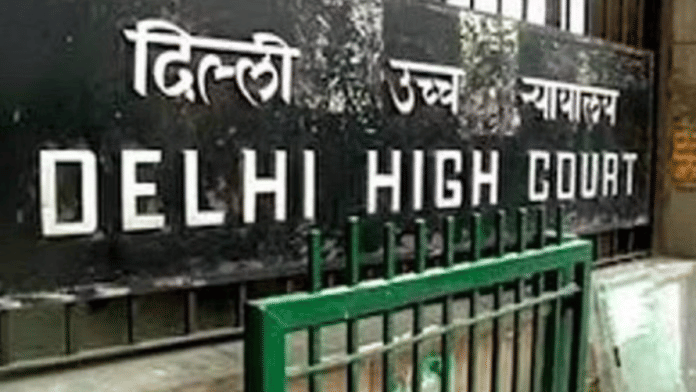



New Delhi: The Delhi High Court last week pulled up the Municipal Corporation of Delhi (MCD) for failing to publish key civic records on its website even 20 years after the Right to Information (RTI) Act came into force.
A division bench of Chief Justice Devendra Kumar Upadhyaya and Justice Tejas Karia observed that the civic body has not fulfilled its statutory disclosure obligations despite the law being enforced in October 2005.
The observations were made while hearing a public interest litigation (PIL) by the Centre for Youth Culture, Law and Environment, a Delhi-based NGO, which had sought directions to upload legislative records, house proceedings, and resolutions passed by standing committees dating to 1957.
“Accordingly, prima facie, it is apparent that the statutory mandate and the duty casts on the MCD by Section 4 of the RTI Act has yet not been fully followed even after lapse of twenty years since the RTI Act was enforced..” the court noted.
The bench directed the MCD to file a detailed affidavit within four weeks, explaining what steps it has taken to meet its disclosure obligations under the RTI Act by publication. It also directed the civic body to file a para-wise reply to the claims made in the petition.
The order is based on Section 4 of the RTI Act, 2005, which mandates “suo-moto” or proactive disclosure of information by all public authorities. Section 4(1)(b) obligates every public authority to publish specified categories of information, and Section 4(2) provides that every authority must make constant endeavour to provide information at regular intervals.
As the bench noted, the intent of Parliament was that information be placed in the public domain so that citizens have “minimum resort to the use of the RTI Act for the purpose of obtaining information”.
The MCD relied on Section 86 of the Delhi Municipal Corporation Act, 1957, arguing that it governs circulation and inspection of resolutions and minutes.
But, the Bench said that disclosure of minutes was squarely covered within the RTI Act, while the DMC Act merely prescribed internal circulation among specified office-holders such as MLAs and chairpersons of committees.
“Section 86 of the DMC Act in our opinion has nothing to do with dissemination of information and particulars to (the) public, as is the mandated under… RTI Act,” the court observed.
Addressing the argument that resolutions and minutes need not be published, the court extracted Section 4(1)(b)(viii), which specifically requires the publication of statements regarding boards, councils, and committees, and whether their meetings or minutes are accessible to the public.
“Thus, public bodies, including the MCD, is (are) under statutory mandate to publish the information in terms of requirement of Section 4(1)(b) of the RTI Act,” it said, adding: “No exception in this regard can be granted to any public authority, including the MCD.”
The petition arose from RTI replies issued by the MCD in September 2025, where the civic body claimed there are no rules or guidelines for publication of such material on its website. “There is (are) no rules and guidelines that govern the publication of resolutions passed by MCD on its official websites. The same is govern(ed) by as per the provision of Section 86 of DMC Act, 1957,” the MCD had said.
Even on appeal, the first appellate authority reiterated this position.
The matter has been scheduled for further hearing in April.
(Edited by Prerna Madan)