








New Delhi: In a case of “complete justice” driven by the “sixth sense” of judges, the Supreme Court has quashed the rape conviction of a man from Madhya Pradesh after he married his girlfriend who had lodged the case against him four years ago apparently on account of a misunderstanding between the two.
While the man had sought to defer their marriage plans, the complainant got the impression that he was not keen and felt cheated, prompting her to file a case of rape against him for developing physical relations with her on the false promise of marriage.
In a nine-page order delivered on 5 December, uploaded Saturday, Justices B.V. Nagarathna and Satish Chandra Sharma acknowledged that their “sixth sense” made them explore the possibility of bringing the accused and complainant together, which worked with both agreeing to get married. The court did not stop here, though.
The bench then waited six months to see whether the union between the two will work or not, before it decided to invoke Article 142 of the Constitution to quash the rape case. Article 142 allows the SC to use its extraordinary powers to decide a matter in the interest of justice and to do complete justice.
Further, the bench asked the government department where the man was employed but suspended in 2024 following his conviction for rape, to revoke his suspension and pay him arrears for the period during which he remained suspended.
“We think that owing to a misunderstanding, the consensual relationship between the parties was given a criminal colour and converted into an offence of false promise of marriage, whereas the parties, in fact, intended to marry each other. It was only owing to the appellant seeking postponement in the date of marriage, which may have led to insecurity in the mind of the respondent prosecutrix and filing of the criminal complaint,” the court observed.
Advocate Nikhil Jain, who represented the complainant, appreciated the court’s humane and sensitive approach in the case.
“Though the matter arose in the context of bail, the Hon’ble Supreme Court adopted a holistic and equitable approach to bring finality and meaningful closure to both sides, enabling everyone to move forward with dignity and peace,” he told ThePrint, welcoming the use of Article 142 in the case.
Also Read: Supreme Court stays Bombay HC’s ‘no skin touch, no sexual assault’ verdict in POCSO case
A look at the case
The Supreme Court order came on an appeal filed by the man earlier this year, challenging the Madhya Pradesh High Court’s order refusing to suspend his sentence in the rape case. In September 2024, the HC had declined to keep in abeyance the 10 years of rigorous imprisonment imposed on him by a trial court in Sagar district which had convicted him in the case.
The man had appealed against the trial court decision, which pronounced him guilty in April 2024 of raping the complainant on the pretext of marrying her. In addition to the sentence, the trial court had also imposed a fine of Rs 50,000. It also convicted and sentenced him to two years’ imprisonment for cheating. For this, a fine of Rs 5,000 was levied on the man.
The FIR against the man was lodged in November 2021 by the complainant who was aggrieved by non-fulfilment of his promise to marry her. The two had met in 2015 on a social media platform and entered into a physical relationship with each other.
Proceedings in SC
When the SC took up the matter in May this year, the lawyer of the accused told the bench that his client was willing to marry the complainant. Since the accused was in custody, the court ordered the state to produce him before it and issued similar directions for the complainant.
On 15 May, both the complainant and accused appeared with their respective parents before the court. Given the sensitivity of the matter, the judges held a hearing in their chamber in the pre-lunch session and then passed it over so as to give them an opportunity to talk to each other and decide if they were inclined to get married.
When the matter was called again on the same day, in the post-lunch session, the man and woman “unequivocally” stated their willingness to tie the knot.
On learning this, the judges made an extra effort to bring the couple closer. Justice Sharma got his court staff to bring the flower pots from his chamber and asked the couple to exchange it with each other in the open court, lawyers involved in the case said.
The court then left it to the parents to make the marriage arrangements as expeditiously as possible. Meanwhile, it asked the accused to appear before the trial court that had convicted him to apply for bail.
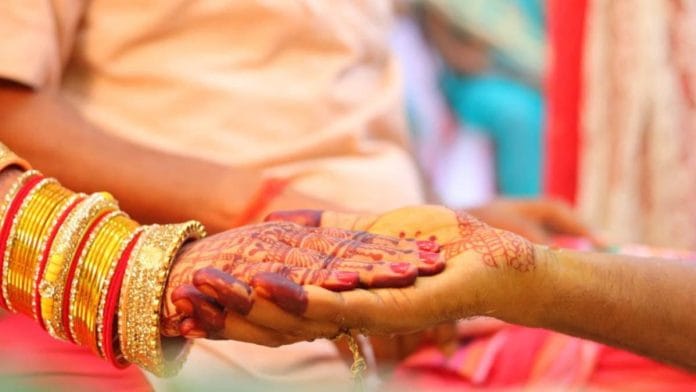
By the time the case was taken up again on 25 July, the accused and complainant had got married, on 22 July. Noting this, the court stayed the conviction of the accused, enabling him to rejoin employment as well.
The couple finally appeared before the court on 5 December and apprised the judges that they were living together. In view of this development, the complainant, who was now the accused’s wife, urged the bench to quash the rape case initiated by her. The counsel for the accused too made a similar request, saying that since the two were residing together, the case may be quashed in the interest of justice.
Recording the sequence of events in its order, the court noted: “On a consideration of the facts of the case, we had a sixth sense that the appellant (accused) and the respondent prosecutrix could be brought together once again if they decided to marry each other.”
Considering that the marriage took place six months ago and the couple had been residing together since then and their parents were happy with the development, the court chose to exercise its extraordinary powers to quash the entire case against the man.
(Edited by Nida Fatima Siddiqui)
Also Read: India maybe revolutionising, but when it comes to marriage, ‘middle-class morality’ wins