





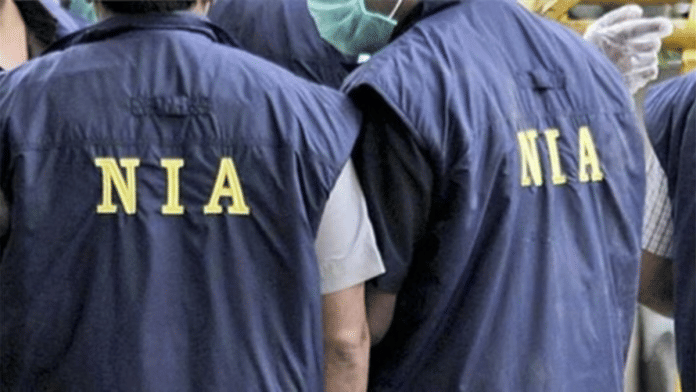



New Delhi: The Centre is considering to appoint retired judges for expediting trials in cases probed by the National Investigation Agency (NIA), as it seeks to expand the number of special courts across the country.
In March, Minister of State for Home Affairs Nityanand Rai informed Parliament that there were 51 special courts, including two designated last year, for NIA cases across India.
Secretary, Justice, Niraj Verma and Additional Solicitor General Aishwarya Bhati made the proposal at a meeting in October, citing a shortage of at least 4,000 judges in trial courts as well as a long list of undertrials languishing in prisons awaiting trial proceedings.
Union Home Secretary Govind Mohan had chaired this meeting, which itself was convened following instructions from the Supreme Court that admitted a PIL highlighting delay in trial of NIA cases.
On Tuesday, the Centre informed the Supreme Court about the steps taken by it and the states to constitute special courts to deal with NIA cases. It also submitted the concerns over recurring expenditure for setting up such exclusive courts and the proposal to increase the amount to Rs 1 crore each per year for states, a demand that was accepted by the Ministry of Home Affairs (MHA).
The proposal is in the final stage of approval in consultation with the stakeholders concerned, the top court was informed.
Based on the recommendation, the Centre directed the Assam government to identify retired judges for the purpose. Additionally, Delhi, Jammu and Kashmir, and Punjab were told to set up additional NIA courts further to reduce the number of pending cases in trial.
The Centre emphasised splitting the special courts that preside over both NIA and Central Bureau of Investigation (CBI) cases—a practice currently underway in states such as Manipur and Punjab. It also directed states such as Manipur to establish separate courts to hear cases involving central agencies.
The October meeting was attended by officials from Assam, Bihar, Chandigarh, Delhi, J&K, Jharkhand, Karnataka, Maharashtra, Manipur, Punjab, Tamil Nadu, West Bengal, and Telangana, along with chiefs of the NIA and the Narcotics Control Bureau (NCB).
Officials from the MHA’s Internal Security and Counter Terrorism and Counter Radicalisation (CTCR) Division were also present in the meeting.
Also Read: In a first, judge holds court at NIA HQ in Anmol Bishnoi case after he cites threats from Pakistan
States’ proposals & reservations
Assam reiterated its concern about recurring expenditure on maintaining exclusive courts, according to the minutes of the Centre’s meeting and a status report that was submitted. It sought rent from the Union government to use rented premises until a permanent arrangement was established.
The Centre recommended that the Northeast state recruit retired judges and establish a permanent mechanism to set up and operate the courts.
The J&K principal secretary, home, and the Crime Investigation Department (CID) chief emphasised the need to establish an additional court following which the Union Territory administration was asked to initiate steps to set up a new set-up in Srinagar, in addition to the existing one in Jammu.
Manipur informed that though CBI and NIA cases were handled by the same court, it has almost finalised all logistics to create a court exclusive for NIA cases. It proposed that the MHA increase recurring expenditure from Rs 60 lakh to Rs 1 crore.
Punjab submitted that it already has a proposal to the Punjab and Haryana High Court to set up an additional court exclusive for NIA cases, and added that it would come up shortly at the court complex in Mohali.
As for Delhi, the Centre suggested opening an NIA court at the Rouse Avenue Court complex, where special courts for ED, CBI cases have been functioning.
Bihar was actively considering the creation of an exclusive NIA court but there was a constraint of space, the state’s law secretary said. Later, the Patna High Court informed that it has designated an exclusive NIA court in the city.
The Chhattisgarh government informed Mohan that it had identified land for establishing a new court building in consultation with NIA officers and that a Detailed Project Report (DPR) was sent to the high court for its approval. The construction, it added, would take around 18 months.
(Edited by Tony Rai)
Also Read: iPhone, Europe trips & ‘mangoes’—ED probe against contractor lands Bihar civil servants in soup