





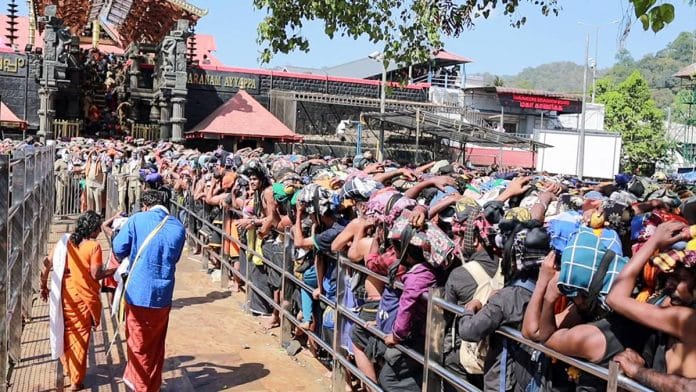



New Delhi: A day after Communist Party of India (Marxist) state secretary M.V. Govindan said Friday that the “legal and constitutional aspects” must be examined before giving an “appropriate response” regarding women’s entry into Sabarimala before the Supreme Court, the Kerala government—instead of clearly supporting or opposing women’s entry into the temple—Saturday filed its response calling for a “wider consultation”.
This matter dates back to September 2018, when the then-Chief Justice of India Dipak Misra-led, five-judge bench of the Supreme Court struck down the practice of disallowing women from entering the temple, while also allowing women of menstruating age—an order that the CPI(M) supported. The debate has resurfaced due to a batch of review petitions and constitutional questions arising from the 2018 Sabarimala judgment that are currently before the Supreme Court. The top court had earlier asked the Kerala government to clarify its position by 14 March.
In its affidavit filed before the Supreme Court Saturday, the Kerala government said, “Any judicial review into any religious practice followed for so many years connected with the belief and values accepted by the people must be after wide consultation with and after soliciting views of eminent religious scholars and reputed social reformers of that religion.”
However, while referring to Article 25 of the Constitution—the fundamental right to religious freedom—the government’s affidavit added that the court, when reconsidering the case, should examine whether the belief that women could not enter the temple was “genuinely and conscientiously held” as part of the profession or practice of religion, or whether it merely appealed to public sentiments.
In its 17-page affidavit, filed through two senior advocates, Jaideep Gupta and Nishe Rajen Shonker, the government also asserted that the impending review should consider that although religious practices are protected under the Constitution, they cannot override constitutional guarantees of equality and reform.
This sets the stage for the top court to once again examine the constitutional questions surrounding the entry of women into the Sabarimala temple.
Also Read: Kerala minister Ganesh Kumar’s wife who ‘caught him cheating’ says issue ‘resolved’ after apology
What is a review petition
In recent times, review petitions have been filed in a large number of significant Supreme Court rulings, including the orders in the Babri Masjid-Ram Janmabhoomi and same-sex marriage cases.
A judgment of the top court becomes the law of the land, says the Constitution, while pointing out its finality and how it would serve as a precedent for future cases. However, the Constitution, under Article 137, allows the top court to review any of its judgments or orders on specific or narrow grounds, such as grave errors in a judgment that resulted in the miscarriage of justice.
In a 2013 ruling, the Supreme Court emphasised three main grounds for a review petition—the discovery of a new and important matter or evidence not known to the petitioners or which they could not produce earlier despite due diligence, mistakes or errors which are apparent on the face of the record, and lastly, “any sufficient reason”.
Kerala government’s affidavit
In its affidavit, the Kerala government said the constitutional right guaranteed under Article 25 is an individual right, but like other fundamental rights it is not absolute.
“It cannot encroach upon the similar right of another person,” the state government added.
The restrictions that may be imposed on Article 25 can be grounded in matters such as public order, morality, or health, the government affidavit stated, adding that even non-religious activities associated with religious practices can be regulated.
Referring to Article 25(2), the affidavit noted that the Constitution empowers the State to make laws throwing open Hindu religious institutions of a public character to all classes and sections of Hindus.
But then, shedding light on the meaning of morality, the affidavit added, “The scope and extent of the word ‘morality’ used in Articles 25 and 26 cannot be considered to be varying according to individual or collective perceptions or ideals. The same has to be sourced to the constitutional principles of equality, prohibition of discrimination and untouchability, protection of life and personal liberty, securing of a social order for the promotion of the welfare of the people.”
Citing Article 25(2), which uses the term “Section of Hindus”, the Kerala government clarified that this includes all divisions, sub-divisions, castes, and sub-castes of Hindus. It added that this provision was added to the Constitution to enable the states to make laws permitting access to Hindu religious institutions for “those depressed castes and communities which were deprived of such entry”. This provision includes all classes and sections of Hindus, including women, the affidavit emphasised.
(Edited by Madhurita Goswami)
Also Read: Left veteran Sudhakaran finally cuts the cord, plans Independent run in Kerala polls