





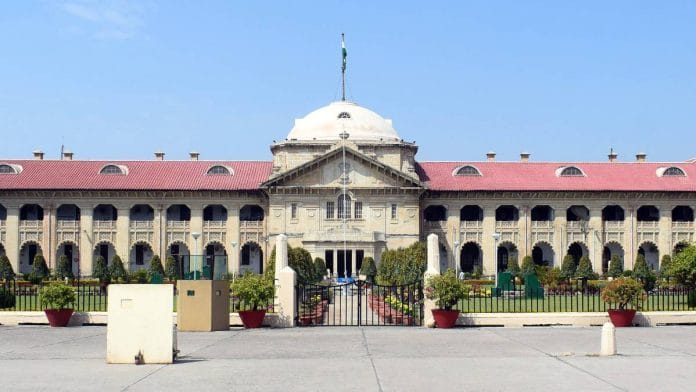



New Delhi: A case involving allegations of promoting enmity and insulting religious sentiments morphed into a constitutional flashpoint before the Allahabad High Court, raising the question: Can a person who converts to Christianity continue to claim Scheduled Caste (SC) status?
Justice Praveen Kumar Giri, in a 21 November ruling, took up the question as he dismissed a plea by Jitendra Sahani, an Uttar Pradesh resident who had sought HC’s intervention to quash proceedings against him under sections 153-A (promoting enmity) and 295-A (insulting religious sentiments) of IPC.
The court concluded in its order that there were several precedents to show that a person who had converted to a religion that wasn’t legally considered Hinduism cannot claim benefits for Scheduled Castes. Justice Giri subsequently issued a series of directions for state-wide scrutiny of cases, where people who converted their religion may still be claiming benefits for SCs.
Also Read: Medical colleges set up for Schedule Caste can’t have general quota ceiling. HC misread it
The plea & the arguments
According to the court’s order, the UP government initiated action against Sahani after he obtained permission from Maharajganj district administration “to preach words of Jesus Christ” at a venue owned by him.
Instead, Sahani pitched a tent on a public place and organised prayer meetings to convince people to join Christianity, the government’s counsel told the HC. This prompted the administration to cancel the permit and sanction prosecution against the Maharajganj resident.
The government’s counsel told the judge that Sahani used “filthy and abusive” language about Hindu deities, and mocked them. This, the counsel said, promoted enmity and outraged religious feelings.
Sahani’s lawyers, seeking directions to police to quash criminal proceedings against him, told the court that he held the gathering only after having obtained permission from the district administration.
What the HC ruled
Justice Giri dismissed Sahani’s plea to quash the case against him, but took “serious note” of contradictory submissions – that he had converted to Christianity years ago, but swore in an affidavit to the court that he belonged to Scheduled Castes.
The court held that this discrepancy could indicate forgery or an attempt by Sahani to unlawfully retain benefits for Scheduled Castes despite having converted.
Justice Giri subsequently expanded the scope of the case before him and delivered directions for the UP government for larger scrutiny of state-wide practices.
Preventing ‘fraud on the Constitution’
The High Court directed Maharajganj district magistrate to inquire into Sahani’s religious status within three months and take strict action if forgery was established.
Across UP, the court said, all district magistrates must ensure within four months that those who converted to minority religions are not claiming SC benefits.
UP chief secretary, Union government’s cabinet secretary and other officials were also instructed to prevent the conflation of SC and minority statuses.
These directions aim to ensure that “fraud on Constitution” – a term coined by the Supreme Court in an earlier judgment – does not recur, the High Court said.
Precedents & what the Constitution says
The issue before the High Court arose when it realised that a police witness had said that Sahani originally belonged to the Hindu-Kewat community, but had “accepted Christianity and held the post of Padri (priest)”.
In Sahani’s affidavit, though, his religion was listed as Hindu.
Justice Giri, in his order, quoted Paragraph 3 of the Constitution (Scheduled Caste) Order, 1950, which said: “No person who professes a religion different from the Hindu, the Sikh or the Buddhist religion shall be deemed to be a member of a Scheduled Caste.”
The High Court underscored this clause, also referring to Section 2 of the Hindu Succession Act, which includes within the term “Hindu” anyone who is not a Muslim, Christian, Parsi, or Jew, unless proved otherwise.
A person who has converted to Christianity, by this logic, clearly falls outside the definition of Scheduled Caste.
This stand has been repeatedly affirmed in court judgements.
In the Soosai vs Union of India (1986) case, the Supreme Court held that a person belonging to an SC community loses eligibility for SC schemes upon converting to Christianity.
The position was sharpened in the C. Selvarani vs Special Secretary (2024)case, where the Supreme Court held that claiming caste-based benefits after conversion amounts to “fraud on the Constitution”.
The Andhra Pradesh High Court (2025) also ruled that SC status “stands nullified upon conversion”, since caste discrimination is not recognised within Christianity; “irrespective of the existence of any previously issued caste certificate”.
“The court (Andhra Pradesh HC) further held that the SC/ST (Prevention of Atrocities) Act is intended to protect communities that historically face caste-based discrimination.
Consequently, its protective provisions cannot be extended to persons who have embraced another faith wherein the caste system is not recognised,” Justice Giri noted in his order.
Similarly, the Karnataka High Court held that extending SC/ST Act protections to Christians was impermissible because the Act exists to address caste-based discrimination—a practice that doesn’t exist within Christian theology.
(Edited by Prerna Madan)