





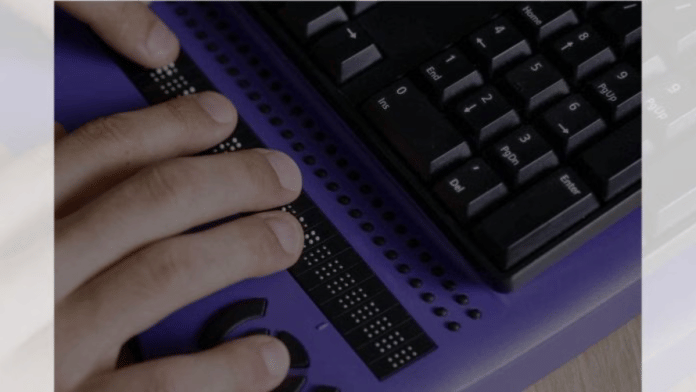



New Delhi: The Supreme Court has directed the Union Public Service Commission (UPSC) to allow blind candidates to change their scribes till at least seven days before the exam, and take measures to deploy screen reader software and other assistive technologies for them.
Noting that the measure of a just and inclusive society lies not merely in the freedoms it proclaims, but in the opportunities it ensures for all its citizens to realise their fullest potential, the court issued a slew of directions to the UPSC to safeguard the rights of civil services examination candidates belonging to the Persons With Disabilities category.
These included the direction to formulate uniform guidelines and protocols for the use of screen reader software and other assistive technologies to ensure standardisation, accessibility, and security of the examination process across all exam centres.
The court asked the UPSC to create these guidelines in coordination with the Department of Empowerment of Persons with Disabilities and the National Institute for the Empowerment of Persons with Visual Disabilities.
The UPSC, being a constitutional body entrusted with upholding the values of merit and fairness in public recruitment, must ensure that its processes are accessible, transparent, and sensitive to the needs of every segment of society, the court said.
The court said the Commission must uphold the constitutional promise given in Articles 14 (right to equality), 19 (right to freedom of speech, practice any profession or trade) and 21 (right to life and personal liberty) of the Constitution.
Incidently, the ruling by a bench of justices Vikram Nath and Sandeep Mehta came on the World Disability Day on 3 December.
The court said the scribe change request by visually-impaired candidates “shall be objectively considered and disposed of by a reasoned order within three working days of receipt of the application”.
Speaking to ThePrint, advocate Amar Jain, the co-founder of Mission Accessibility who appeared for petitioners in this case, said currently there is no formal process in place for changing the scribe. In fact, he said, the scribe details had to be given while filling the application form, which is generally at least three months prior to Pre- and Main exams.
The court noted that the UPSC has taken a “conscious progressive decision” to extend the facility of screen reader software, which reads the text on a computer or device aloud to visually-impaired candidates, but underlined that it is also important to ensure that the mechanism is effectively implemented.
“While the policy decision has been taken, the mechanism and modalities for its effective implementation remain to be streamlined and operationalised,” the court said, pointing out that the UPSC’s dependence on external infrastructure and manpower, coupled with the absence of a clearly delineated roadmap or timeline for establishing the requisite technological framework across examination centres, necessitates institutional coordination and phased execution.
Towards this end, the court directed the UPSC to file an affidavit in two months, containing details of a proper plan of action, along with a timeline for the deployment of such screen reader softwares.
“The affidavit shall also specify the steps proposed for testing, standardisation, and validation of the software and related infrastructure across all or designated examination centres,” the court said, adding that it should indicate the feasibility of ensuring that the facility is made operational and available to all eligible candidates from the next cycle of examinations.
This is what led the court to rule that that the creases in implementation of the process be ironed out through concrete planning, inter-agency collaboration, and the establishment of uniform standards, so as to ensure that the laudable objective of accessibility does not remain confined to paper but translates into a practical reality in the forthcoming examination cycles.
The court was acting on a plea filed by Mission Accessibility, an organisation engaged in the advancement of the rights of persons with disabilities. The plea sought modification of the timeline for scribe registration in the Civil Services Examination conducted by the Union Public Service Commission. It also sought permission for the use of laptops equipped with screen reader software along with accessible digital question papers for eligible candidates.
Amar Jain said, “Among those who have studied and appeared for exams using the scribe facility, many say that the scribes are not of good quality. Especially, if you want to appear for complex exams like those involving science, maths and commerce. But, honestly these guidelines concerning the scribes have been in existence since 2013, but haven’t been implemented. It’s not formal equality that is needed but substantive equality.”
In its 21-page ruling, the court said that equality, in its truest sense, demands not uniformity but the removal of barriers that prevent individuals from standing on equal footing. “The Constitution of India envisions a Republic where every person, regardless of physical or sensory limitation, can participate with dignity in the nation’s collective journey. The law, as an instrument of justice, must therefore move beyond formal equality to ensure substantive inclusion.”
Moreover, the Department of Personnel and Training (DoPT) and the Ministry of Social Justice and Empowerment, was also directed to extend all necessary administrative and technical support to UPSC for the expeditious implementation of the court-ordered measures.
The court listed the matter for next hearing 16 February.
(Edited by Ajeet Tiwari)
Also Read: Cleared UPSC in 2008, appointed 2024—visually impaired candidate’s 15 yr fight with the system
I have seen how in a lot of countries there are people who do sign language translations when someone of a status of a CM or PM in those countries address the nation or journalists. I don’t see that in our country where we definitely have a lot of deaf people just because of our population size. I mean only in 2020 we recognized the Indian sign language (the so called “progressive left – Congress didn’t care about it huh ?)
I have never seen that in our country. Most of our footpaths (the ones which are not encroached or in bad conditions) are very unfriendly towards people using wheelchairs.
Our country is very unfriendly towards physically abled people. Now I have seen NGOs and some initiatives from the government but clearly we are very behind because we have still not made the basics accessible to such groups. NGOs can help but can’t build the infrastructure. That’s the job of the government.