





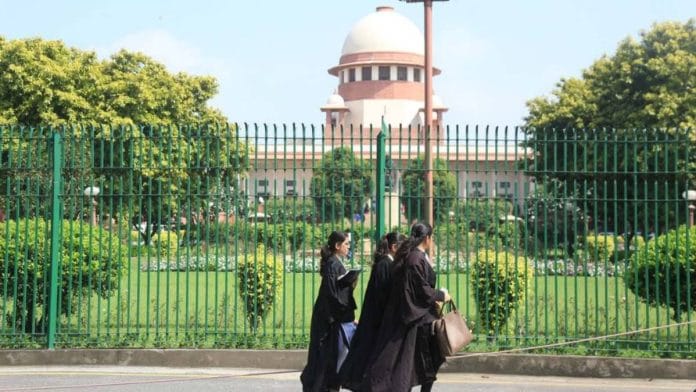



New Delhi: Over a century after the Legal Practitioners (Women) Act, 1923, abolished the bar on women from practicing law, many women lawyers in India still struggle to even set up a practice, with poor access to offices, legal databases, staff and even stable internet, according to a new Supreme Court Bar Association (SCBA) report that underlines how structural gaps continue to define—and derail—their careers.
The report, titled ‘Documenting Voices of Women Legal Professionals in India’, was released by Chief Justice of India Surya Kant in March this year. It surveyed 2,604 women across 23 state bar councils, aiming to document the working reality of women practitioners within the world’s second largest legal fraternity.
The association had circulated an online questionnaire and sought assistance of bar councils in collecting data on structural as well as institutional barriers faced by women lawyers.
Up to 81 percent women reported harder professional journeys than their male peers and 34.4 percent personally experienced/witnessed institutional gender bias. Significantly, women lawyers also experienced horizontal hostility with 44.8 percent claiming that women discouraged other women within the profession. And as many as 72 percent said their gender hindered professional networking, considered an essential element of the legal profession.
As many as 63.7 percent women surveyed found the profession discouraging at some point.
Speaking to ThePrint, SCBA secretary and Advocate-on-Record (AoR) at the Supreme Court Pragya Baghel said: “(The) survey is not a one-time initiative. The findings from this survey will feed directly into discussions and policy-oriented sessions at forums like the SCBA National Conference, ensuring that the conversation leads to concrete outcomes. This report is given to CJI, views of the ladies members of the bar can be taken for appointment and election.”
Among the respondents, early career (0-5 years) practitioners were the largest group at 37.4 percent, with seniors (15+ years) second at 30.7 percent. The number of women practitioners in higher courts—high courts (28.8 percent) and Supreme Court (13 percent)—was found to be significantly lower as compared to district courts (52.9 percent).
The survey also found that women’s representation in government or institutional positions is low, raising a demand for a mandatory minimum representation in such panels.
Crucially, more than 83 percent of women who participated in the survey were first-generation lawyers with no immediate or distanced family member in the profession.
This, according to the report, is striking since the law is seen as a profession where essential informal networks are often built over generations. In the absence of this benefit, first-generation women lawyers not just face structural disadvantages, but are also vulnerable to possible gender discrimination and sexual harassment in the profession, says the report.
“As a first-generation lawyer it is difficult in the initial years as you don’t have the advantage of guidance and support from the professional network built over generations. However one must also be cognisant of the fact that after those initial few years, we make our own network and that comes to our aid,” Mehaak Jaggi, a first-generation lawyer and an Advocate-On-Record (AOR) at the Supreme Court, told ThePrint.
“This is also not an issue peculiar to litigation but is true for other branches in law,” said Jaggi, who was among the respondents.
Also read: Fewer Indian women in higher judiciary? Blame high court collegiums, suggests data
Office, infra & tech difficulties
Even though 84 percent of women lawyers acknowledged that an office near court is better for access and visibility in the justice system, only 14.6 percent reported having an office near court. High rent/cost of space (45.4 percent), lack of financial viability (37.5 percent), early stage of practice, and family responsibilities (20 percent) were identified as the major barriers to proximity.
For women lawyers, securing the confidence of a client is not the only challenge. Many reported struggling to create an infrastructure essential for legal practice.
Up to 75 percent of women do not have access to paid legal databases and 47.65 percent rely on physical law libraries. As many as 77 percent lack clerical staff, 56 percent do not have stable internet/devices and 21 percent have zero access to any listed professional resources, according to the survey.
An overwhelming 42.7 percent complained of gender bias when it came to payment of professional fee to a woman lawyer. This was followed by disproportionate work-life balance expectations (39.5 percent). Other major areas of bias were client trust (32.8 percent), panel appointments/designation process (29 percent) and allocation of sensitive matters (26.6 percent).
As for sexual harassment at the workplace, 16 percent of women surveyed admitted to being victims, whereas 12.7 percent chose not to respond to the question. However, according to the report, “prefer not to say” responses can be interpreted as affirmative due to fear of identification or consequences.
The legal profession is also known to have a high rate of attrition for women lawyers, and the survey found that 84 percent of women experience work-related stress/burnout.
“(The) biggest challenge is not entry into the profession—it is retention and growth. Women are joining law schools in large numbers, but the real issue arises in sustaining long-term careers. Factors such as lack of institutional support, absence of mentorship, work-life balance pressures, and limited access to high-value briefs often lead to a gradual drop-off,” said Baghel.
As many as 71.5 percent of women reported some form of professional impact due to their marital status. The most cited issues were: work-life imbalance, financial instability, household pressure, physical exhaustion, caregiving duties.
According to the report, the key areas for reform are equal access and opportunity, reservations, mentorship, financial support, maternity/returnships, POSH/safety, childcare infrastructure, bar institution reforms, and women networks.
Speaking to ThePrint, former Additional Solicitor General and senior advocate Pinky Anand was optimistic about the future. “When I joined the profession, it was rare to see more than 2-3 women (lawyers) in the corridors, and most were given the advice to either move into teaching or the judiciary. Today the courts are teaming with lawyers, not just men or women, but competent men and women. The change has come about through the change in generations as well the gumption of women advocates who have paved the way for a future generation of female lawyers,” she said.
Adding, “The change is obvious and I do personally believe that when the current generation of women comes at the helm, they will welcome and appreciate their female colleagues more.”
Saumya Sharma is an alum of ThePrint School of Journalism and an intern with ThePrint
(Edited by Nida Fatima Siddiqui)
Also Read: Only 2 woman judges in SC and 82 of 1,079 judges in HCs — judiciary has a gender problem