





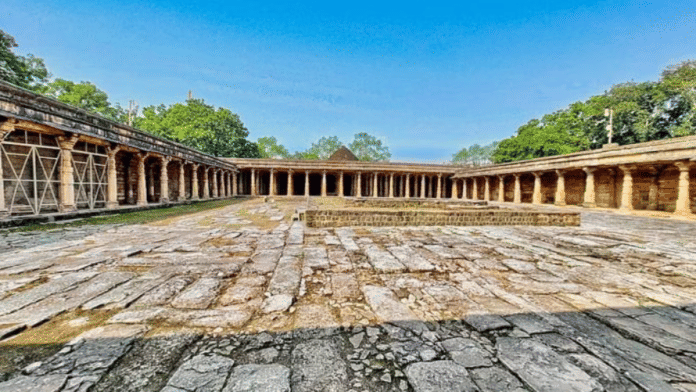



New Delhi: The Supreme Court has laid down a framework for both Hindus and Muslims to carry out their respective religious activities at the disputed Bhojshala Temple–Kamal Maula Mosque complex in Madhya Pradesh’s Dhar on Friday, when Basant Panchami coincides with the weekly Jumma namaz.
The apex court permitted Hindus to offer prayers and perform rituals throughout the day on the occasion of Basant Panchami, which marks Saraswati Pooja, while allowing Muslims to offer Friday prayers at the complex between 1 pm and 3 pm.
The court was hearing a plea filed by advocate Ashwini Kumar Upadhyay, seeking directions to both sides to maintain peace.
A bench comprising Chief Justice of India Surya Kant, and justices Joymalya Bagchi and Vipul M. Pancholi noted that the timing overlap has necessitated immediate intervention to avoid any untoward situation, even though an Archaeological Survey of India’s 2003 directive stays in force, specifying who accesses the monument when.
The SC urged all stakeholders and members of both the communities to “observe mutual respect and tolerance and cooperate with the state and District Administration in maintaining law and order”.
In its order, the court recorded the submissions made by the Union government and the Madhya Pradesh government.
“Learned ASG (representing the Centre) as well as learned Advocate General (representing the MP government) have fairly suggested that, after knowing that how many persons belonging to Muslim community are likely to come tomorrow for Namaz between 1 to 3 p.m., an exclusive and separate space within the same compound/premises shall be made available, so that the Namaz can be performed at the prescribed time,” said the bench.
“Similarly, a separate space, as per the past practice, shall be made available to the Hindu community to hold the traditional ceremonies on the occasion of Basant Panchami,” it added.
The SC bench appealed to both sides to act with restraint and extend cooperation to the state and district administration.
Hindus consider 11th-century monument Bhojshala a temple dedicated to Vagdevi (Goddess Saraswati), while the Muslims call it Kamal Maula mosque.
On 7 April 2003, an order issued by the then director general of the ASI sought to regulate access to the protected monument. The order allows Muslims to offer Friday namaz on the complex between 1 pm and 3 pm, while Hindus get exclusive access every Tuesday and can perform traditional rituals on Basant Panchami.
“Apart from the relaxations enumerated above, the premises shall be open to tourists on all other days,” said the ASI order.
The order, however, does not specify arrangements when Basant Panchami falls on a Friday.
In his plea, Upadhyay had said that Basant Panchami this year falls on Friday, and it could cause difficulty to the authorities to ensure the compliance of ASI’s directions.
Appearing for the petitioner, senior Advocate Salman Khurshid informed the court that Basant Panchami rituals would be observed from sunrise to sunset, involving poojas and havans.
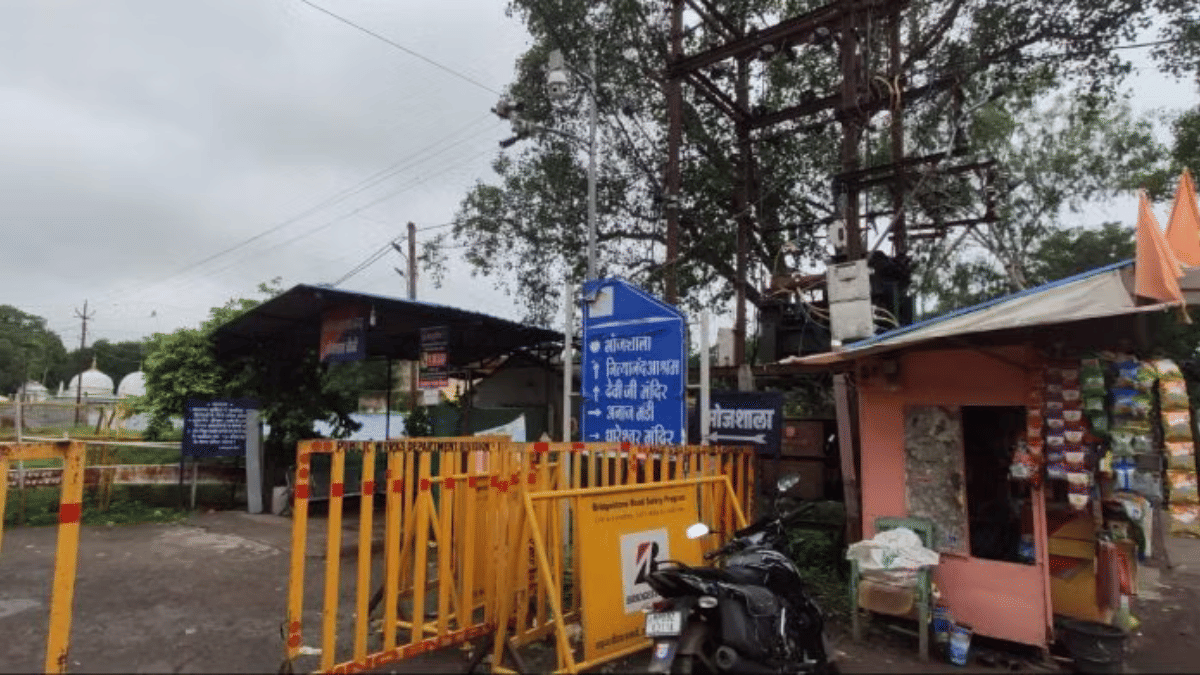
And the Muslim community intended to offer Friday prayers between 1 pm and 3 pm, after which the premises would be vacated, Khurshid said.
During the hearing, it was submitted that Jumma prayers could not be rescheduled, though other prayers could be.
Accepting the proposal for segregation of spaces within the same premises, the court further recorded, “Shri Salman Khurshid, learned senior counsel for the petitioner, while accepting this proposal, states that the approximate number of persons belonging to Muslim community, who will come for Namaaz tomorrow between 1 to 3 p.m., will be furnished to the District Magistrate, Dhar well in time… The District Administration may… issue appropriate passes, free of cost… to ensure that no untoward incident takes place.”
The bench also noted assurances from the Centre and the state that law and order would be maintained.
Also Read: Hindu groups in Dhar determined to ‘reclaim Bhojshala’ after ASI report—‘It’s a matter of pride’
The HC order for survey
Beyond the immediate issue, the appeal before the Supreme Court also concerns the Madhya Pradesh High Court’s 11 March 2024 order, directing the ASI to conduct a scientific survey of the site.
The survey involved documentation, photography, and examination of structural features, including sealed rooms.
The Supreme Court clarified that its order on basant panchami and Friday prayers will have no bearing on other cases related to the complex.
However, it reiterated that no excavation was to be carried out, and no action should be taken based on the survey until the High Court decides the matter regarding the challenge to the site’s religious character and the ASI survey findings.
The ASI survey has since been completed, and the report remains sealed before the High Court.
Disposing of the petition in light of the cooperative stance adopted by all parties, the Supreme Court directed that the pending writ petition before the high court be heard by a division bench of the HC within two weeks.
It also ordered that the sealed ASI report be unsealed in open court, with copies supplied to both sides, allowing them to file objections and submissions before final adjudication.
(Edited by Ajeet Tiwari)
Also Read: Mosque in Bhojshala complex stands on pre-existing structure from Paramara era, ASI tells MP HC