





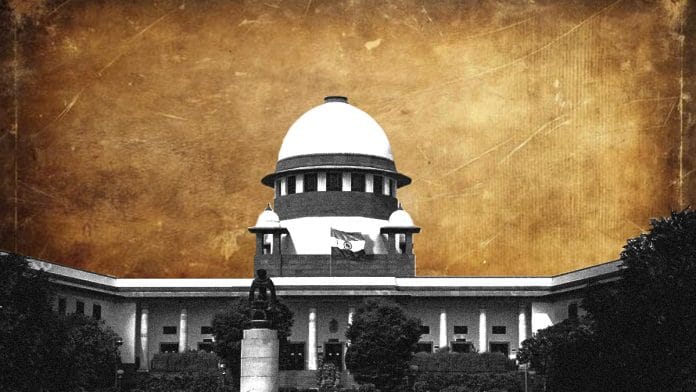



New Delhi: In 2025, the Supreme Court delivered some landmark judgments that recalibrated constitutional boundaries amid political turbulence and institutional strain. In a few, however, the court rolled back its own orders, after faulting previous rulings.
The apex court dealt with issues of judicial discipline, and the finality of verdicts (Anisur Rahaman v. State of West Bengal); made bail the rule rather than exception in routine arrests (Satender Kumar Antil v. CBI); and addressed delays in passing of bills (in State of Tamil Nadu v. Governor).
The top court also mandated three years’ practice for aspirants of judicial exams (All India Judges Association v. Union of India); reiterated the ban on ‘truth serum’ or ‘narco test’ as standalone proof for conviction (in Amlesh Kumar v. State of Bihar); and took suo moto cognisance of decades-old inconsistencies between states’ definition of which landforms constitute the Aravalli hills.
As the year comes to an end, ThePrint takes a look at the most impactful judgments delivered by the Supreme Court of India in 2025.
Also Read: In 1st decision, CJI Surya Kant-led Collegium recommends new Chief Justices for 5 high courts
‘Maintain finality of verdicts’ in Anisur Rahaman v. State of West Bengal
Anisur Rahaman, accused of a political rival’s murder, approached the Supreme Court after lower courts rejected multiple bail pleas moved by him. The top court granted him bail in January 2025, but with strict conditions—he was not allowed to leave his place of residence, Kolkata. He again moved the top court, this time challenging the bail conditions.
Refusing to alter bail conditions imposed by a prior bench, the top court held that altering the conditions would amount to dilution of the original intent of the bail orders, delivering an institutional warning against benches overturning earlier Supreme Court verdicts.
The court noted that to prevent endless litigation, the sanctity and finality of verdicts must be maintained. It held that reopening settled issues because a later view may be preferable not only undermines Article 141 (law declared by Supreme Court is binding on all courts) but also erodes public confidence in the justice system.
Referring to the impact and scope of Article 141, the court said that precedence set by the Supreme Court may resolve the controversy and should be followed by all courts.
Examining the doctrinal importance of finality being attached to judicial orders, the court noted that reopening decisions even when there was no error in the decision would defeat judicial discipline and propriety for which deference to old decisions was important.
It ruled: “Judicial discipline, propriety and comity, which are also inseparable parts of a just and proper decision-making process, demand that a subsequent bench of different combination defers to the view expressed by the earlier bench, unless there is something so grossly erroneous on the face of the record or palpably wrong that it necessitates a re-look in exercise of inherent jurisdiction either by a review petition or through a curative petition…”
‘Bail is the rule, jail the exception’ in Satender Kumar Antil v. CBI
In this case, the top court built on its foundational directive, reiterating that bail was the rule, jail the exception.
Satender Kumar Antil, accused of bribery, criminal conspiracy and offences under the Prevention of Corruption Act, failed to appear before the court even after summons, instead filing an anticipatory bail application before the Allahabad High Court. This the court rejected, and issued a non-bailable warrant against him.
Antil went to the top court, which then examined arbitrary pre-trial arrests by police and other agencies and declared that liberty is an essential fundamental freedom under the Indian Constitution.
The judgment said: “The principle that bail is the rule and jail is the exception has been well recognised through repetitive pronouncements of this court. This again is on the touchstone of Article 21 (Right To Life) of the Constitution.”
It issued strict guidelines for under-trials, stating they must be released on personal bonds if charges are bailable; for non-bailable offences, magistrates must classify cases by gravity, mandating liberty unless there are exceptional risks.
‘Courts can’t decide timelines for executive dialogue’ in Tamil Nadu v. Governor
The Tamil Nadu government approached the Supreme Court in April, challenging Governor R. N. Ravi’s decision to keep various bills and proposals submitted by the state pending without action for over three years.
In this landmark case, the Supreme Court invalidated the governor’s “pocket veto” or the indefinite withholding of legislative assent. The issue at the centre of the debate was whether courts can impose procedural timelines on constitutional discretionary powers.
The court set a three-month outer limit for all actions, whether the governor decided to withhold assent or reserve the Bill for the President, or whether a Bill was re-passed and re-presented by the legislature.
Notably, in November 2025, the President referred 14 questions to the Supreme Court seeking clarity on the scope of Article 200 (governor’s assent to Bill) and 201 (Bills reserved for the Presidents’ consideration) on review of bills, timelines, discretion, scope of judicial review among others, effectively challenging the April 2025 Tamil Nadu judgment.
A Constitution Bench, pronouncing its opinion through Chief Justice B. R. Gavai, critisised the “one-size-fits-all timeline” approach, finding that the nature and complexity of Bills should decide the period for deliberation. It reasserted that the “dialogic process under Article 200 and 201 is not adjudicatory”, raising questions about judicial review of executive dialogue.
‘Uniform criteria for judicial recruitment’ in Judges Association v. Union of India
In this case, the All India Judges Association challenged the diverse practices and inconsistent application of recruitment/promotion rules for higher judicial services.
The court upheld that three years of practice was mandatory for a civil judge (junior division), observing that fresh law graduates lacked courtroom readiness, the ability to manage complexities like evidentiary disputes and witness examination.
It directed uniform guidelines across states, while allowing exceptions for extraordinary candidates, prioritising training over rote qualifications.
The Supreme Court also restored the Limited Departmental Competitive Examination (LDCE) quota for district judge promotions from 10 percent to 25 percent, noting that this quota is calculated on total cadre strength rather than annual vacancies, and it ensures uniformity across states while preventing administrative imbalances.
It directed all high courts to adopt uniform suitability tests for promotions, preventing regional disparities in judicial appointment standards.
‘Convictions can’t be based on narco-tests’ in Amlesh Kumar v. State of Bihar
In this case, the Supreme Court struck down a Patna High Court order allowing narco-tests as a bail condition in a dowry harassment case against Amlesh Kumar. The court reiterated that narco-analysis, brain mapping, or polygraphs cannot be the basis for conviction.
Invoking foundational rights protection and overruling lower court precedents, the court deemed such practices as violative of Article 20(3) (protection against self-incrimination).
The top court also held that even where an accused voluntarily consents to narco-analysis, the test results cannot form the basis of conviction.
Prioritising “fundamental rights of accused persons” over what might seem a modern investigative necessity, it noted that the trial court must evaluate whether consent provided is genuine, if constitutional safeguards are met, and if the test is truly necessary. The appropriate stage for any voluntary test is during the accused’s defence evidence and not during investigation or bail hearings.
SC ordered fresh review of ecological issues of Aravallis (suo moto)
The Supreme Court took suo moto cognisance of decades-old inconsistencies in states’ definition of which landforms make up the Aravalli hills for purposes of legal protection and ecological conservation.
These gaps in the law had made space for illegal mining, environmental degradation, and protection failures causing ecological damage. In November 2025, the then CJI B. R. Gavai -led bench accepted a committee recommendation proposing a definition based on elevation, with Aravalli hills defined as landforms at least 100 metres above local relief; and Aravalli ranges defined as two or more such hills within 500 metres of each other.
Amid significant backlash from environmental groups, scientists and residents across states, expressing concerns that the new definition would exclude approximately 90 percent of the Aravalli landscape from legal protection, including vast low-lying slopes, plateaus, and interconnected geological formations that are ecologically integral to the range.
A bench led by Chief Justice Suryakant took suo moto cognisance again, and 29 December, in an urgent vacation bench hearing, stayed implementation of the November judgment and committee recommendations, acknowledging fundamental flaws and a failure to assuage the very issue it was meant to resolve.
The court noted that the elevation-based taxonomy created a “structural paradox” and was riddled with scientific inaccuracy and “a fair, impartial and independent expert opinion was necessary”. The court has now ordered the constitution of a new high-powered, independent expert committee to assess the issues, with detailed identification of excluded territories and an ecological impact assessment, while maintaining the ban on new mining leases and renewals pending the new committee’s report.
Reversals
With the recent stay on implementation of the Supreme Court’s earlier order in the Aravalli hills case and the implicit reversal of the judgment in the State of Tamil Nadu v. Governor of Tamil Nadu, another aspect worth noting is the reversals by SC of its own legal positions.
In another reversal, taking suo moto congnisance of the rising incidents of stray dogs biting people, the SC first mandated that all stray dogs in Delhi-NCR be captured and housed permanently in shelters; but it later recalled the order, referring to a 2024 Supreme Court ruling which held compassion towards animals as a constitutional value and a 2014 ruling which extended the Right to Life under Article 21 to animals.
Characterising the original order as “too harsh” and “idealistic”, the bench took note of the incapability of the municipalities to fulfil the original directions in the given timeframe. It issued new directions mandating sterilisation, deworming and vaccination of stray dogs before releasing them back into their locality, and ordered the setting up of dedicated feeding zones in each municipal ward, prohibiting feeding on the street by the public.
Disha Vashisth is an alum of ThePrint School of Journalism currently interning with ThePrint
(Edited by Viny Mishra)