





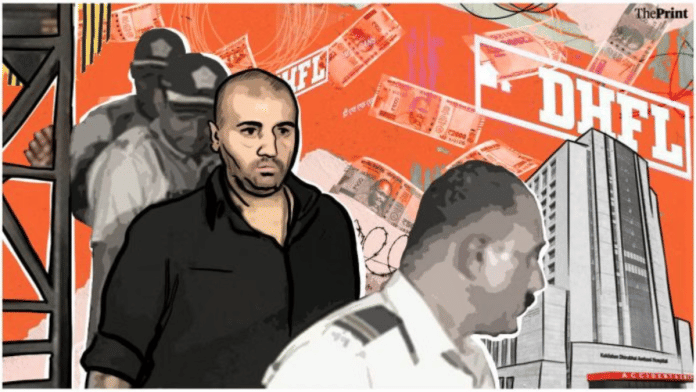



New Delhi: The Supreme Court has granted regular bail to Kapil and Dheeraj Wadhawan, the former heads of Dewan Housing Finance Limited (DHFL), in a multi-crore bank fraud case.
The brothers are in custody since April 2020 in connection with loans and credit facilities worth Rs 57,252 crore availed by DHFL from a consortium of 17 banks.
The decision to set aside the rejection of their bail applications by the Delhi High Court was primarily driven by the staggering volume of the charge sheet and the resultant conclusion that a timely trial would be impossible, thereby infringing upon their fundamental right to a speedy trial.
The Wadhawans faced charges related to alleged offenses under various sections of the erstwhile Indian Penal Code (IPC), including criminal conspiracy, criminal breach of trust, cheating, and falsification of accounts, coupled with charges under the Prevention of Corruption Act (PC Act).
On Tuesday, the top court noted that the brothers were accused on account of non-payment of loan and credit facility availed from the bank consortium and divesting the money in 81 shell companies. It also admitted that this was a case based on documentary evidence and that all the accused connected with these companies, except the brothers were granted bail.
The Central Bureau of Investigation (CBI) charge sheet is voluminous in nature, containing more than 4 lakh pages and having 736 witnesses. In addition, 17 trunks of documents are those which are not relied upon and may be brought on record subsequently if deemed necessary by the prosecution.
The National Company Law Tribunal (NCLT) has already initiated proceedings against the assets, and the Corporate Insolvency Resolution Process (CIRP) is in progress.
In the present case, pending trial, a bench of Justices J.K.Maheshwari and V. Bishnoi noted that charges have not yet been framed by the court.
The bench said that looking at the number of witnesses and the orders passed by the courts, it appears that “if the case is taken up on (a) day-to-day basis, even in two to three years, the conclusion is not possible”—as pointed out by the Wadhawans.
Charges of financial misconduct
The CBI alleged that the NBFC, a Non-Banking Financial Company (NBFC), siphoned off Rs 34,926 crore by establishing shell companies. It further contended that specific companies fraudulently transacted money amounting to Rs 29,051.73 crore.
The brothers pointed out that they have been in custody since April 2020, and that they had been granted bail in all 10 other related cases arising out of the same transaction.
Central to the Supreme Court’s reasoning was the sheer magnitude of the documentation submitted by the CBI, which strongly indicated that the trial would be excessively protracted.
The initial charge sheet was filed on 15 October, 2022. Subsequent investigation led to a supplementary charge sheet arraying 40 individual accused persons and 70 companies, totaling 110 accused.
The substantial nature of the documentary evidence and the large number of witnesses have already created obstacles in bringing the matter to trial, the brothers contended.
Recognising the practical difficulties, the trial court in 2024 observed that “keeping in view the number of witnesses, voluminous documents and number of accused persons, even if the case is taken up for hearing on a day-to-day basis, then also the trial cannot be concluded within two to three years”.
Furthermore, the bench noted that charges were not yet framed by the court in this case, meaning the substantive trial has not even begun.
Constitutional right to speedy trial
The apex court underscored the constitutional mandate that ‘bail is the rule, and jail is an exception,’ emphasising that pre-trial incarceration must not be allowed to “degenerate into punishment without adjudication”.
Citing numerous precedents, the court reaffirmed that the right to a speedy trial is an integral part of Article 21 of the Constitution (protection of life and personal liberty).
The judgment cited the principle that where “a timely trial would not be possible and the accused has suffered incarceration for a significant period of time, the courts would ordinarily be obligated to enlarge them on bail”.
The court emphatically stated that prolonged pre-trial detention, especially when custody is no longer needed for investigation, “has an inherently punitive in character and amounts to a violation of Article 21.”
Reading out the Javed Gulam Nabi Shaikh vs State of Maharashtra (2024) ruling, it concluded that if the prosecution lacks the capacity to ensure a speedy trial, it “cannot oppose the plea for bail on the ground that the crime committed is serious”.
Consequently, subject to imposing strict restrictions, the SC ordered the release of the brothers. The conditions include furnishing a personal bond of Rs 10 lakh each, surrendering passports, and a mandate that they shall not leave the territorial jurisdiction of the country without the prior permission of the High Court.
(Edited by Tony Rai)
Also Read: A Rajasthan king’s estate goes to Khetri trust, just as he wanted. Inside the 40-yr battle royale