





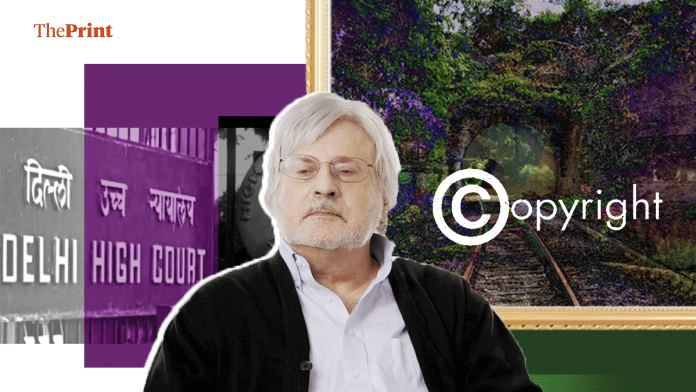



New Delhi: Can an AI-generated art work be protected under India’s copyright law or is such protection entitled only to the works generated by natural persons?
The Delhi High Court posed this question Thursday while hearing the plea of an American inventor and researcher, who sought copyright protection for his AI-generated painting titled ‘A Recent Entrance to Paradise’.
A copyright is a legal right given to creators of literary, dramatic, musical and artistic works, as well as to producers of cinematographic films and sound recordings.
Simply put, it is a bundle of rights, including reproduction, public communication, adaptation and translation, aimed at protecting such creative works, which are deemed to be the creator’s intellectual property under the Copyright Act, 1957.
Stephen L. Thaler, the petitioner, claims to have developed an AI-system DABUS that autonomously generates new inventions without human intervention. In his application filed four years ago, Thaler told the copyright office that the work in question was generated by this system.
However, in July 2023, the Registrar of Copyrights asked Thaler to disclose the name of a “natural person” as the creator of the artistic work. He was suggested to tweak or amend the details in his application accordingly.
Thaler reiterated that the work was autonomously generated by the AI software created by him and that it was squarely covered under Section 2(d)(vi) of the 1957 Act. The section states that in relation to a computer-generated work, the person who created it is the author. Thaler wants the term “work” to be construed as artistic work.
After taking note that the copyright office scheduled a hearing of this issue on 27 April, Justice Tushar Rao Gedela asked the Registrar to decide the application of the American citizen in an expeditious manner.
“The copyright office has been given eight weeks to decide the application of the artist,” the court noted.
Broadly, the case concerns copyright protection of an AI generated artistic work. It assumes significance as its one of the first applications filed in India seeking to register an artistic work generated autonomously by an AI-system.
As of now, there’s no bar in a foreign nationals seeking copyright protection for artistic works in India, Thaler’s lawyers said.
“The case squarely raises the question of whether an AI-system like DABUS can itself be identified as an author, particularly where the work is generated without direct human creative input,” advocate Chirag Ahluwalia told ThePrint.
“It also presents an opportunity for the statutory framework to be interpreted in a manner which meaningfully addresses technological developments, while remaining consistent with the principles of copyright law.”
Ahluwalia represented Thaler in the high court, where his client submitted the petition after the Registrar of Copyrights did not respond to his application for four years.
Despite a notice for a hearing and the passage of two years following that, the Registrar did not schedule any fresh hearing or pass any order, the petitioner said. Under the 1957 Act, the Registrar is the statutory authority for deciding and examining applications seeking registration of copyright in India.
Thaler has sought a proper order or direction to the Registrar for expeditiously hearing and deciding his application in accordance with the law.
The delay, he petitioned, is “causing serious prejudice”, as his application raises issues of considerable importance in the field of artificial intelligence and intellectual property rights (IPR) law.
“While the Copyright Act recognises computer-generated works, it does not address scenarios involving works generated without identifiable human authorship, leaving key questions open to interpretation,” Delhi-based lawyer Kritika Sahni, who also appeared for Thaler, explained to ThePrint.
The court’s direction requiring a time-bound decision by the copyright office is particularly important as it ensures that these novel questions do not remain in a state of administrative uncertainty, Sahni asserted.
Also Read: HC upholds Relaxo’s piracy claim against Aqualite—how humble hawai chappal became an ‘object of art’
The plea
Thaler, who calls himself an inventor and researcher in AI and machine creativity, submitted that he is the developer of DABUS (Device for the Autonomous Bootstrapping of Unified Sentence).
The system, he said, is designed in such a way that it simulates human brainstorming and generates new inventions autonomously, without any need for direct human intervention in the creative process.
The petitioner argued that the main reason for approaching the court was due to the continued inaction of the copyright office in decking Thaler’s application for copyright protection of his artistic work.
While Thaler’s application was still in the middle of being examined by the copyright office, a letter was issued in July 2023, saying that under law, only a natural person can be the author of an artistic work.
He then submitted a detailed response saying that the artistic work in question was autonomously generated by the AI-system created by him. He also added that this artistic work was squarely covered under Section 2(d)(vi) of the Act.
Due to his overseas travel, there was a lack of consensus with the copyright office on deciding a time for the hearing. While the Registrar wanted to meet on 5 March 2024, Thaler submitted, he simply sought 10 days more time to appear before officials.
Two years have passed since the last hearing was scheduled, he said, adding that no decision was taken in his case. This is arbitrary, unreasonable and contrary to the provisions of the 1957 Act, the plea argued.
(Edited by Tony Rai)
Also Read: UNDP-commissioned report flags ‘shadow use’ of AI in India’s legal sector. ‘Unaware of risks’