





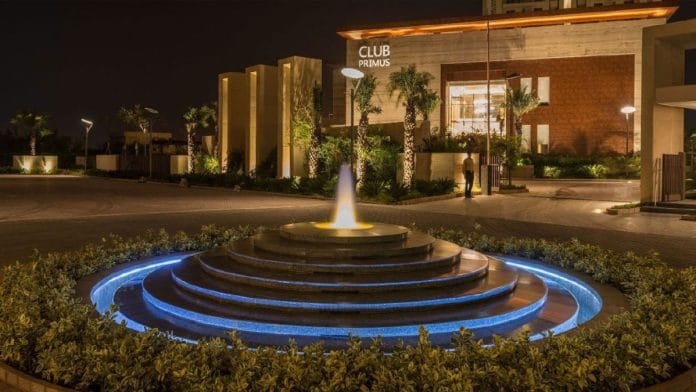



New Delhi: Over 13 years ago, the real estate giant DLF Home Developers launched a massive marketing campaign, projecting its residential group housing project, The Primus, as a premium residential complex. The project came with two 24-metre access roads, banquet facilities, tennis courts, and swimming pools, among other amenities.
More than a decade after launching this campaign to promote the housing complex in Sector 82A, Gurgaon, the Supreme Court directed the Central Bureau of Investigation (CBI) to inquire into complaints from prospective homebuyers.
These homebuyers alerted the court about a huge mismatch between legal requirements and what was transpiring on the ground. Last Wednesday, a bench of Justices Ahsanuddin Amanullah and R. Mahadevan passed an order, acting on a plea filed by a group of prospective homebuyers against DLF. After considering the documents and photos shared by the petitioners, the court directed the Central Bureau of Investigation (CBI) to launch an investigation. The petitioners’ submissions indicated administrative lapses and raised serious suspicions of “collusive approval” and abuse of official position.
However, the court, in its February 25 order, also said that it had not formed a definitive opinion against anyone or any authority.
The case against DLF initially began as a consumer dispute. However, it soon mushroomed into a full-scale dispute that reached the Supreme Court. The buyers purchased the flats when the project was still under construction. Later, they realised that the society was landlocked, surrounded by farmlands on all sides. Although DLF informed the court that the government had to acquire the surrounding farmlands, the government told the court that it had no such policy in place.
In its order, the two-judge bench noted that many people invest their entire life savings into buying one small house or flat of their own, often near the end of their careers or lives, yet they are unable to realise their dreams.
Giving the DLF Group the benefit of the doubt, the court said this could be “only a one-off incident”. However, it still expressed concern over how such instances happen and affect ordinary consumers in the organised real estate sector.
Also Read: ED files charge sheet against Robert Vadra in Shikohpur land deal case
What prompted SC order
Saying that there appeared to be a “huge mismatch” between the requirements under the law and what was actually happening on the ground, the Supreme Court said there were clearly several issues in the representation DLF made to prospective buyers. “These representations may not have been fully translated into reality,” the court noted.
After considering the totality of factors at play in this case, a two-judge bench of the court said it was compelled to take a “very strict view” of the matter and directed Additional Solicitor General S.V. Raju to request CBI Director Praveen Sood to conduct an inquiry into the matter if the agency was willing and if it was possible.
“Gladly, the director, CBI, stated that the CBI would conduct an inquiry, as desired by the court,” the court noted after recording the CBI’s submission. It added that it had explained the broad contours of inquiry in the case to the CBI director. After that, the court ordered that all relevant materials, including photographs and documents, must be shared with the CBI. The central agency was directed to hold a meeting at the director’s office within two days.The court also made it clear that if any person or authority was required to assist the CBI, they had to do so.
“The director, CBI, may constitute an appropriate team specifically for the above purpose. Such a team shall discharge its duties independently, without any fetter, as officers of this court, under the overall supervision and control of the director,” the court said, adding that the findings of the agency’s inquiry and the overall progress had to be placed before the court by 25 April.
Subsequently, the court listed the matter for hearing on 28 April this year. The matter will be taken up after lunch.
Also Read: What makes Gurugram’s Camellias India’s most exclusive pin code? It’s not just about money
What case is about
The origins of the dispute can be traced back to the start of The Primus’s development in Sector 82A, where licenses were given in favour of certain builders for developing the land in 2008 and 2009. The relationship between those entities, Naja Builders and Shiva Buildcon, and the DLF Home Developers was never transparently disclosed, according to the petitioners.
Afterwards, DLF began marketing and executing the project around 2012. At the same time, it began marketing the housing complex as a premium residential complex—replete with pools, tennis courts, and other such facilities, while highlighting the two 24-metre sector roads as a defining feature.
Relying on these promises, several homeowners booked apartments for themselves or their elderly parents. One such homebuyer was Swarnpreet Kaur, who is one of the petitioners in the case. It was in October 2012 that Kaur paid Rs 1,15,93,350, following which an apartment buyer’s agreement was drawn up. It stipulated possession within 42 months or by 28 February 2016.
Despite receiving nearly the entire sale amount upfront, the project was nowhere near completion in February 2016. By October that year, no water connection, electricity, roads, or infrastructure had been completed at the project site, according to the petitioners, who added that DLF, however, obtained a partial occupation certificate. This allowed DLF not to register the project under the Real Estate Act, 2016, the petitioners said, adding that the certificate was challenged before the Punjab and Haryana High Court in 2019.
Nearly a year after the promised time had passed, in 2017, towers remained under construction with scaffolding in place. The prices of the property were also hiked up. However, when the petitioners raised objections about the incomplete infrastructure, no statutory authority took corrective action, they complained.
In June 2017, the homebuyers finally approached the National Consumer Redressal Commission, where it was revealed that the 24-metre road had been constructed by DLF on private agricultural land belonging to farmers. In a nutshell, that is what rendered the project “landlocked”, the petitioners said, adding that the consumer body had also taken note of unfair trade practices.
From the petitioner’s side, Senior advocate Senthil Jagadessan, along with advocates Suriti Chowdhary, Abha Zaidi, Arushi, Tanya Sharma, Manoj Agarwal, Bhumitra Dubey, and Ashish Bainsla, appeared in court.
DLF’s stance
When ThePrint contacted DLF’s legal team, a spokesperson refused to comment on the case, saying it was still pending before the top court. However, the spokesperson explained that the 696 allottees had taken possession of their flats in the New Gurgaon project after receiving their occupation certificates in 2016.
“The present proceedings arise from consumer complaints filed by five allottees—which were adjudicated by the NCDRC—and are presently being challenged before the Supreme Court,” the spokesperson said, adding that the developer has acted in full compliance with applicable laws and regulatory requirements and that it would extend full cooperation in the investigation.
(Edited by Madhurita Goswami)