





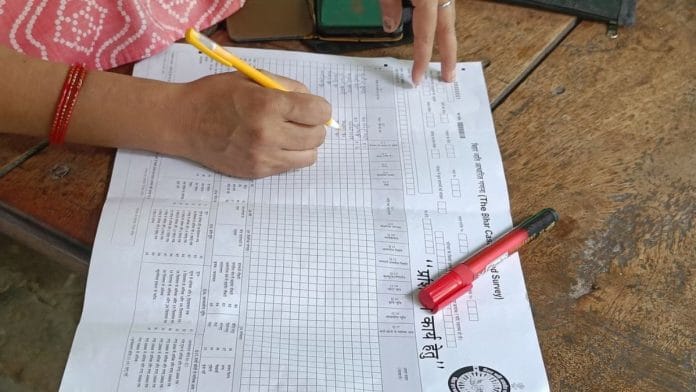



New Delhi: The Supreme Court has found “relevant” a Delhi resident’s suggestion to base the caste enumeration in the upcoming census on verifiable data, rather than just following the proposed self-declaration mechanism. The court asked authorities concerned to look into the issue raised by the petitioner.
Aakash Goel, the petitioner, has said in the petition that only self-declaration to record people’s caste can be hazardous, and the claim should be backed by verifiable data.
A bench of Chief Justice Surya Kant and Justice Joymalya Bagchi “agreed in principle” with the petitioner.
“In principle, we agree with you. Nothing should be included or excluded based upon a certificate, the genuineness of which might be either doubtful or unverified,” the CJI said.
Senior Advocate Mukta Gupta, appearing for the petitioner, clarified her client was not opposed to the caste census, but sought for precautionary measures to avoid incorrect data collection.
She pointed out that the data gathered during this census would become a reference material for the government’s welfare policies, including reservation. Hence, just self-declaration would not be advisable.
“We are not going on the genuineness, but there should be some material. Today, it is only on the self-declaration. A self-declaration without verifying can be very hazardous because anybody would say anything,” she argued, adding such an exercise would affect the sanctity of the enumeration process.
The bench visibly agreed with the petitioner’s concern, but felt the census authorities were the best to decide on the procedure. It, therefore, asked Goel to submit a representation to the authority responsible for carrying out the census.
Though the court did not issue any binding directions on Goel’s petition, it expressed its opinion backing his suggestion in the order.
While disposing of the writ petition, the bench said, “The census exercise is regulated under the Census Act, 1948, and the 1990 Rules framed thereunder which empower the respondents to determine the particulars and manner of census operations. We have no reason to doubt that the respondent authorities with the aid and assistance of the domain experts must have evolved a robust mechanism in order to rule out any mistake as apprehended by the petitioner or several like-minded persons.”
“Nevertheless, we find that the petitioner has flagged some of the relevant issues in the legal notice dated July 9, 2025 addressed to the Registrar General and Census Commissioner of India as well as the Directorate of Census Operations.”
Thus, added the judges, they deem it “appropriate to dispose of this writ petition with a direction to the respondent authorities to consider the suggestions/issues raised by and on behalf of the petitioner in the above-mentioned legal notice”.
The petitioner, if so advised, may forward a copy of the writ petition to the respondent authorities as supplementary representation and that may also be taken into account by the authorities, they said.
“Census exercise is an absolutely specialised exercise by trained minds of vast experience. They know exactly what parameters to be put for the purpose of the census. And the enumeration, it is a question to be left to them to decide,” Justice Bagchi told Gupta.
Also Read: India needs caste census more than Chandrayaan-3. SC verdict on Bihar caste survey shows why
‘Self-declaration’
The CJI appreciated Goel’s efforts to highlight a significant issue.
When he advised the petitioner to let the law take its own course, hinting that in case the authorities proceed without considering his viewpoint, the court can step in, senior counsel Gupta said it would be too late by then. “It will be totally irreversible.”
“This census will be itself costing Rs 13,500 crore, plus the impact on all the welfare policies. That’s the problem. If ultimately, anyone by a self-declaration may give whatever they want, we are not saying verify the certificates, but there should be some material that yes, they belong to this caste. At that stage, they cannot hold an inquiry whether that certificate is genuine or not, but some material should be there,” Gupta told the court.
However, the bench refrained from issuing any effective direction to the executive, and told Gupta that for now it would only “direct the authority to consider the issue”.
As per the petitioner, the Centre’s notifications announcing that Census 2027 shall be conducted in two phases, and the initiation of preparatory and pre-test exercise, do not outline the guidelines, or provide a sample questionnaire, or notified framework in the public domain explaining how caste data is to be recorded, classified, or verified.
Particularly, the petition added, there is no indication of the determining factors by which information furnished by individuals or families identifying themselves as SC, ST, or OBC would be verified or cross-checked.
Such an omission, he said, is significant and once the data is finalised and published upon completion of the fieldwork, any subsequent correction would be practically impossible.
(Edited by Ajeet Tiwari)
Also Read: What’s behind Modi govt’s U-turn on caste census & how it targets Oppn ahead of crucial Bihar polls