





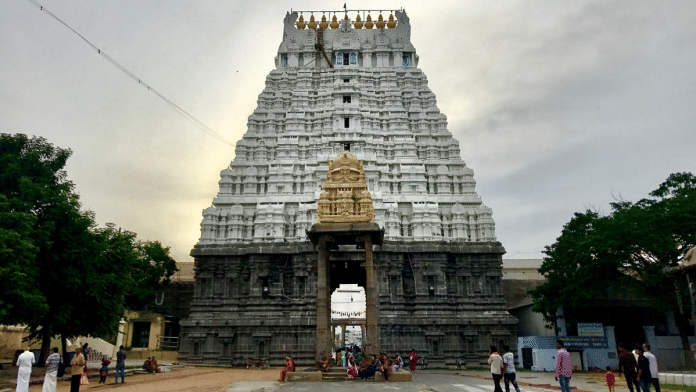



New Delhi: The Thengalai and Vadagalai sects, which follow the teachings of the 11 century Hindu philosopher-saint Ramanuja, have been locked in a dispute for over 200 years over who has the right to pray at the Sri Devaraja Temple in Kancheepuram, Tamil Nadu. The latest round of this sectarian dispute is being fought in the Supreme Court.
On Wednesday, a bench of Chief Justice of India (CJI) Surya Kant and Justice Joymalya Bagchi adopted a unique approach to resolve the differences between the two groups: it referred the conflict for mediation and appointed former Supreme Court judge Justice Sanjay Kishan Kaul as mediator.
“Agar aap in devta ki ek baar nahi do baar puja krenge toh devta khush honge ya naraz honge? (If you offer your prayers twice to the Lord, will the Lord be happy or angry?” Justice Kant remarked as he nudged both parties to amicably settle their differences over which sect should be allowed to conduct services during ceremonial worship in the temple and during the ceremonial procession of the deity inside and outside it.
ThePrint explains the conflict and the history of the litigation between the two sects.
Dispute
The case arises from a dispute between two religious groups—Thengalai (referred to as Southern Cult) and Vadagalai (Northern Cult)—over worship at Sri Devaraja Swamy Temple in Kancheepuram, with Lord Vishnu as its deity.
Though both are Ramanuja followers, they want to invoke their respective spiritual gurus at the time of offering prayers.
Southern Cult members claim they have the right to the Office of Adhiapaka Miras in the temple and, as a result, only their “mantram” in praise of their guru, Sri Manavala Mamunigal, should be recited before the puja and at its conclusion.
On the other hand, the Northern Cult says its members are entitled to recite their “mantram” in praise of their guru, Vedanta Desigan.
The two cults also have their own insignia: the Southern Cult uses a ‘Y’-shaped symbol, the Northern Cult uses a ‘U’-shaped one.
Past decisions by different judicial platforms have repeatedly upheld the Southern Cult’s exclusive right to the prayers.
History of litigation
The litigation between the two groups began in the 18th century. Judicial documents show that the first landmark decision in the highly-contested dispute was delivered by the Madras High Court in 1882.
It arose out of a suit filed by the Southern Cult seeking a declaration of their right to the Adhiapka Mirasi Office. A HC division bench declared that Southern Cult members were entitled to discharge the duties on all occasions. Members of the Northern Cult were specifically injuncted from reciting their ‘mantram’ or ‘prabandhams’.
The conflict was back in the High Court, which in 1915 reiterated the 1882 judgement. It held that from the commencement of the puja till the distribution of the prasadam, Northern Cult members could not recite any mantram of their own.
However, they were allowed to join the Southern Cult as worshippers by reciting the latter’s ‘prabandhams’.
Further, this decision barred Northern Cult members from forming a separate group during the ceremonial procession of the deity within and outside the temple. They were told to join the Southern Cult and repeat what they recited.
The Northern Cult was given minor relief, though with the high court holding that its members could form a separate group and recite the Vedas behind the idol.
Also Read: Hindu temples belong to deities & devotees, not the govt. Himachal Pradesh HC got it right
Front row dispute to pray your way
Twenty-four years later, a single-judge bench of the Madras High Court upheld the Southern Cult’s right to form the front two rows in front of the deity and said that Northern Cult members could only join as ordinary worshippers.
This time, the two sects were back in court with a fresh set of disputes—whether members of the Southern Cult could recite their ‘mantram’ their own way.
This appeal before the HC arose out of a suit filed by Northern Cult members, invoking the provisions of the Madras Hindu Religious and Charitable Endowments Act, 1951. The suit sought a direction to the Deputy Commissioner, a statutory authority under the 1951 law to decide on questions relating to custom and usage in a religious institution.
Upon losing at every stage, the Northern Cult approached the high court, virtually reagitating the same issues that were settled through the previous decisions.
In 1969, a two-judge bench of the Madras High Court once again ruled in favour of the Southern Cult.
Present case
The current petition in the apex court arises from a December 2025 high court verdict, which through a common order decided two petitions filed by the Northern Cult—in 2018 and 2022—as well as a petition filed by the Southern Cult in 2021 and a contempt plea moved in 2020.
Though the prayer in the Northern Cult’s two petitions was similar in nature, their grounds differed.
The 2018 petition sought direction to the officials of the Tamil Nadu Hindu Religious and Charitable Endowment Department to arrange rendition of ‘prabandham’ for their guru.
The 2022 plea challenged a notice by the Executive Trustee of the temple, asking its members to strictly comply with earlier high court decisions. It invoked Articles 25 and 26 (freedom of individual religion & freedom to manage religious affairs) of the Constitution to assert their right to recite their own prayer.
The plea contended that the previous high court rulings were pre-constitutional judgements and that it would be a violation of their fundamental rights if Northern Cult members were not permitted to sing their prayers.
The Southern Cult’s petition, in the latest round of litigation, sought police protection to allow its members to render services during the worship ceremony. Its contempt petition sought action against the Northern Cult for its wilful disobedience of the earlier judgements.
The high court reiterated the findings of the previous decisions, while rejecting the Northern Cult’s argument that the earlier rounds of litigation were between individuals belonging to the two cults.
The high court held otherwise, quoting one of the old decisions that ruled the litigations between the parties were in their representative capacity.
Before the Supreme Court, the Northern Cult has appealed that it is a recognised religious denomination under Article 26 of the Constitution.
According to it, the Thatacharya family of the Northern Cult had administered the temple since the Vijayanagara period and performed various services, including recitation of the 4,000 Divya Prabandham sung in praise of Lord Vishnu and bringing of holy water.
It has referred to a 1711 agreement by which the Southern Cult obtained the right to recite the verses in praise of their guru.
(Edited by Sugita Katyal)
Also Read: Why are South Indian temples larger than ones in North? Answer isn’t ‘Islamic invasions’