





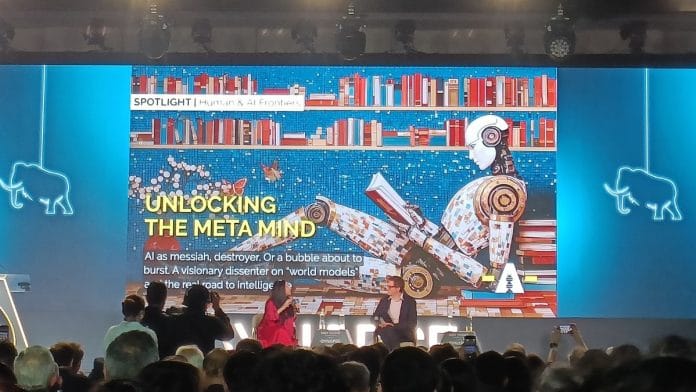



Gurugram: Large language models will never lead to superintelligence, said Yann LeCun, Executive Chairman of AMI Labs, at the Synapse India Conclave. According to him, even the most sophisticated LLMs cannot match the intelligence of a cat.
“LLMs are fundamentally limited in their capabilities. This whole discourse that they will lead to superintelligence is false… We will have superintelligence, no doubt. But not through LLMs,” LeCun added.
Held at Le Méridien Gurgaon from 21 February, the Synapse India Conclave is a two-day conference founded by journalist Shoma Chaudhury. It brings together leaders in science, technology, and society.
“Tell us why you’re not worried about LLMs, when the world over, people are investing and building infrastructure around them,” Chaudhury said to LeCun, who was the former chief AI scientist at Meta.
LeCun clarified that the predictive abilities of LLMs such as ChatGPT, Claude, and Gemini don’t indicate intelligence.
“The only thing LLMs can do—and they’re very good at it—is predict one word after another. They do not have, and cannot develop, intuition or any real human intelligence skills,” he said.
‘Takes time to build intelligence’
Known as one of the godfathers of AI, LeCun has been working in the field of deep learning and programming for over three decades. In 2018, he received the prestigious Turing Award—along with computer scientists Yoshua Bengio and Geoffrey Hinton—for working on deep learning and neural architecture, which is the basis of many innovations, including speech recognition, computer vision, and bioinformatics.
Hinton and Bengio, close friends of LeCun, remain cautious about the powers of LLMs and the “existential threat” they pose. But LeCun dismissed the notion that there can be any real threat from LLMs as they exist now.
“Human intelligence is fundamentally more complex than we see it as,” LeCun said. He mentioned that the total amount of publicly available data that an LLM is trained on is about a few trillion TBs.
“A child that is four years old has gotten the same amount of information from hearing and listening to the world around him, but his information is much more cognitive than an LLM’s can ever be,” he added.
LeCun’s scepticism of LLMs attaining superintelligence is rooted in his years of experience in the field of AI. Over the last few decades, he has seen several AI fads being promoted as “the next big thing” only to taper out soon after. To build something truly intelligent, he said, takes time.
Also read: India’s Silicon Beach: As Bengaluru sputters, a new IT haven in taking shape on Karnataka’s coast
‘World domination is a human desire’
LeCun is currently busy building a new ‘world model’ at AMI Labs. According to him, it will be both more powerful and more controllable than LLMs.
He explained that these models will understand the physical world and its constraints, and move beyond predictive thinking into “real-world, common sense” thinking. While AMI Labs is valued at $3.5 billion, according to a Bloomberg report, it doesn’t allay concerns about the existential threat of superintelligence.
“If we do get superintelligence through future ventures that aren’t LLMs, what are the possibilities of ‘world domination’ by this technology?” Chaudhury asked LeCun.
“We think superintelligence would lead to domination because the only intelligent creatures we know are humans. But the desire for domination in humans doesn’t come from our intelligence but from us being social animals who crave prestige—from our emotions and nature,” LeCun said.
Intelligence doesn’t guarantee a desire for domination in machines, he added.
“Machines will only desire domination if we hardwire it into them. Of course, we won’t do that.”
(Edited by Prasanna Bachchhav)