








In development policy, some problems persist not because they are complex, but because they fall between categories. Uncorrected presbyopia—the age-related loss of near vision—is one such case. It affects hundreds of millions of working adults, undermines productivity and income, and is easy to diagnose and correct. Yet it rarely features in serious debates about public or philanthropic priorities.
This is not accidental. Governments and donors operate under scarcity. Health systems face competing demands—from maternal mortality to non-communicable diseases. Philanthropy must choose between education, nutrition, climate resilience, and a growing list of urgent causes. In such an environment, any intervention must clear a high bar: scale, cost-effectiveness, feasibility, and the ability to sustain itself beyond subsidies.
Presbyopia correction does so more convincingly than most.
Globally, an estimated 800 million adults need near-vision correction, the vast majority in low- and middle-income countries. The condition typically emerges in the late 30s or early 40s—precisely when individuals are at peak economic participation. Multiple randomised trials and field assessments indicate productivity gains of 20–30 per cent in vision-intensive occupations following the provision of reading glasses. These gains rank among the largest immediate productivity improvements observed in simple health interventions. Analyses published in the Bulletin of the World Health Organization estimate a social return on investment of up to 36:1 for refractive error correction—comparable to the highest-performing global health interventions, such as childhood immunisation.
The technical solution is straightforward. At roughly a dollar a pair at scale, presbyopia correction sits among the cheapest productivity-enhancing interventions available to public systems. Affordability, in isolation, is not the issue. The binding constraint is distribution. Traditional eye-care systems—clinic-based, professional-heavy and urban-centric—impose high opportunity costs on dispersed rural populations. They require daily-wage earners to trade income for a diagnosis of a condition they often do not perceive as “medical”.
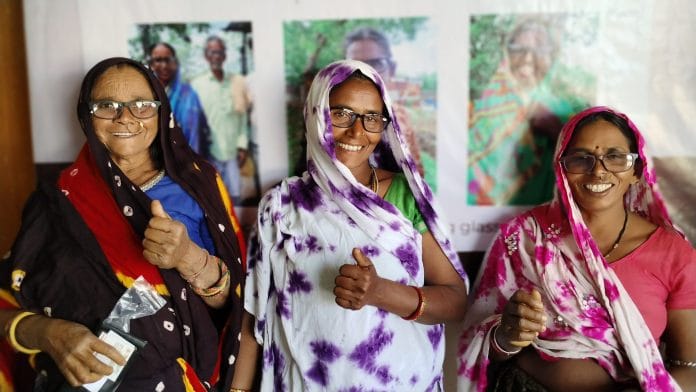
This is where a shift in delivery model becomes critical. By training community workers and village-level entrepreneurs to screen for near-vision impairment, services are taken to where people live. These workers operate on trust, convenience, and proximity—attributes formal health systems struggle to replicate at scale. In contexts such as India, reading glasses are already de-medicalised and widely available over the counter. Yet public health protocols often continue to require a doctor’s prescription for subsidised provision, limiting activation through community workers and necessitating modest protocol adaptations to scale last-mile delivery. Integrating with existing networks—such as community health and childcare workers and self-help groups—strengthens reach while positioning presbyopia correction as a gateway to broader health engagement.
The model is not without critics. One concern is that screening only for presbyopia risks neglecting other eye conditions. Another is substitution: that individuals might abandon clinic-based care if given reading glasses. These objections are understandable, but they misread the counterfactual.
Presbyopia correction has no known health downside. If someone has cataract or severe myopia, those conditions remain unchanged whether or not presbyopia is corrected. In practice, most people with such conditions are already not accessing care. There is scant evidence that providing simple reading glasses causes harm to eye health or reduces the likelihood that people seek care for other conditions; where broader eye care is not accessed, the binding constraints are typically awareness, cost and access—factors that predate and persist irrespective of presbyopia correction. Implementation experience on the ground suggests that many people prefer to receive glasses immediately rather than visit clinics that entail lost wages, travel costs and uncertainty. For households that are as time-poor as they are cash-poor, convenience is a binding constraint, not a behavioural anomaly.
The more relevant question, however, is one of prioritisation. When resources are scarce, why should governments or philanthropies invest here rather than elsewhere?
The answer lies in leverage. Presbyopia correction improves productivity without new infrastructure, raises incomes without recurrent transfers, and supports ageing workforces. It avoids the trap of recurrent fiscal liability while bolstering workforce participation in demographic-shift economies such as India’s. Once distribution channels exist, market-based provision follows naturally—fostering entrepreneurship in underserved areas.
This is where public and philanthropic capital plays a catalytic, not permanent, role. Funding is most valuable upstream—training community workers and establishing supply chains. Once demand is activated, dependence on donor or government funding diminishes. Glasses are purchased, not gifted. Entrepreneurs earn. Systems sustain themselves.
We write this drawing on experience from both sides of the policy divide: decades spent designing public programmes, and years working on last-mile delivery. That combined perspective makes one thing clear. In a world of finite attention and money, the case for presbyopia correction is not that it is the most dramatic problem, but that it is one of the most solvable.
Development policy often aspires to be comprehensive. In practice, progress comes from sequencing: tackling the largest, simplest gaps first. Near-vision correction fits that logic. It is a rare intervention that is cheap, scalable, dignifying, and capable of sustaining itself once initial barriers are removed. In a crowded field of priorities, that is not a marginal advantage. It is a decisive one.
By: Mukhmeet Singh Bhatia (IAS), Former Secretary, Govt. of India and Amit Gupta, COO, The/Nudge Institute
At charcha 2025, India’s largest collaborative convening, a multitude of industry experts and partners converged to explore various topics. With 40+ sessions spanning across 6 immersive, livelihood-intersecting themes, supported by 30+ sector-leading co-hosts, charcha convened to collaborate towards the shared goal of Viksit and Inclusive Bharat by 2047.
charcha 2025, an initiative by the*spark forum, was held at India Habitat Centre, New Delhi, from November 12–14, 2025. To know more, visit: charcha25.thespark.org.in
ThePrint was official media partner for charcha 2025
Also read: charcha 2025 is building India’s next infrastructure: the capacity to work together