





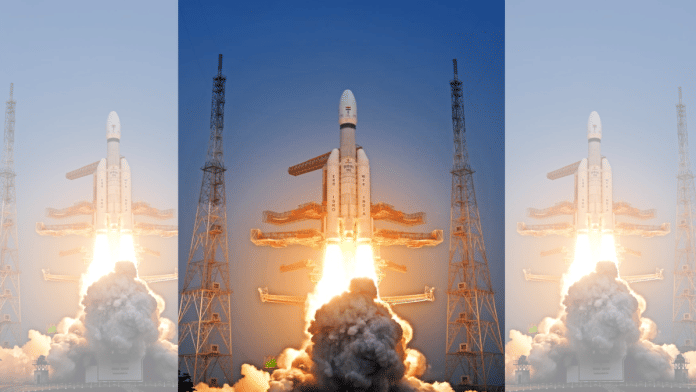



New Delhi: The Indian Space Research Organisation (ISRO) successfully launched the BlueBird Block-2 satellite Wednesday, the largest commercial communications satellite to be placed in the Low-Earth Orbit (LEO).
This is the first ‘next-generation’ Bluebird satellite produced by the United States-based private company AST Spacemobile, and was launched using ISRO’s launch services, marking a key step in India-US space relations.
The launch took place at 8:55 am from the Satish Dhawan Space Centre in Sriharikota, Andhra Pradesh, marking an important milestone for ISRO’s Launch Vehicle Mark-3 (LVM-3). It successfully carried the heaviest payload yet to the LEO—weighing a whopping 6,100 kg. The LEO is at a distance of around 2,000 km from Earth, where most commercial satellites are placed.
ISRO Chairman V. Narayanan said that it was “the heaviest satellite ever lifted from Indian soil using an Indian launcher”. He added that the launch today “further improves our confidence for the (upcoming) Gaganyaan programme”.
This was also the ninth consecutive successful launch by the LVM-3 vehicle, adding to its potential and calibre for both commercial and heavy launches. The LVM is also the designated vehicle for the human spaceflight Gaganyaan Mission.
“With LVM3 demonstrating reliable heavy-lift performance, we are strengthening the foundations for future missions such as Gaganyaan,” read PM Narendra Modi’s post on X after the launch. “(We are) expanding commercial launch services and deepening global partnerships.”
BlueBird Block-2 satellite
The BlueBird Block-2 satellite is part of a global constellation of communication satellites in LEO. It is aimed at providing ‘direct-to-mobile’ connectivity through satellites, bypassing cell towers and increasing accessibility for consumers, making it the ‘next-generation’ satellite that is designed for direct cellular communications. The satellites will enable both 4G and 5G connections, internet, calls, texts and all streaming data globally.
Launched by ISRO Wednesday, it is the first of many large satellites that will be launched to form an ‘array’ in space bycreating a large network. According to the Texas-based satellite company, 45-60 more satellites will be launched by the end of 2026. The AST website reads that the end goal is to have a satellite array spreading across 2400 ft.
Also Read: India will soon have its own satellites to monitor spy satellites. How the technology works
The launch
The launch was possible because of an agreement between ISRO’s commercial arm, NewSpace India Limited (NSIL) and AST SpaceMobile. This was also the third commercial mission completed by the LVM-3 rocket.
“BlueBird 6 is going to be the largest ever communications array deployed in the LEO commercially,” said Scott Wisniewski, President of AST SpaceMobile, in a video before the launch. “It is a big step for the company, but also for connectivity globally.”
The launch was completed on the LVM-3 vehicle, which was designed and deployed by ISRO in 2014. As a heavy-duty launch vehicle that stands at over 142 feet in height, the LVM-3 has been a part of significant ISRO launches, including Chandrayaan-2 and Chandrayaan-3. It is also scheduled to launch the Gaganyaan Mission in 2027.
Previously, LVM-3 had also launched satellites for the private company OneWeb, a global satellite provider. Those satellites, too, were launched into the LEO.
For ISRO, the mission is an indicator of increasing private and commercial partnerships, both national and international. The LVM-3’s success has a major role to play in this, since it enables ISRO to carry heavy commercial satellites up to 8000 kgs into the LEO and 4000 kgs to Geosynchronous Transfer Orbit (GTO).
(Edited by Insha Jalil Waziri)
Also Read: Three Hyderabad start-ups are conquering the new frontier in space race — Low Earth Orbit