





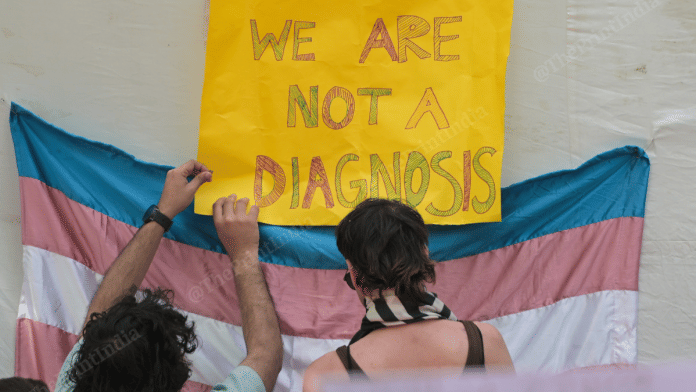



New Delhi: With the contested transgender bill receiving presidential assent last month, the UN Human Rights joined the chorus of international condemnation, warning that the amendments risk “setting back hard-won rights of transgender people” by replacing self-identification with mandatory medical verification.
India, it said in a post on X, “has been a pioneer for rights of transgender and gender-diverse people” and that the Act would have “far-reaching impacts on the right to privacy” and risk the “marginalisation of transgender people.”
The UN body also flagged the “fast passage of Transgender Persons (Protection of Rights) Amendment Bill, 2026, without adequate stakeholder consultation”.
Union Minister Virendra Kumar had introduced the bill in the Lok Sabha on 13 March. Less than two weeks later, both houses of Parliament cleared it, despite drawing widespread criticism. President Droupadi Murmu then gave her assent on 30 March.
The bill was introduced without dialogue, including with statutory bodies like the National Council for Transgender Persons. A Supreme Court-appointed expert committee on transgender rights led by Justice (retd) Asha Menon had explicitly asked the government to withdraw the bill and engage in meaningful consultation with transgender communities.
Earlier, Amnesty International had come out saying that the presidential assent to the 2026 bill, “is a serious setback for human rights in India.”
Though Human Rights Watch had not issued an official statement, its associate director of Asia Division, Jayshree Bajoria, had earlier made a similar observation. “India’s parliament passed a bill this week that changes how transgender people are legally recognized and removes their right to self-identification. If the bill becomes law, it will be a major reversal of the hard-won rights of transgender people in India,” she said.
What the law changes
The 2019 Act that provided for the rights and welfare of transgender persons, was itself Parliament’s legislative response to a landmark moment in Indian judicial history: the Supreme Court’s 2014 ruling in NALSA v. Union of India, which held that gender identity is self-perceived, that medical procedures cannot be a precondition for legal recognition, and that transgender persons have a right to a certificate of identity based on self-declaration.
What the 2026 version does is dismantles that framework. It deletes the statutory right to self-perceived gender identity and replaces the earlier broad definition of transgender person with a narrow list of socio-cultural identities and medicalised categories. Trans men, genderqueer and trans women outside the named socio-cultural categories have effectively vanished from the definition.
The new law replaces self-identification with a system where identity must be verified by a medical board and thereafter recognised by the District Magistrate. It also removes the separate definition of intersex persons, grouping them with transgender persons and blurring the distinction between sex characteristics and gender identity.
It also introduces new criminal provisions. It penalises compelling, forcing, or alluring a person or a child to outwardly present as transgender, with penalties extending up to life imprisonment.
After the Rajya Sabha passed the bill on 25 March, National Council for Transgender Persons (NTCP) members Rituparna Neog and Kalki Subramaniam resigned from their posts, citing the amendment as “a step backward for our fundamental rights to self-identification and dignity.” More than 140 lawyers, law students, feminists, and social activists had earlier appealed to the President to withhold assent.
The Rajasthan High Court, in observations made during the period, noted that what was recognised by the Supreme Court as “an inviolable aspect of personhood” now risks being reduced to “a contingent, state-mediated entitlement.”
Inside Parliament, TMC’s MP Saket Gokhale cited data showing that 31 percent of transgender people in India have attempted suicide because of discrimination they face. Opposition members from the Congress, the Aam Aadmi Party, the Communist Party of India (Marxist) and others questioned both the substance of the legislation and the urgency with which it was pushed through. CPI(M)’s John Brittas called it “a black-letter day” that was “taking India a century back.”
India’s last census recorded 4,87,803 transgender persons, but so far only about 32,500 have identity cards, according to government data which are essential for accessing social security measures.
(Edited by Tony Rai)
Also Read: Transgender amendment bill drops self-perceived identity, adds penalties for coerced identity change