





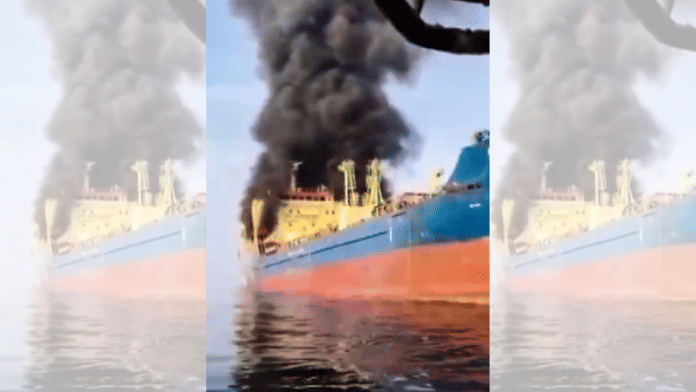



New Delhi: At least three Indians were killed in Iranian strikes on vessels in waters off Oman, and 20 others were injured as the war in West Asia widened in scale and scope.
The Indian Embassy in Oman Monday confirmed that a citizen was killed on board MKD Vyom, which was attacked by an unmanned boat off the coast of Muscat. Two Indians on another merchant vessel, MV Skylight, died in strikes, government sources told ThePrint.
“The Embassy of India expresses its deepest condolences on the tragic demise of an Indian national on board MKD Vyom. The Embassy is in close coordination with the local authorities in Oman to facilitate the safe and early repatriation of our nationals on board the vessel,” the Indian Embassy in Oman said in a statement on X.
Sources said another Indian citizen was critical, and on ventilator support in Oman. The deaths and injuries were from Iranian strikes across the Gulf, they said.
Tehran’s attacks come in retaliation for strikes launched by the US and Israel on 28 February that killed Iran’s Supreme Leader Ayatollah Ali Khamenei. US President Donald Trump Monday said that Washington would continue to attack Iran for as long as it took to curtail its threat to the region.
Fighting expanded to Lebanon this week, as Tehran-backed Hezbollah launched strikes at Israel in support for Iran. Early Tuesday morning, Israel carried out strikes in Southern Beirut.
Iran has so far targeted the United Arab Emirates, Bahrain, Qatar, Oman and Saudi Arabia–all Gulf nations that host American military bases. The US has confirmed that six Americans have been killed in the war so far.
More than 550 people have been killed in Iran since the attacks by the US and Israel began last Saturday, the Iranian Red Crescent had said. Apart from Khamenei, a number of senior Iranian leaders and commanders, including the head of the Islamic Revolutionary Guard Corps Mohammad Pakpour, have been targeted and killed by US-Israel.
US Secretary of Defence Pete Hegseth Monday laid out the goals of the war–to destroy Iran’s military and naval capabilities and ensure it does not produce a nuclear weapon. But, days before, Israel and the US called on the Iranian people to overthrow the clerical regime, and said that they support a change in administration in Tehran.
India has urged dialogue and diplomacy to de-escalate the situation. Prime Minister Narendra Modi Monday spoke with Israeli Prime Minister Benjamin Netanyahu and called for “early cessation of hostilities”.
There are an estimated 9 million Indians living across Gulf nations, including around 10,000 in Iran.
Modi also spoke with Bahrain’s King Hamad bin Isa Al Khalifa, Crown Prince of Saudi Arabia Mohammed bin Salman and the King of Jordan Abdullah II, besides UAE President Sheikh Mohamed bin Zayed Al Nahyan earlier. External Affairs Minister S. Jaishankar, too, spoke with his counterparts in Israel, Iran, Saudi Arabia and the UAE.
Iran has taken a defiant stand, with the country’s head of National Security Council Ali Larijani denying reports that the country was seeking to negotiate an end to the conflict. Larijani criticised Trump for having “delusional fantasies” and blamed the American President for engulfing the region in war.
The US President’s actions have faced pushback domestically. A number of Democratic leaders exited a classified briefing this week and said that US administration officials have “more questions” than answers over their military operation in West Asia.
The end goal of the war remains murky, with the US Secretary of State Marco Runio passing the onus of the strikes on Israel by saying that Washington joined in the 28 February-attack as part of its strategy to pre-emptively defend American troops in the region. Rubio said that Israel was preparing for an attack on Iran, and the US joined in, knowing that Tehran’s retaliation would take aim at American military installations in the region.
The war, crucially, has led to a spike in oil prices, as Iran vowed to close the Strait of Hormuz, which accounts for roughly a fifth of the world’s total oil and gas supplies. Separately, global air travel has taken a hit due to closure of airspace across the Gulf.
Also Read: Iran’s dictatorship deserved universal condemnation—but US-Israel strikes not reliable cure