








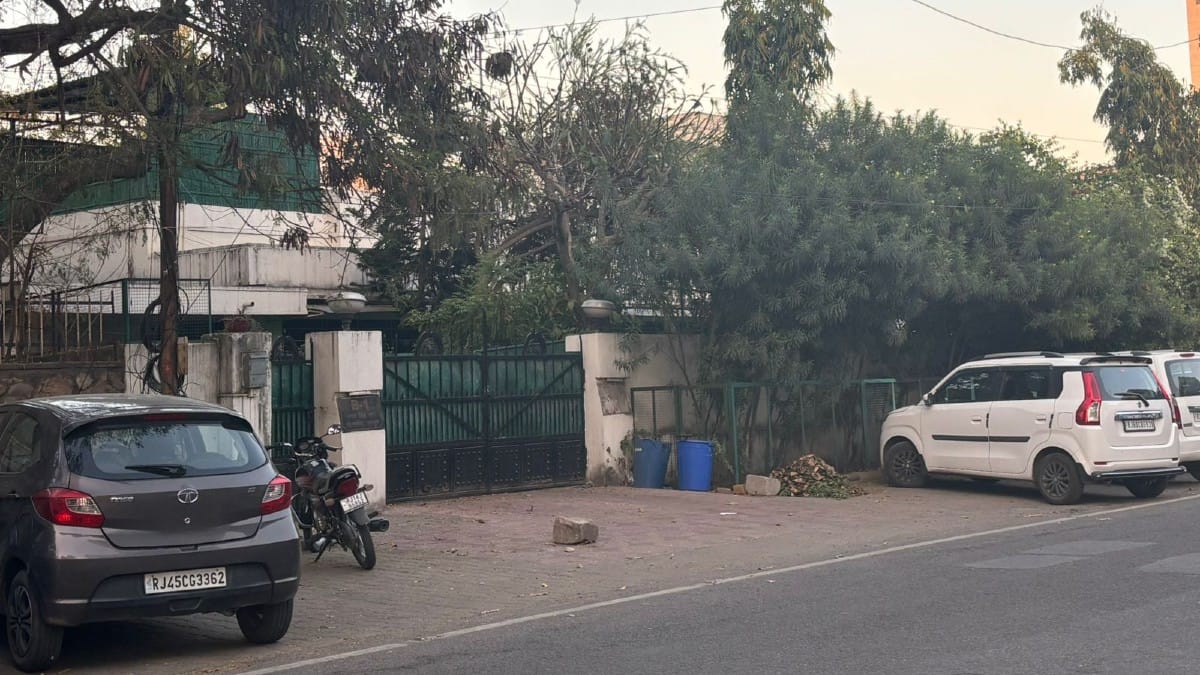
Jaipur: The white-and-green bungalow in the heart of Jaipur’s upscale C-Scheme neighbourhood is on the main road, yet out of sight. There is no nameplate. Guarded along its perimeter by trees, it’s seen better days; the paintwork is peeling off in places.
The only regular visitor is a gardener who tends daily to the garden. “Na madam ji rehti hain. Na sir ji (neither madam nor sir live here),” he said, a little confused.
The ‘madam ji’ he refers to is Indian Revenue Service (IRS) officer Rolee Agarwal, and the ‘sir ji’ is now-retired Indian Administrative Service (IAS) officer Subodh Agarwal—the former additional chief secretary (ACS) who is now the subject of a manhunt, stemming from his alleged role in the Rs 960-crore scam involving the Jal Jeevan Mission (JJM).
Subodh Agarwal has been posted in nearly every major department of the Rajasthan government, from energy to mines to industries. Since 17 February, however, the Rajasthan Anti-Corruption Bureau (ACB) has been telling a very different story. His phone was last seen active on 16 February, at around 9 pm. He has been untraceable since.
On 13 March, the ACB court issued a non-bailable arrest warrant against him. More than 40 different teams have raided over 100 locations across 21 cities in search of Agarwal.
JJM was meant to be a lifeline for India. Launched by Prime Minister Narendra Modi in 2019, it aimed to bring water to every rural household in India. In a few states, including Rajasthan, however, it became a headline and a matter of investigation.
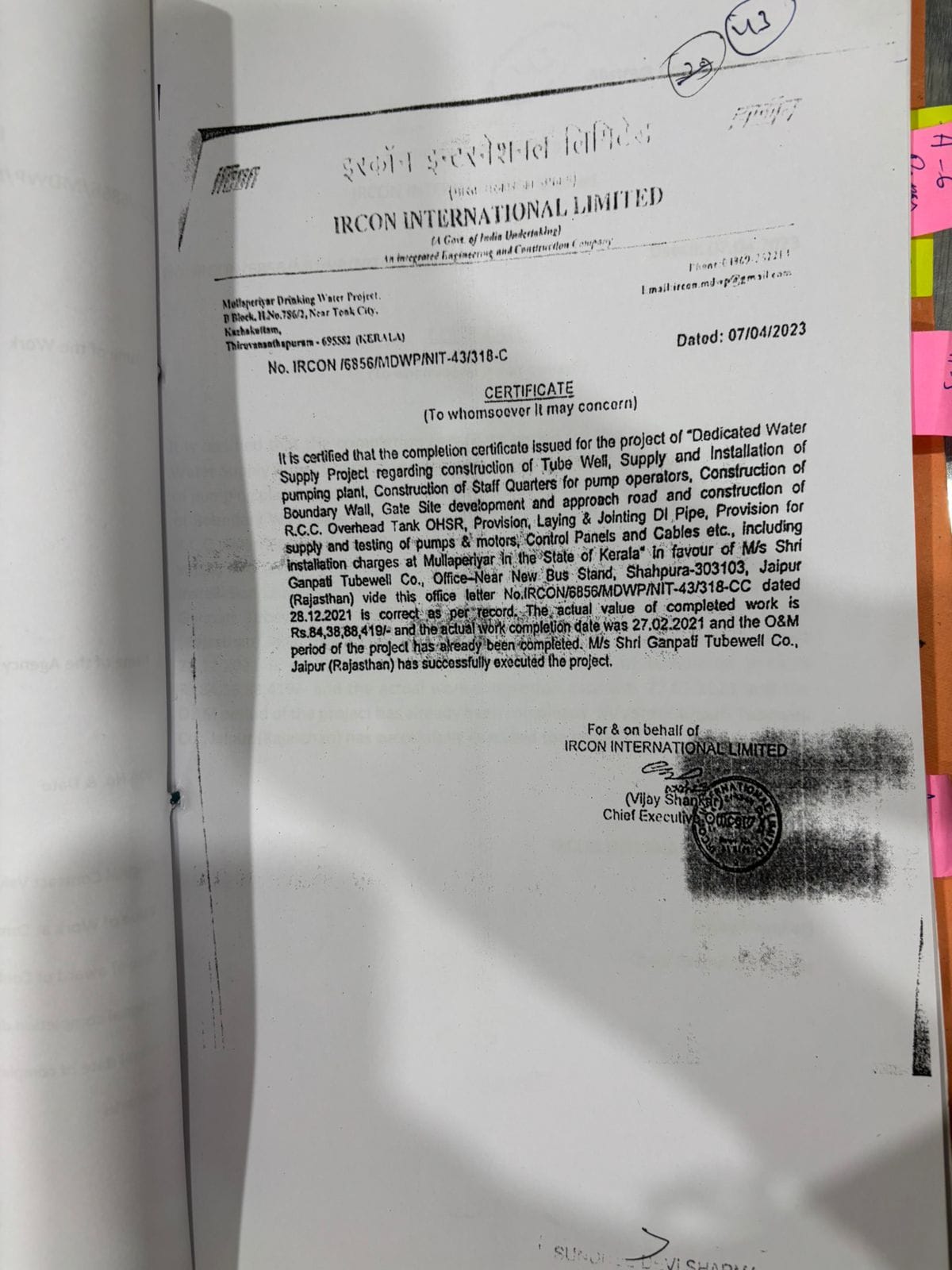
The core of the scam is simple: two private firms—M/s Shri Ganpati Tubewell Company and M/s Shree Shyam Tubewell Company—allegedly used fake documents to acquire government contracts. They submitted forged “completion certificates” from Ircon, a central government company, to prove they were qualified for the work. Investigations by the ACB, Enforcement Directorate (ED) and Central Bureau of Investigation (CBI) revealed that Ircon never issued these certificates. Even the names on the official certificates were fictitious. Despite these, the firms were awarded tenders for pipelines, pumps, and household taps across Jhunjhunu, Alwar, Jaipur and beyond, from 2021 to 2023.
Cost to taxpayers? All of Rs 960 crore.
What began as a local complaint into forged experience certificates has turned into one of the most talked about corruption probes in Rajasthan, pulling the CBI, ED and ACB into a multi-state manhunt. Four First Information Reports (FIRs) have been registered by the ACB, Rajasthan Police and one by the CBI. The investigation has revealed how JJM became a conduit for middlemen and government officials who allegedly charged commissions.
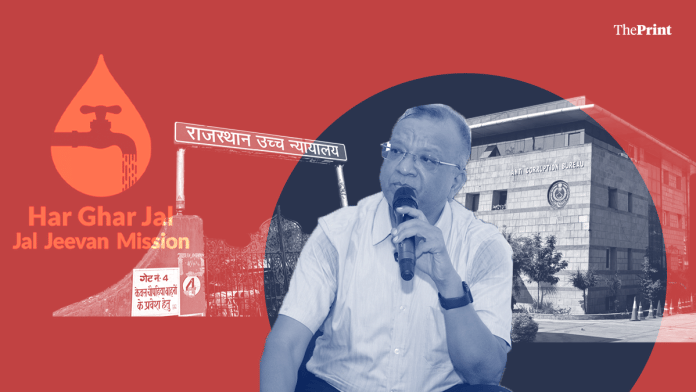
From Rajasthan’s Secretariat to the hallways of Rajasthan High Court, ThePrint traces the origins of the case that has put Congress leader and former state minister Mahesh Joshi, a now-retired top bureaucrat, and several private individuals in the dock.
Certificates of deceit
At the centre of the web were two men: Mahesh Mittal, businessman and owner of Ganpati Tubewell, and Padamchand Jain, businessman and owner of Shree Shyam Tubewell.
A PHED tender is a formal invite issued by the Public Health Engineering Department to private contractors or firms for public work related to water supply and sanitation. In Rajasthan, the PHED is the agency responsible for implementing JJM work. To win PHED tenders, either for laying pipelines, digging tubewells or constructing water tanks, these firms needed to show experience. They didn’t have it.
Instead, they used a “consultant”, Devendra Singh Rathore, to file their bids. Shri Ganpati Tubewell filed 68 tenders, while Shree Shyam Tubewell filed 169 tenders using the same forged documents, ACB’s FIR has revealed. Meanwhile, CBI’s investigation revealed, through Rathore, Mittal filed 66 tenders, and Jain 146 tenders.
Indian Railway Construction International Ltd, or Ircon, a public sector undertaking under the Ministry of Railways, was never a participant in the fraud. Instead, its identity was used to forge the experience certificates for unqualified contractors. In a PHED tender, a firm must prove it has successfully completed similar large-scale projects. To bypass this, the accused in the particular case used Ircon’s name and fabricated these certificates.
The warnings were loud and clear. In March 2023, Jaipur-based lawyer Mahesh Kumar Kalwania, who has also filed a complaint, sent three legal notices to the department, explicitly pointing out the discrepancies in these applications. Lawyer T.N. Sharma also informed the department that forged certificates were being used. As did Ircon, telling Agarwal that such certificates were being issued.
“Kind attn: Subodh Agarwal,” a letter from Ircon’s Vigilance Department, dated 7 June, 2023 said, adding: “A complaint has been received regarding use of fake completion certificates on Ircon’s letter head to participate in various bids of PHED, Govt of Rajasthan by M/s Shree Shyam Tubewell Co., Shahpur, Jaipur and Shri Ganapati Tubewell Co., Shahpur, Jaipur. The said certificates on Ircon’s letter head are fake and fabricated.
“You are requested to provide the information with regard to the action taken on the fake & fabricated certificates which were used as stated by the complaint in the bid process related to PHED, Govt. of Rajasthan.”
What did Agarwal do? Very little, alleges the ACB.
One of the accused in the case is Vishal Saxena, an executive engineer.
“Vishal Saxena in his statement under Section 50 of PMLA, 2002 has stated that he was asked to give a positive verification report for the certificate submitted by the firm M/s. Shri Ganpati Tubewell Company by Ramesh Chand Meena, Subodh Agarwal and others,” the ACB has alleged in one of its FIRs.
The first FIR in August 2023 named a roster of engineers and contractors. It was only in December 2025 that the Rajasthan government granted a Section 17A sanction, a mandatory legal nod to probe senior officials, allowing the ACB to move in on Subodh Agarwal and others. Another FIR on the alleged irregularities was registered by the JJM Department in October. Then the CBI registered a case in May 2024.
Another case was registered by the ACB in April 2024, the “mega FIR” of the scam.
‘Mega FIR’ and ‘big fish’
By the time the ACB decided to file a second FIR in connection with the forged certificates, the scam had become household news in Rajasthan and across India.
This time, however, the FIR, named Mahesh Joshi, Rajasthan PHED minister from the Congress government of Ashok Gehlot, with 21 others. In the FIR, the ACB claims the modus operandi followed a clever three-step process.
First, the two contractors used forged Ircon experience certificates and created fake Gmail accounts to impersonate officials during tender verification.
Second, accused officials ensured these bids were “responsive” by handpicking compliant engineers to submit false, positive verification reports, ignoring formal, legal notices and deleting official warning emails from Ircon to destroy the paper trail.
“Being a Central company and as per Central government rules, gmail.com domain cannot be used for emails by any such company,” the ACB’s investigation said.
“Even spelling of LOA is written as LoA, that too from a Central government company. Thus, fake email ID at gmail is generated just to revert any verification query from department,” the investigation revealed. “The bidder fulfills the criteria as per the bid document and is declared responsive,” ACB officials said in the FIR.
Finally, a standardised bribery system was established where 4 percent upfront commission on tender value was allegedly split equally between the ministers, private syndicate and the top bureaucracy.
“Further, in the tenders Padamchand Jain and Mahesh Mittal had paid 4 percent of the tender amount upfront as bribe to both ACS, PHED and Sanjay Badaya, for Mahesh Joshi, Minister, PHED, (and) 2 percent each of the tender value in cases where the tender value is less than the Notice Inviting Tender (NIT) cost, a lumpsum amount is paid to the ACS, PHED which in the case of said firms was 0.40 to 1 per cent,” ACB alleged in the FIR.
Joshi and Agarwal were alleged by the ACB to have headed the committee that cleared the fraudulent tenders. Then there was the middleman—Sanjay Badaya, a private individual who allegedly acted as the minister’s liaison to manage staff transfers and bribe collections.
The facilitators involved senior engineers like R.K. Meena and Dinesh Goyal, alongside Vishal Saxena who admitted to providing false reports under pressure and Arun Srivastava, ACE, who provided false positive verification reports, according to the FIR. There were beneficiaries too—Mahesh Mittal and Padamchand Jain—supported by Mukesh Pathak, an insider from Ircon who physically fabricated the forged documents.
And there were financial controllers: Sushil Sharma, financial advisor, and Niril Kumar, chief engineer, who were instrumental in clearing technical and financial bids despite the forgery.
But the investigation wasn’t in the hands of just the ACB now. The CBI and ED got involved to probe the alleged irregularities and the money laundering. Now, there were agencies, officers, multiple FIRs, names, lawyers, judges, courtrooms, and arrests.
In May 2024, the CBI registered an FIR and booked executive engineer of Rajasthan’s Public Health Engineering Department Vishal Saxena and proprietors Padamchand Jain and Mahesh Mittal for alleged criminal conspiracy, forgery and cheating, among other charges.
The CBI action came after an eight-month preliminary enquiry launched in August 2023.
Also Read: Plumber, mason, mechanic—new roles for rural women under Modi govt’s Jal Jeevan Mission
The ‘missing’ bureaucrat
It all began in 2024, with the ACB unearthing the “administrative seal” of approval. While the federal agencies were busy tracing the money, it was the ACB’s deep dive into the department’s files to look at finance committee records that led them to Agarwal.
The pursuit of former Additional Chief Secretary Subodh Agarwal has transformed the JJM investigation into a high-stakes legal drama in the corridors of Rajasthan High Court, the Secretariat, and the Jal Jeevan Bhawan.
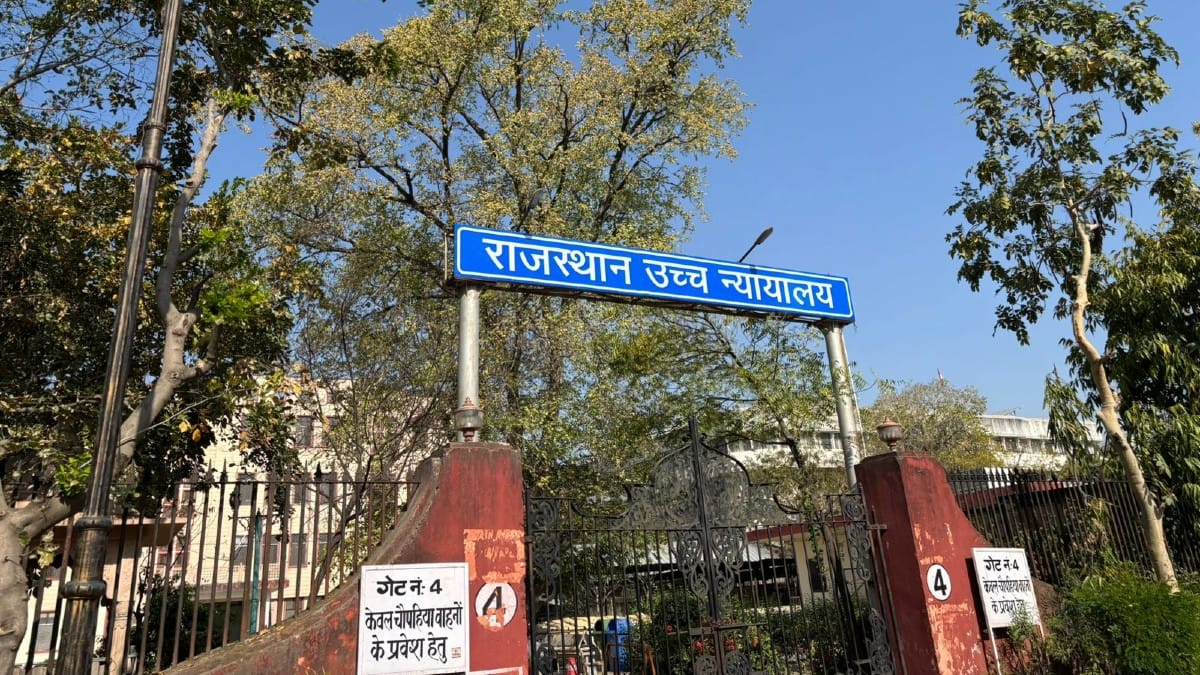
Since 17 February 2026, the ACB has deployed more than 40 specialised teams in a massive dragnet spanning a hundred locations across 21 cities, including Delhi, Mumbai, and Noida, ranging from the elite enclaves like Malabar Hills in Mumbai and New Moti Bagh in Delhi to farmhouses in Sohna and hideouts in Noida. The ACB has alleged that Agarwal ignored explicit legal warnings and whistleblower notices to facilitate the massive fraud.
“It has been observed that Subodh Agarwal had made no efforts to get all the aspects highlighted in the legal notices verified. Further, no efforts were made to get all other work experience certificates submitted by these firms verified even when the legal notices had clearly mentioned that both the firms had used around four to five certificates to secure tenders under PHED,” the ACB says in its FIR.
The ACB has issued a Look-Out Circular for Agarwal. A senior ACB official said, “Searches were conducted at over 100 locations in a total of 21 cities including Jaipur, Udaipur, Barmer, Jodhpur, Jhalawar, Kota, Nagaur, Virat Nagar, Niwai Tonk, Chandwaji Amer, Gaganpur City, New Delhi, Chandigarh, Faridabad and Sohna in Haryana, Noida, Meerut, Prayagraj, Bulandshahr, Khurja in UP, Mumbai and surrounding areas, etc.”
The main places among these hideouts are the accused’s own residence, New Moti Bagh Colony, Defence Colony and hotels in New Delhi, flat located in Sector-39 in Faridabad, residences of family members and friends in Noida, a farmhouse in Sohna, residences of relatives located in Malabar Hill and Juhu in Mumbai, their own residences located in C-Scheme, Nirman Nagar, Bajaj Nagar Extension in Jaipur, Man House in Sundar Nagar Jaipur, farmhouses located in Siwad Jaipur, Bagru, Bindayaka around Jaipur, etc., he said.
So far, about 50 people have been interrogated, including Agarwal’s close relatives, friends, servants, drivers and people who provided him shelter, he added.
“Four persons who helped in Delhi, Mumbai, Noida, Faridabad, Meerut, Gaurav Agarwal, cousin brother of Subodh Agarwal from Mumbai, Saurabh Agarwal, cousin of Subodh Agarwal from Faridabad, Sameer Agarwal, cousin brother of Mrs Rolee Agarwal from Meerut and Pranav Chandra, close friend and businessman from Noida were brought and interrogated in connection with the search of the accused,” he said.
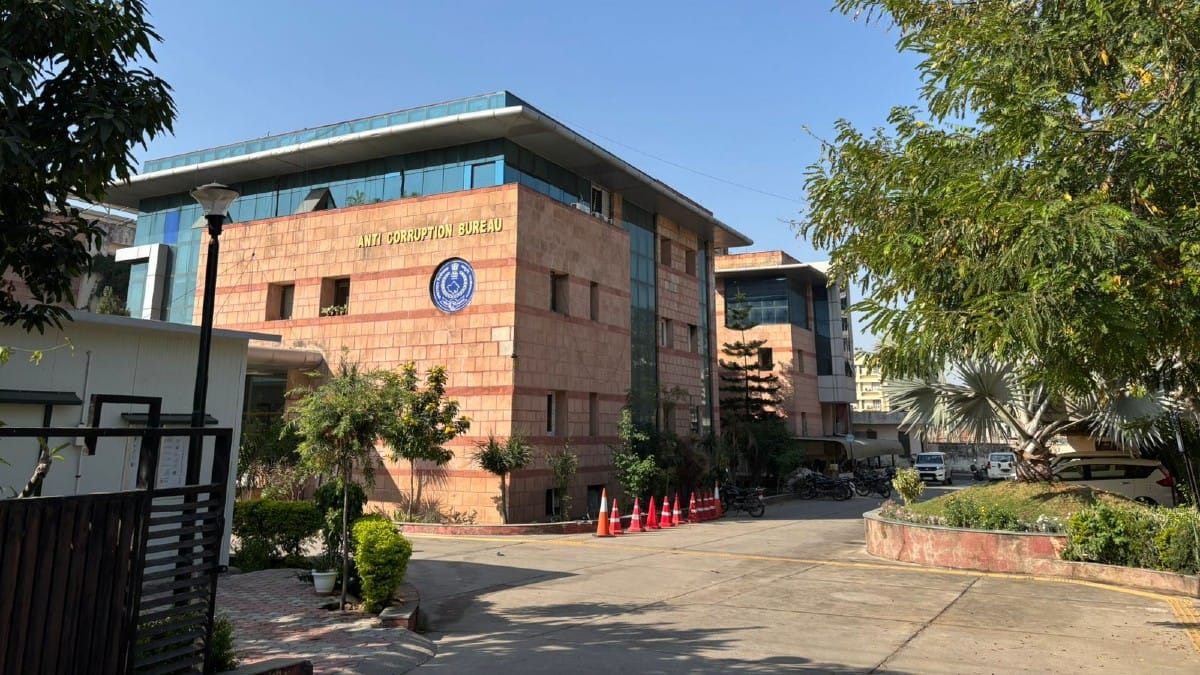
ACB officials say, Agarwal, on the other hand, has launched a bold counter-strike in the Rajasthan High Court seeking to quash the FIR he has been named in. The move came last month, with Agarwal, through his counsel, alleging “selective targeting”.
His primary argument is that as the additional chief secretary, he acted in “good faith”, reviewing financial bids only after they were technically cleared by the Bid Evaluation Committee. Agarwal contends that he was legally entitled to rely on the “positive verification” provided by senior engineers who physically inspected the Ircon certificates.
To distance himself from the criminal conspiracy, Aggarwal highlighted his own corrective actions, noting the ultimate blacklisting of the firms, stoppage of all payments, and suspension of the tainted executive engineer once forgery was confirmed in August 2023.
“A complaint dated 11.08.2023 was also preferred by the Chief Engineer against the accused firms in Police Station Bajaj Nagar for registration of FIR. That Accused Firm M/s Ganpati Tubewell Company and M/s Shayam Tubewell were blacklisted by the PHED Department dated 14.08.2023 and 18.08.2023 respectively,” Subodh’s counsel argued.
Adding, “Bare perusal of the aforesaid facts and circumstances unequivocally demonstrates that the Petitioner had no role, involvement or complicity whatsoever in the crime committed by the accused firms. The material placed on record fails to disclose any act, omission or conduct attributable to the petitioner that could, even prima facie, establish culpability or connivance. In the absence of any direct or indirect evidence linking the petitioner to the alleged offences, the continuation of proceedings against the petitioner is wholly untenable in law and facts.”
Agarwal shifts the blame further. “It is pertinent to mention here that more than 95 percent of the work order given to the accused firms were approved by the Finance Committee headed by previous ACS, PHED, Sudhansh Pant and not by the petitioner,” the counsel claims in Agarwal’s petition.
“No payment towards work orders were approved during the tenure of the petitioner. Hence, there has been no loss to the public exchequer as a direct or indirect result of the conduct of the petitioner. Hence, the FIR is liable to be quashed on this ground alone,” it says.
He argues that the ACB’s decision to “whimsically exonerate” previous leadership while targeting him demonstrates a “pick and choose” policy and “malafide intent.” He challenges the legality of the FIR, labelling it “abuse of process” because of the same facts for an already ordered investigation in a 2023 case.
By framing the allegations as mere “discrepancies in disposal of official duty” rather than “meeting of minds”, Agarwal has attempted to convince the Rajasthan High Court that the criminal proceedings are baseless overreach. “The FIR is conspicuously silent with respect to any specific role, overt act, or meeting of minds attributable to the Petitioner,” the counsel said. An ACB source said arrest warrants have been issued by ACB Court No. 1 against accused Subodh Agarwal, Jitendra Sharma, Sanjeev Gupta and Mukesh Goyal.
“In compliance with court orders, the ACB is continuously making tireless efforts to arrest the accused in this case. Raids are being conducted at various potential locations to ensure the arrest of the accused,” the source said.
If the arrest warrant issued by the court is not executed, then action will be taken to issue orders from the court to confiscate the property of the accused.
Fake emails, fake certificates and a Kochi trip
While ACB had been investigating the case initially, the CBI on 3 May 2024 registered a case to investigate the matter pertaining to cheating and forgery. It suspected offences pertaining to criminal conspiracy, forgery, cheating, public servant framing an incorrect document with intent to cause injury, personating a public servant, punishment for cheating by personation.
On 30 October, ACB registered a case to focus on corruption and administrative misconduct, including senior PHED officials, minister Mahesh Joshi and IAS officer Subodh Agarwal.
The CBI investigation has unmasked multiple levels of coordination between public servants and contractors, revealing that a high-stakes “official verification trip” to Kerala was planned.
At this point, Vishal Saxena becomes an interesting character in the entire conspiracy. In April 2023, PHED executive engineer Saxena was sent to Kerala to physically verify the Ircon certificates. The CBI discovered that the “inspection” was a complete sham.
A day before Saxena arrived, the contractors—Mittal and Gupta—and alleged forger Mukesh Pathak reached Kochi, and checked into Hotel Woodlark, the CBI claims in its chargesheet.
Mittal avoided using his ID at the hotel, staying in Sanjeev Gupta’s room to conceal his presence. He also left his own mobile phones in Jaipur, using an employee’s SIM to avoid GPS tracking.
“Investigation revealed that Mahesh Mittal, Vishal Saxena, Mukesh Pathak and Sanjeev Gupta conspired together to project Mukesh Pathak as Vijay Shankar, Chief Executive officer, Ircon, during their stay in Kattappana, Kerala. In furtherance of conspiracy, Vishal Saxena projected Mukesh Pathak as Vijay Shankar, Chief Executive Officer, IRCON International Limited, in his report and used random pictures of various pumphouses and water tanks as the work done in relation to certification IRCON/6856/MDWP/NIT-43/318-CC,” the chargesheet states.
The CBI claimed that the investigation revealed that “Vishal Saxena, deliberately prepared a false verification report. In order to deceive PHED Rajasthan, he knowingly and dishonestly projected Mukesh Pathak and other local persons as officials of IRCON International Limited in his report.”
Of commissions, cash bribes and extortion
On the face of it, the JJM scam probe has uncovered that certain private individuals had “more power” than departmental heads. Sanjay Badaya was one such person.
According to the ED’s chargesheet and statements recorded under section 50 of the PMLA, Badaya acted as the “middleman” and “trusted associate” of then minister Mahesh Joshi.
Badaya had his role cut out. Statements of contractors Mahesh Mittal and Padamchand Jain have revealed an environment of absolute administrative capture. Mittal explicitly said that “any contractor who wanted to get his work done in PHED had to approach Badaya”.
“Both Sanjay Badaya and Mahesh Joshi took commissions on tender values; if any contractor refused to pay them, they would use their influence on PHED employees to harass the contractors and make it difficult for them to work in the PHED; they took the bribe in cash,” Mittal told the ED, as per the chargesheet.
Meanwhile, Padamchand Jain has told the ED that Mahesh Joshi had given Badaya ‘complete immunity’ within the PHED department, and Joshi allegedly benefited from this arrangement by receiving bribes.
Senior ACB officials said that Badaya is a trusted associate of Mahesh Joshi, who not only supervised the management of PHED staff but also controlled their transfers, initiated vigilance inquiries, and made them APOs through Joshi. “Badaya was neither working with PHED nor had any official association with PHED,” one official said.
The ED arrested Joshi in April 2024. Denying bail to Joshi, the Rajasthan High Court noted: “It (case) illustrates that the petitioner (Mahesh Joshi), in a position of power and responsibility, has not upheld the integrity and trust that are vital for someone in a high-ranking governmental role responsible for the diligent execution of public duties.
“The criminal misconduct attributed to the petitioner represents a grave breach of duty that is both disconcerting and intolerable in the public sphere.”
Joshi secured bail from the Supreme Court later.
The former minister maintains that there was “no negligence” on his part.
“We have fought the legal battle for some years now. And I will prove my innocence,” Joshi told ThePrint. “I will live up to the trust placed in me by the people of Jaipur and Rajasthan.”
Also Read: MP district Burhanpur declared itself 100% Har Ghar Jal. But that’s just a start
Magnitude of the scams
M/s Shri Ganpati Tubewell Company and M/s Shree Shyam Tubewell Company have become a prominent name in Rajasthan after 2023. But, the magnitude of the JJM scam isn’t limited to these two companies.
It involved a systemic subversion of the The Rajasthan Transparency Public Procurement Act, 2012, where officials allegedly manipulated bidding rules to award contracts worth approximately Rs 1,000 crore. According to an FIR registered in January, 2026, M/s Bhoorathnomn Construction secured five major projects in Bhilwara, Nagaur, Sikar by concealing Rs 187.33 crore in incomplete work through false affidavits.
The collusion centres on chief engineer Dinesh Goyal and ACE M.P. Soni who allegedly pressured subordinates to sanitise records. Within 24 hours, a factual report was rewritten to remove mentions of incomplete work, creating a default into favourable qualifications.
“The water supply department is already facing significant notoriety nationwide due to numerous cases of false and forged work experience certificates and fraudulent bidding capacity claims,” the ACB claims in the FIR.
To capture the full magnitude of the JJM investigation, it is important to look beyond the initial arrest to the “criminal nexus” currently being challenged in court.
Jaipur based lawyer T.N. Sharma, a key whistleblower who collaborated with Agriculture Minister Kirodi Lal Meena to expose the scam, has filed a Public Interest Litigation (PIL) and multiple complaints, alleging that fraud extends far deeper than current FIRs suggest.
In one of his complaints, Sharma says that a significant portion of the recent allegations centres on M/s Om Infra Limited, which handled projects in Nokha and Khajuwala areas. Sharma alleges embezzlement of Rs 22 crore through “earthwork” irregularities. “The MO was simple. The firm laid multiple pipelines within a single trench, but billed the department for separate trenches for each individual pipe,” Sharma told ThePrint.
He said M/s GA Infra Ltd and SSG also submitted fraudulent experience certificates, much like the instances involving Shyam Tubewell and Ganpati Tubewell. “No action has been taken against the companies involved in the fraudulent activities,” he added.
ThePrint has reached Ganpati Tubewell owner Mahesh Mittal, and Shyam Tubewell owner Padamchand Jain via call and email for a comment. This report will be updated when a response is received.
JJM irregularities
The government is not just laying pipes anymore; it is now focusing on making sure they actually work. The Union Cabinet approved Jal Jeevan Mission 2.0 last week, with a massive budget of Rs 8.69 lakh crore. The goal is to reach every rural home by December 2028.
To prevent scams like the one in Rajasthan, a new digital system called Sujalam Bharat will map every pipe from the water source to the tap. Villages will now have to certify that the water is actually flowing before they are declared ‘Har Ghar Jal’. This utility-based approach aims to turn water supply into a reliable service rather than just a constructive project.
In a Lok Sabha reply on 18 December 2025, Union Minister C.R. Patil confirmed a nationwide crackdown on Jal Jeevan Mission irregularities. Across 32 states, action has been taken against 621 officials, 969 contractors and 153 inspection agencies for financial fraud and poor work quality.
Gujarat reported a loss of Rs 120.65 crore to the taxpayer, leading to the debarment of 112 agencies and nine arrests. Despite these breaches, the mission has scaled from 16.7 percent coverage in 2019 to 81.41 percent as of late 2025. It has provided tap water to 15.67 crore households through mandatory third party audits and geotagging.
Rajasthan in the net
In a Lok Sabha response on 27 March 2025, the Ministry of Jal Shakti reported that Rajasthan has significantly expanded its rural water network under the Jal Jeevan Mission though it remains a focal point for corruption enquiries.
Since 2019, the state has increased its tap water coverage from a mere 10.84 percent to 55.95 per cent, providing connections to over 60.29 lakh rural households.
Districts like Dudu and Shahpura lead the state with 96 percent coverage, while Barmer lags behind at just 19.02 percent.
The state government formally acknowledged receiving multiple complaints of bribery and corruption, affirming that it is now “closely monitoring” the mission to ensure transparency.
“After the scam was reported, many officials went underground, became inactive, and many were feared. This impacted the drinking water schemes in Rajasthan. They were paralysed, because all the money went into corruption,” Rajasthan Agriculture Minister Kirodi Lal Meena told ThePrint.
Even in the Jal Jeevan Mission department, a lot has changed over the years. Officials either at the top, or bottom, don’t discuss the scam. “What if our name gets dragged in?” says one, laughing.
For the Jal Jeevan department, the process has changed. “The Rajasthan Transparency in Public Procurement Act is implemented thoroughly,” said a senior official at the Jal Jeevan Mission department on condition of anonymity.
He added that the staff has become more aware and sensitive, down the line. “Earlier, the complaint was disregarded. Now, it is seen more sensibly.”
With Sujalam IT being built, the official said, whatever scheme has been made, how much infrastructure has been installed, everything will be kept a note of, technologically.
“Rajasthan is in the top three best performing states,” he added. “The big challenge is not to create infrastructure; but it is how to manage the infrastructure. For that, we are bringing an Operation and Maintenance Policy. If the pipe breaks, where will it come from? Who will see the work? We are working on ensuring officials sitting for every six to seven clusters, who will give technical guidance and support.”
The official said that Enterprise Resource Planning is a software that will monitor it, and data will be checked without manual interference at the state level. “There has been a stigma due to the scam. But, it’s not that work has not been done. Water has reached 60 lakh homes…”
(Edited by Nardeep Singh Dahiya)