








For the second time in a decade, discord at India’s richest conglomerate is going public. If boardroom squabbles reach the courtroom once again, or the government gets involved, Tata Sons’ control over its operational units, worth more than $300 billion, could fray.
The most logical way to end this risky drama at the 158-year-old group, central to what I call India’s “national team,” is to take its holding company public.
The majority shareholder’s resistance to a listing is rooted in a long-running family feud. Two-thirds of Tata Sons Pvt. is owned by philanthropic trusts, an arrangement that grants them immense say over the group’s multi-billion-dollar dividends. This structure has long been defended as a safeguard for the group’s broader social purpose, but it is now being tested by modern regulatory demands.
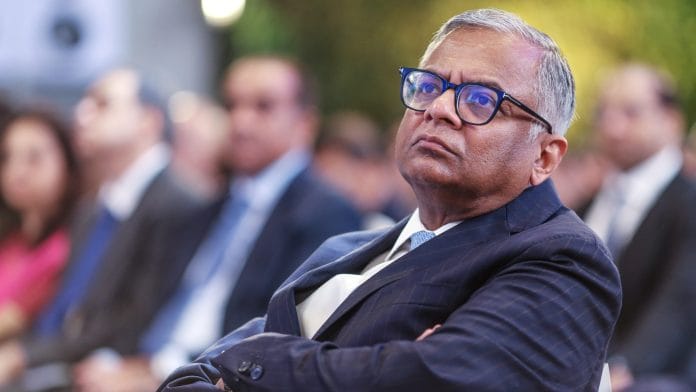
The empire’s stewardship came under doubt once more when a Feb. 24 board meeting of Tata Sons ended without approving a third term for Chairman Natarajan Chandrasekaran. Noel Tata, representing the largest shareholder, pressed Chandra — as he’s widely known — with tough questions. Most critically, Noel sought assurances that the closely held firm could avoid a public listing, Bloomberg News reported, citing people familiar with the matter.
Chalk up the apprehension to list to the block of equity that sits outside the Trusts’ sway. This 18.4% stake, acquired by the Mistry family of the Shapoorji Pallonji Group between 1965 and 1995, remains the primary source of friction between the two Parsidynasties. There are deep ties between them through marriage and decades of cooperation. Noel, who became chairman of the Trusts after the death of his half-brother Ratan Tata, is married into the Mistry family.
Still, the SP Group failed to convince India’s Supreme Court in 2021 that it was an oppressed junior partner in the larger conglomerate. That legal battle followed Ratan Tata’s 2016 ouster of Cyrus Mistry, his successor as group chairman. It shattered the reputation for cohesive leadership that had defined the group in the first decade of the millennium when other Indian tycoons — like Dhirubhai Ambani’s sons — fought bitterly for control. Though both Ratan Tata and Cyrus Mistry have since passed away, the dispute over this illiquid 18.4% stake survives them.
Tata Sons has refused to buy out the Mistry family or swap their holdings for shares in liquid entities like Tata Consultancy Services Ltd., India’s largest outsourcing firm and the group’s cash cow. The Trusts maintain that Tata Sons shares aren’t freely transferable. But the liquidity-strapped SP Group has pledged them to raise expensive debt. It has very publicly demanded an IPO.
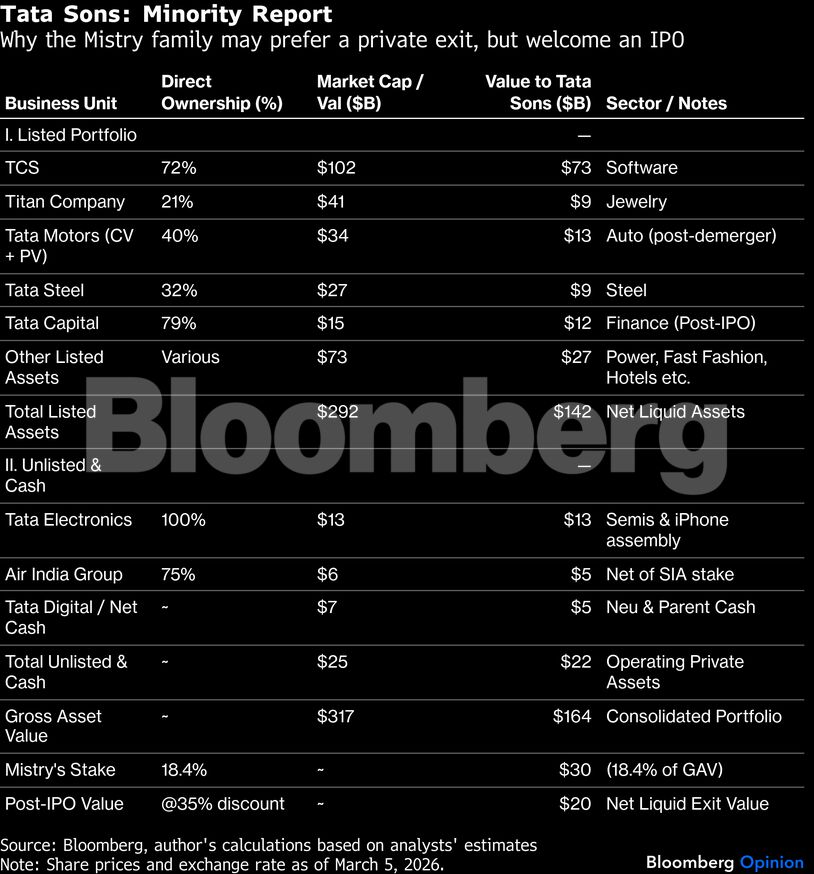
The Trusts aren’t closed to the idea of giving SP an exit. But they’re opposed to a listing because of the inevitability of a holding-company discount — the entity will trade below the sum of its parts. There may also be an unstated motivation: Allowing public shareholders a seat at the table would pry open the trustees’ absolute grip over Bombay House, the conglomerate’s nerve center in Mumbai, India’s financial capital.
But the current structure has become untenable. The Trustees aren’t a united front; in fact, their infighting led to a much-publicized meeting with Home Minister Amit Shah, the No. 2 in the Modi government, in October. As the power struggle intensifies, politicians’ involvement can only increase. The consequences for the operational units may be unpredictable.
Chandra, the first leader in the group’s history from outside the Tata-Mistry clans, has placed some high-stakes bets. It could spook bondholders that his continuance is no longer a certainty just as those gambles — like a multi-billion dollar semiconductor foray in Gujarat, Prime Minister Narendra Modi’s home state — reach a critical, capital-intensive juncture. The group, hit hard by last year’s Jaguar Land Rover cyberattack, is about to conclude a debt-fueled takeover of an Italian commercial-vehicles firm. Chandra is also navigating a slow-burning e-commerce play at home, and an even slower integration of a struggling Air India. The former state-owned carrier’s turnaround has been hampered by the June 2025 crash of a Boeing 787 Dreamliner in Ahmedabad. A prolonged conflict in the Middle East would further complicate a recovery.
As a director on the Tata Sons board, Noel Tata is entitled to question any or all of these capital commitments. However, Chandra can’t guarantee that the holding company will stay private. Under the Reserve Bank of India’s rules for so-called “upper layer” nonbank financial firms, Tata Sons was mandated to list by September last year. While the firm has retired its debt and sought a waiver, the central bank’s final verdict is pending.
With a crucial debt refinance coming up just as ongoing hostilities in the Persian Gulf tighten credit markets, the SP Group will want closure. Depending on whether they have to wait for an IPO or get a private exit, the Mistry family’s stake could be worth anywhere between $20 billion and $30 billion. Beyond the financial stakes, a prolonged fracture risks damaging the Tata brand’s reputation for ethical, public-spirited conduct, transforming a symbol of national pride — from salt and steel to chips and code, and from tea and trucks to iPhones and AI — into a cautionary tale of dynastic fragility.
This report is auto-generated from Bloomberg news service. ThePrint holds no responsibility for its content.