








Hyderabad: As part of policy reforms aimed at tackling the state’s declining fertility rate, the Andhra Pradesh government Thursday proposed a slew of measures, including Rs 25,000 in assistance for those who choose to have more than one child.
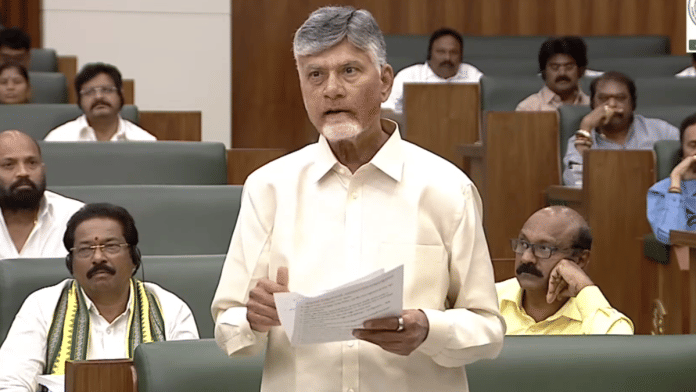
Chief Minister N. Chandrababu Naidu tabled the Draft Population Management Policy in the assembly, outlining the initiatives, also including subsidised In-Vitro Fertilisation (IVF) services and a five-stage life cycle approach to population management.
For ease of implementation, the government plans a Matrutva Centre of Excellence under the public-private-partnership model which would offer counselling services to women and facilitate deliveries at cheaper costs.
Naidu also said the policy proposes parental leave for mothers and fathers and Poshan–Shiksha–Suraksha package to ensure nutrition, education and protection for every child.
A strong and youthful population is the foundation of long-term prosperity. Andhra Pradesh will introduce India’s first-of-its-kind Population Management Policy, shifting the focus from population control to population care. With fertility declining sharply, we must act now to… pic.twitter.com/EJg4TWcoVh
— N Chandrababu Naidu (@ncbn) March 5, 2026
The policy also spells out stringent measures to reduce the teenage pregnancy rate in the state from the current 8.8 percent to 3 percent, the CM said.
Also Read: India’s delimitation debate needs bigger ideas, not just bigger numbers. Here are the options
Delimitation concern
Introducing the policy, the chief minister said that besides falling fertility rates, an ageing population and the prospect of reduced parliamentary representation for southern states in a population-proportionate delimitation exercise are major concerns.
Addressing the assembly, Naidu called the policy intervention a “game changer” to address the issue of falling fertility rate and its impact on the state’s economic wellbeing.
“Currently, approximately 58 percent of families, or three lakh families have only one child, around 2.17 lakh families have two children, and nearly 62 lakh families have three or more children.” the chief minister said.
While the chief minister did not reference the data source, he stated that Andhra Pradesh’s total fertility rate (TFR) was 1.5 against the country’s average TFR of 2.1.
He called for urgent intervention, stating that many Indian states could soon mimic Japan, South Korea, and Italy, with states such as Andhra Pradesh and Karnataka reporting a fall in fertility rates.
“Earlier, population (growth) was seen as a major problem, and before 2004 we incentivised family planning. We even brought a law disqualifying those with more than two children from contesting local body elections. However, today, there’s a need to amend the law to allow those with more than two children to contest,” he said.
“A nation is not just about its land, regions, towns or borders, it is about its people.”
While Andhra Pradesh, Telangana, Karnataka, Kerala, and Tamil Nadu’s TFR hovers around the 1.5 to 1.8, Bihar has a TFR of 3 and Uttar Pradesh stands at 2.4, according to the Ministry of Health and Family Welfare.
Citing the importance of maintaining a critical demographic balance, Naidu reiterated his stance which he first made public last July about parents having more children.
Leaders across political parties in southern India have argued for long that the delimitation process suggested by the Centre would pose a challenge to southern states that have been successful in controlling population growth.
However, this is the first time that the TDPc chief, a BJP ally, has made reference to falling population rates potentially having an adverse impact on parliamentary representation for southern states.
The draft policy was placed before the assembly and the public and the government asked for suggestions of experts in a month before announcing the final framework.
(Edited by Ajeet Tiwari)
Also Read: India’s fertility rate plunged in last 70 yrs, population to shrink further by 2050 — Lancet study