





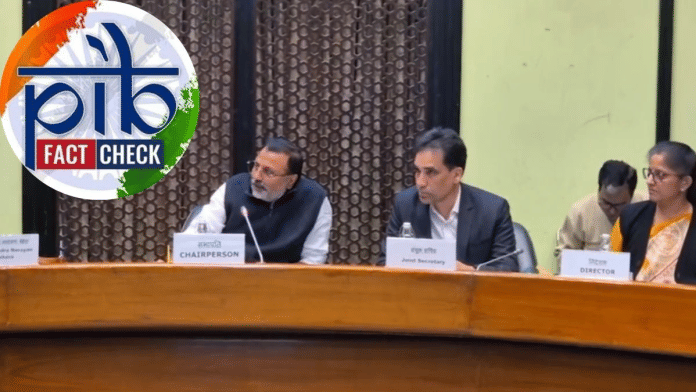



New Delhi: A parliamentary standing committee has flagged gaps in the regulation of online media and OTT platforms, calling for the expansion of the Press Information Bureau-led fact-checking system, even as the government’s proposed fact-check unit remains under judicial review.
In its report tabled Tuesday on the Ministry of Information and Broadcasting’s demand for grant, the committee, led by BJP leader Nishikant Dubey, noted that the Fact Check Unit (FCU) under PIB, set up in 2019, continues to function as the government’s primary mechanism to counter misinformation related to its policies and programmes.
At the same time, the Standing Committee on Communications and Information Technology pointed out that a separate central fact-check unit envisaged under the Information Technology Rules 2021 remains under judicial review. The PIB is the government’s nodal agency for disseminating information on government policies and initiatives.
The ministry, in its deposition, acknowledged a “regulatory gap” in dealing with online media and OTT platforms, stating that efforts are underway to develop broader regulatory measures. The committee underlined the need to address this gap through a more structured and coordinated framework.
The legal uncertainty stems from the Bombay High Court’s 2024 ruling striking down the 2023 amendments to the 2021 IT Rules that allowed the government to notify a fact-check unit empowered to flag “fake or misleading” content about itself.
The Centre has challenged the ruling in the Supreme Court, which is currently hearing the matter, without staying the High Court order. As a result, the proposed central FCU is not operational.
In the interim, the PIB’s internal fact-check unit has assumed greater significance. According to the ministry, the unit receives complaints from the public through WhatsApp, email, social media platforms and the PIB website, and issues clarifications or rebuttals.
Content flagged by the unit is taken up with intermediaries for action under Rule 3(1)(b) of the IT Rules.
Also Read: Govt can now remove ‘fake news’, but how will it do it? PIB’s Fact Check Unit gives a clue
The Op Sindoor reference
The committee noted that during Operation Sindoor, the PIB-FCU functioned round the clock and blocked around 1,400 URLs linked to fake news, edited videos and misinformation. The panel cited this as an example of the scale at which misinformation is being addressed, but also flagged the need for greater institutional capacity.
Budget figures placed before the panel show a steady increase in allocations to the PIB, rising to Rs 129.75 crore at the Budget Estimate stage for 2026-27, compared to Rs 115.09 crore in 2025-26. However, utilisation has been uneven, with actual expenditure in 2025-26 at Rs 93.35 crore, or about 81 percent of the initial estimate.
The ministry also informed the committee that action against online content violating norms and regulations is being taken under existing legal provisions, including Section 79 of the IT Act, which allows withdrawal of safe harbour protection for intermediaries, as well as provisions under the Bharatiya Nyaya Sanhita and the Indecent Representation of Women Act.
It said that 25 OTT platforms were blocked over the past year, followed by another 18 platforms, with more currently under examination. Blocking orders, the ministry said, are being issued on a continuing basis against platforms and content circulating online.
Despite these measures, both the ministry and the committee acknowledged that the current regulatory framework remains fragmented, particularly in relation to grievance redressal and oversight of OTT content.
The committee recommended a set of measures to strengthen the PIB fact-checking system and address regulatory gaps. These include expanding public outreach to improve awareness about the fact-check unit, deploying artificial intelligence tools for real-time monitoring of misinformation trends, and increasing staffing with a focus on regional language capabilities.
It also called for the publication of quarterly transparency reports detailing misinformation flagged and action taken, and for the setting of quantifiable targets for the unit’s operations in the next financial year.
More broadly, the panel recommended the formulation of a comprehensive regulatory framework for online media and OTT platforms, along with a structured grievance redressal mechanism integrating provisions of the IT Act with existing civil remedies such as defamation and compensation.
(Edited by Ajeet Tiwari)
Also Read: Social media intermediaries should remove content deemed as ‘fake’ by PIB, says Centre