





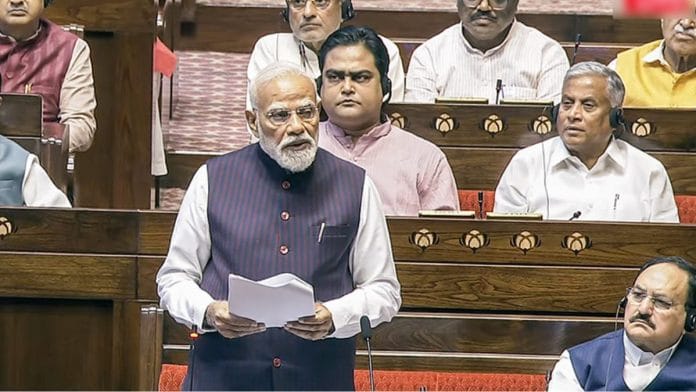



New Delhi: Addressing the Rajya Sabha Tuesday, Prime Minister Narendra Modi spoke of the country’s preparedness amidst the global energy crisis amid the ongoing conflict in West Asia.
“The war in West Asia has been going on for over three weeks now. The war has created a serious energy crisis in the entire world. For India as well, the situation is worrisome. The war is impacting our trade routes. It is impacting the routine supply of essentials like petrol, diesel, gas and fertilisers,” the PM said.
He added that the government has constituted seven new empowered groups to evolve strategies on subjects, such as supply chain, petrol, diesel, fertiliser, gas and inflation.
His remarks in the Upper House come a day after he addressed the Lok Sabha to say India “must be prepared to face the long-term impact” of the war in West Asia.
On Tuesday, Modi warned that if the global situation created by this war persists for a long time, it will certainly have “serious consequences”. Therefore, India is accelerating the efforts it has made over the past years to increase its resilience, he asserted.
He declared that the “fundamentals of our economy are strong”, and that the government is working strategicially for the short-term, medium-term and long-term impact on the country.
He said that several decisions have been taken in the past 11 years to ensure that the country can deal with such a crisis. For instance, he referred to the diversification of energy imports, with an increase in import partners from 27 to 41 countries, covering crude oil, LPG and PNG.
In the past decade, India has also prioritised crude oil reserves for such a time of crisis, he further said, adding that Indian oil companies keep substantial stocks of petrol and diesel for such situations. Additionally, he said that in the past 11 years, 53 lakh MT strategic petroleum reserves have been developed, and the work on 65 lakh MT additional capacity is underway.
“I wish to assure this House and the nation that India possesses adequate crude oil storage and robust arrangements for continuous and uninterrupted supply,” he remarked. The government has been promoting PNG to replace LPG and that there have been large-scale efforts to increase domestic LPG production, he added. “Greater self-reliance across every critical sector is the only path forward, and major steps are being taken on each of these fronts.”
Also Read: India ‘must prepare to face long-term impact’ of West Asia war, conditions will be difficult: Modi
‘3.75 lakh Indians returned safely’
In his address, PM Modi also pointed out that over 1 crore Indians work in Gulf countries, and that the security of their lives and livelihoods is a major concern for India. He also said that several ships, with Indian crew members, are stranded in the Strait of Hormuz.
Reiterating that the safety of Indians across the world is a top priority for the government, he said that 3.75 lakh Indians have safely returned to India since the war began. Over 1,000 Indians have returned from Iran, he said, of which over 700 were medical students.
The prime minister told the House that all countries have accorded full assurance of the safety of Indians. “However, it is extremely unfortunate that a few Indians have lost their lives or have been injured due to the attacks,” he said, adding that affected families are being given adequate assistance. “In such a tense situation, it is essential that a united voice of peace and dialogue should reach the entire world from this Upper House of the Indian Parliament.”
‘In touch with Iran, Israel, US’
PM Modi further said that since the beginning of the conflict, he had had two rounds of phone calls with most Western heads of state, and that India is constantly in touch with all Gulf countries. “We are in touch with Iran, Israel and America as well.”
“Our aim is to restore peace in the region through dialogue and diplomacy,” he asserted, adding, “We have spoken to them about de-escalation and opening up the Hormuz Strait as well.”
Attacks on commercial ships and blocking an international waterway like Strait of Hormuz is “unacceptable”, he asserted. “India has opposed attacks on citizens, civil infrastructure, and energy and transport related infrastructure. Through diplomacy, India is making continuous efforts to ensure safe passage of Indian ships even in this atmosphere of a war.”
Modi reiterated that India has suggested the path of dialogue to resolve this problem, and that the country’s constant endeavour is to encourage all parties to seek peaceful resolution at the earliest.
(Edited by Mannat Chugh)