





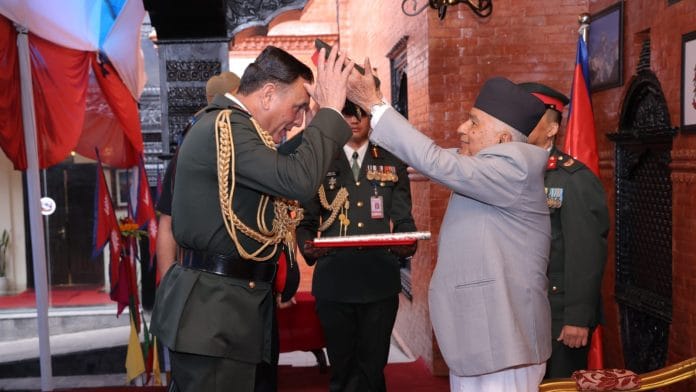


New Delhi: Indian Army Chief General Dhiraj Seth has been conferred the Honorary Rank of General of the Nepali Army by President of Nepal Ram Chandra Paudel, at a special Investiture Ceremony at Sheetal Niwas, the presidential residence in Kathmandu, on Monday
During the ceremony, the President presented Chief of the Army Staff (COAS) Gen Seth with a sword, insignia, and a certificate of conferment order.
The conferment is part of a unique and time-honoured military tradition, dating back to 1950, under which India and Nepal reciprocally confer the honorary rank of General on the Chiefs of each other’s Army. It started off as a symbol of the close relationship between the Indian Army and the Nepali Army.
The tradition began in 1950, when then Indian Army Chief Gen K M Cariappa was conferred the honorary rank of General of the Nepal Army. It emerged in the context of the India-Nepal Treaty of Peace and Friendship, signed in July 1950, which provided the broader framework for closer ties between the two countries.
Nepal’s decision was reciprocated later that year, when the then Nepal Army Chief Gen Sir Kiran Shumsher Jung Bahadur Rana was made an Honorary General of the Indian Army. The practice has continued since then, with the serving Army Chiefs of the two countries being given the honorary rank of General by the other country.
The appointment does not give the recipient any command or authority over another country’s army. It is a ceremonial military distinction, intended to underline the unusually close relationship between the two armies.
The military relationship itself is considerably older. Gorkha soldiers have served in the Indian Army for more than two centuries now. Recruitment and deployment of Nepali Gorkha soldiers have continued under an arrangement between India, Nepal and the UK since independence.
However, this has been stopped after India introduced the Agnipath scheme. Meanwhile, the Indian Army in a statement said that more than a ceremonial honour, the reciprocal conferment is an institutional expression of mutual trust, professional respect and military camaraderie between the two Armies.
Sustained across successive generations of military leadership, the ceremony therefore represents both tradition and strategic continuity. It underscores the commitment towards the steadfast nature of India-Nepal Military ties.
Nepal shares a border of over 1,850 km with five Indian states – Sikkim, West Bengal, Bihar, Uttar Pradesh and Uttarakhand.