





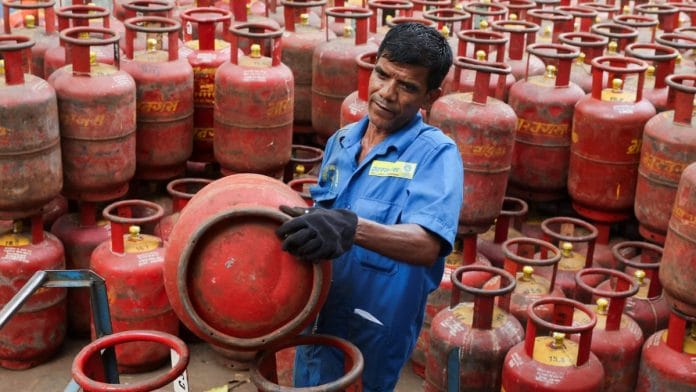



New Delhi: The government has secured 800 TMT of LPG cargoes—10 days’ worth of supplies—to meet energy import requirements, and the barrels are currently en route from the US, Russia, and Australia, among other countries, the Union Ministry of Petroleum and Natural Gas has said, emphasising a “secure” LPG supply.
LPG domestic output had been “ramped up by 40 percent”, with daily production now at 50 TMT (50,000 metric tonnes)—60 percent of India’s total requirement of 80 TMT—the ministry said Thursday. It added that consequently, the net daily import requirement had dropped to only 30 TMT, which would be met with incoming barrels.
“Oil companies are successfully delivering over 50 lakh cylinders every day. Cylinder demand had gone up to 89 lakh cylinders due to panic ordering by consumers and has now come down to 50 lakh cylinders again,” according to a press release by the ministry.
Rejecting “speculations” about an energy crisis and claims that the government had recently been promoting piped natural gas (PNG) to meet shortages, the ministry statement emphasised, “The claim that PNG is being pushed because LPG is running out is misinformation. LPG supply is secure.”
Highlighting that piped natural gas (PNG) was part of its long-term energy strategy—instead of a response to any short-term shortages—the statement said, “Piped Natural Gas is being promoted… because it is cheaper, cleaner, and safer for Indian households.”
India produces 92 million metric standard cubic metres per day (MMSCMD) of PNG domestically, against a demand of 191 MMSCMD, making it less import-dependent compared to LPG. City gas distribution has expanded from 57 geographical areas in 2014 to over 300 today, while PNG connections have grown from 25 lakh to more than 1.5 crore households.
Crude oil and fuel availability
Crude oil supplies, according to the government, remained adequate despite global concerns around the Strait of Hormuz. “India is today receiving more crude oil from its 41-plus suppliers across the world than what was previously arriving through the straits,” the statement said, adding that alternative supplies, especially from the Western Hemisphere, were offsetting disruptions.
“All Indian refineries are running at over 100 percent utilisation,” the ministry said, adding that crude supplies for the next 60 days had already been secured and that “there is no supply gap.”
India’s broader fuel ecosystem also remained unaffected, the ministry claimed. India was described by the ministry as “an oasis of energy security,” being the world’s fourth-largest refiner and fifth-largest exporter of petroleum products, supplying fuel to over 150 countries. More than one lakh retail fuel outlets across India were operating normally, with “not a single outlet… asked to ration supply”, said the ministry statement.
The ministry said that isolated instances of panic buying were driven by “deliberate misinformation” on social media. But even in those cases, fuel, it said, continued to be supplied without disruption. To ensure smooth operations, oil companies have extended credit to petrol pumps to three days—up from one day earlier—to preventi any working capital constraints.
Emphasising the overall situation, the government said that India “does not feel the need” for measures, including fuel rationing or emergency declarations, and maintained that supplies across LPG, PNG, and crude oil remained secure.
(Edited by Madhurita Goswami)
Also Read: India’s strategic oil reserves tell a tale of structural constraints & stalled expansion. Here’s why