





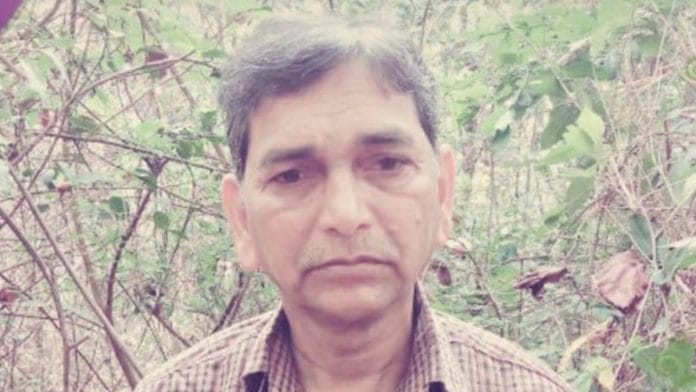



New Delhi: It was in the early 1980s when the now-slain Maoist leader Ganesh Uike alias Paka Hanumanthu—who was among the last remaining members of the Central Committee of the CPI (Maoist) after two years of anti-Maoist operations and surrenders—first surfaced on the Andhra Pradesh Police’s radar in connection with killings of leaders linked to the Akhil Bharatiya Vidyarthi Parishad (ABVP) and the Radical Students Union (RSU).
Back then, he was a final year BSc student at a college in the then undivided Andhra Pradesh’s Nalgonda district.
He eventually dropped out of college to join the ranks of the banned outfit. Over the decades that followed, Uike rose through the ranks and became a member of the Central Committee, the top decision-making body of CPI (Maoist). He shifted base from Dandakaranya region to Odisha in 2019, eventually heading the state committee.
The police’s pursuit of Uike ended Thursday when the 67-year-old was eliminated in an encounter in the forest range between Odisha’s Ganjam and Kandhamal districts, according to security officials.
“Based on input from Special Intelligence Wing, a joint operation involving 23 teams comprising troops from the Special Operations Group (SOG), CRPF and BSF launched an operation in the Chakapad Police station area of Kandhamal district and bordering areas of Ganjam district in Rambha forest range,” an Odisha Police officer told ThePrint.
Adding, “There were multiple exchanges of fire in the morning on 25 December with SOG teams at various places. After a search of the area, four bodies of Maoists in uniform (two male and female each) and two INSAS rifles, one 303 rifle were recovered.”
Ganesh Uike, the police officer confirmed, was among the Maoists killed in the operation.
Union Minister Amit Shah hailed Uike’s killing as a ‘significant milestone’ in the direction of the government’s target to make India Naxal-free Bharat by March 2026.
Also Read: Dreaded Maoist commander Madvi Hidma killed in encounter at Chhattisgarh-Andhra border
Rise through the ranks
One of six children of Paka Chandraiah and Paka Yellamma in Nalgonda’s Pullemla village, completed intermediate and enrolled at the district college to pursue a Bachelor’s in Science, according to sources in the security establishment.
This was the time he got embroiled in student politics. According to dossiers maintained by the police and agencies, Uike was implicated in the murder of Yechuri Srinivas, who was killed in alleged retaliation for the killing of an RSU leader outside Nalgonda court in 1982.
The RSU, at the time, was a front of the CPI (Maoist) active in college campuses.
Also known as ‘Rajesh Tiwari’, Uike was fluent in English and Gondi, in addition to his mother tongue, Telugu. His entry into the Maoist ranks coincided with the establishment of the People’s War Group (PWG), the precursor of today’s Maoist outfit in the southern state.
Police records suggest Uike has been active in the Dandakaranya region since 1988, working as a mobiliser. He was the Jagdalpur city organiser for the outfit for a decade, from 1988 to 1998, and then served as secretary of the West Bastar Divisional Committee from 1998 to 2006.
Over time, Uikey rose within the organisation, particularly after the October 2004 merger of the PWG and the Maoist Communist Centre of India (MCCI).
He was appointed to the Dandakaranya Special Zonal Committee after 2006.
According to police dossiers, Uikey attended a Special Zonal Committee-level meeting in the Gattakal area of Chhattisgarh in September 2008, stayed there for nearly a month, followed by a similar meeting in the Irpanar area in October 2009. He also stayed there for nearly a month.
Police officers ThePrint spoke to described him as a prominent leader active in the jungles of Bastar from 2008 to 2011, during which he attended several meetings and classes for lower-level cadres in the region.
Notably, this was the peak of the Maoist movement when ambushes and attacks on security forces were a routine affair in Chhattisgarh’s Bastar. Uikey is said to have travelled to the limits of the Orcha police station in Narayanpur district to meet Kadari Satyanarayana Reddy, alias Kosa.
According to Chhattisgarh Police, Uike had at least 16 criminal cases against him in the Sukma and Bijapur districts, which include one from 201 when a police party was attacked in Tongpal area of Sukma, resulting in the deaths of 15 police personnel. Shortly after the incident, Uike was elevated to the Central Committee of the banned outfit in 2014-15, and he moved to Odisha from the Dandakaranya region in 2019, police records suggest.
Police sources also suggest that Uike’s health had deteriorated drastically over the past few years, and worsened by repeated bouts of malaria.
(Edited by Tony Rai)
Also Read: India’s long war with Maoists has a huge void — no number of dead bodies can fill it