








Every year, millions of Indians enter the workforce, yet only about 40 percent of graduates find employment. At the same time, Micro, Small & Medium Enterprises (MSMEs), the job creation engine of India, which account for nearly 70 percent of employment in India, report unfilled roles, delayed hiring, and drop in productivity.
This is not a contradiction. It is a discovery failure.
Take Dhanashree, a 22-year-old ITI graduate in Dharwad. She is ready to work, but cannot see what jobs exist nearby. Local jobs are invisible. The only jobs she can find on job platforms point her to distant cities, with uncertain costs and certain uprooting.
A few kilometres away, MSME employers are hiring. They have open roles but cannot see candidates like Dhanashree. They ask the same contacts, put up posters, and wait.
Work exists. Talent exists. They simply do not see each other in time.
This pattern plays out across districts and towns of India because the signals on both sides remain weak and physical. Nearly 80 percent of non-agricultural jobs and a similar percentage of job seekers still rely on paper-based discovery like posters or biodatas, word of mouth, or local intermediaries. This is not a failure of intent by MSMEs or workers. It reflects how local labour markets have always functioned.
The cost of this invisibility is measurable.
For blue- and grey-collar roles, MSMEs typically take two to eight weeks to source candidates. Employers spend ₹1,000 or more per candidate on sourcing, screening, and basic verification, often with low conversion and high attrition. These costs repeat every time hiring restarts, even when demand is steady.
For jobseekers, delayed discovery means uncertainty and repeated trial and error. For women, the cost is even higher. When nearby work is uncertain or invisible, they remain unemployed. This is one reason behind why women’s labour force participation remains low. Not because aspiration is absent, but because local discovery is missing.
Employment outcomes, in other words, are shaped long before hiring. They are shaped at the moment of discovery.
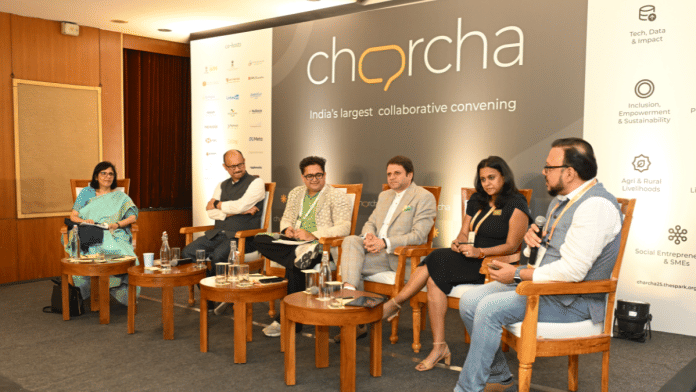
This reality was discussed at charcha 2025, held on 13 November, a dialogue on India’s future of work. In a session titled Jobs Next Door: Unlocking India’s Local Economy, Smt. Vandana Gurnani, Secretary, Ministry of Labour and Employment (MoL&E), articulated a shift worth paying attention to.
India’s employment challenge, she noted, is not only about creating jobs or skilling people, but about whether people and opportunities are able to find each other in time. Today, information about jobs, skills, and benefits is spread across silos.
Within this context, Smt. Vandana Gurnani highlighted the importance of the Blue Dot approach with pilots happening in Dharwad and Ghaziabad and linked this directly to the design of India’s emerging Employment and Welfare Stack. She highlighted that this stack will soon be made available to the ecosystem to innovate and build upon.
At its core, the idea is simple: make the signal of intent discoverable.
Local jobs. Local talent. Digital signals from both sides, enabling timely, credible discovery at the district level.
The goal is not to “solve hiring” in one stroke. It is to address what comes before it. Who is available? Who is hiring? What exists nearby? All as Blue Dots.
This matters most for youth and women. When discovery improves, participation improves. Not because preferences change, but because risk reduces.
Pilots of the Blue Dot approach, being tested through an EkStep Foundation initiative called ONEST, show what happens when this gap is addressed. When digital signals of intent enable timely, credible discovery, hiring timelines compress from weeks to a day, and the cost of sourcing and verification drops by nearly 90 percent.
The impact is especially clear at the district level.
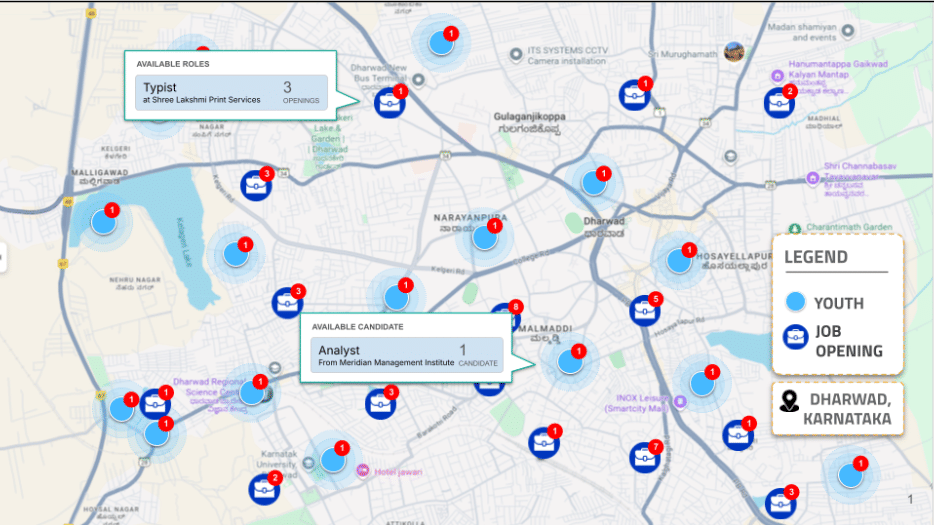
Consider Dharwad in Karnataka. Often referred to as Vidya Kashi, the district produces thousands of graduates each year from colleges and ITIs. It also has a dense base of MSMEs across manufacturing and services. Work exists. Talent exists. But until recently, the district was digitally dark in the context of employment.
In recent district-level efforts led by the local ecosystem, a digital map of employment for the district was surfaced to bring local talent and local opportunities into view. Thousands of individuals and hundreds of employers have begun emitting digital signals of intent.
The district lit up digitally with Blue Dots. What changed was timely, credible discovery in the context of employment.
When people earn locally, spend locally, it can also stir up the district’s local economy and activate the local ecosystem. With Dharwad’s district GDP estimated at roughly USD 5.5 billion, even a one to two percent uplift can be significant.
This is the larger promise of the Blue Dot approach as a part of the Employment and Welfare stack. The digital rails do not aim to replace the local ecosystem, but strengthen it. This expands the pie for ecosystem players who largely play in metros and large towns to drive innovation across districts on top of this digital public infrastructure. Ecosystem players can build tools and offer services to match, verify, and assess talent to drive better employment and skilling outcomes. Innovation shifts from guessing where opportunity lies to responding to what is already in view.
Several states, including Karnataka, Uttar Pradesh, Maharashtra, Assam, and Haryana, are now moving in this direction.
If India is serious about inclusive growth, discovery cannot remain in the backseat. Jobs do not fail because they do not exist. They fail because people do not see them in time.
Imagine a Bharat where districts consistently emit clear, credible digital signals of intent. Where youth and women can see nearby opportunities without guesswork. Where MSMEs hire without delay because talent is visible. Where earning with dignity doesn’t depend on migration.
That future is not abstract. It is already being tested.
Gaurav Gupta is the Chief Growth Officer at EkStep Foundation. Pranay VK leads Narrative at ONEST, an initiative of EkStep Foundation. Views are personal.
At charcha 2025, India’s largest collaborative convening, a multitude of industry experts and partners converged to explore various topics. With 40+ sessions spanning across 6 immersive, livelihood-intersecting themes, supported by 30+ sector-leading co-hosts, charcha convened to collaborate towards the shared goal of Viksit and Inclusive Bharat by 2047.
charcha 2025, an initiative by the*spark forum, was held at India Habitat Centre, New Delhi, from November 12–14, 2025. To know more, visit: charcha25.thespark.org.in