





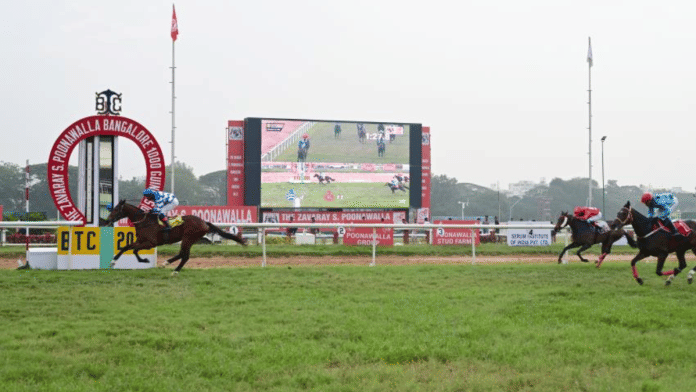



Bengaluru: Creating over 80 acres of lung space! That’s the argument the Siddaramaiah-led Karnataka government has made to justify the Cabinet’s decision to move the Bengaluru Turf Club (BTC)—a premier horse racing club—out of the congested IT capital of India to Kunigal, about 70 km away.
Several club patrons who ThePrint spoke to questioned the government’s move and the arguments made in its favour.
“More than 60-70 acres of the turf club are already open space without any construction,” one of the club members told ThePrint, requesting anonymity. “It is already a lung space.”
On Thursday, the cabinet decided to grant around 110 acres in Kunigal Stud Farm for 29 years with an option to extend. The racing activity would be shifted there. It was also decided that BTC will pay an annual lease amount equivalent to 2.5 percent of the land guidance value.
The BTC sits on 83 acres of prime land in the heart of Bengaluru’s business district, and the move to shift it has sparked fears that the heritage space could see parts of it being chipped away in the future for road widening and other infrastructure projects in the garb of decongesting India’s IT capital.
‘More than 60-70 acres of turf club are already open space without any construction. It is already a lung space’, says a club member.
Earlier, the B.S. Yediyurappa-led BJP government proposed to build a 100-floor high-rise in this space. But it dropped the idea later.
The Siddaramaiah-led Cabinet has now decided that the BTC would be moved out of the city to Kunigal Stud Farm—one of India’s oldest and most prominent horse-breeding centres—over the next two years.
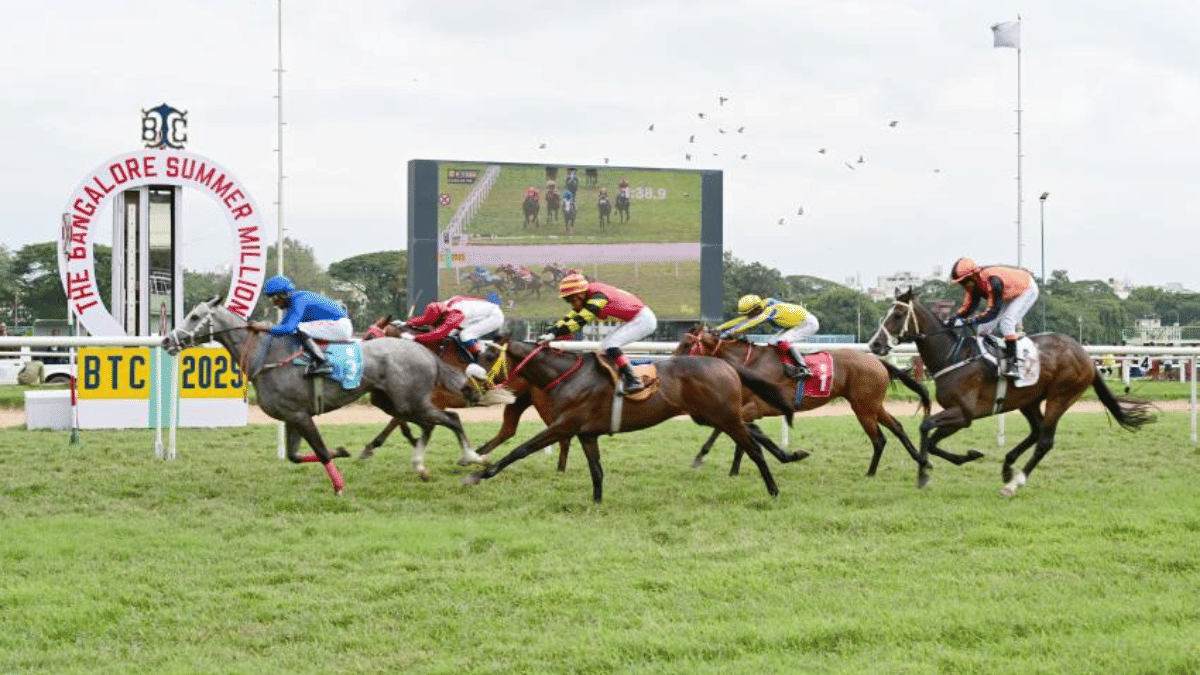
But patrons claim it would harm the sport, the ancillary economy it supports as well as the 200-year-old heritage horse breeding centre at Kunigal.
The government has proposed to allot 110 acres out of the 420 acres in Kunigal, currently used for horse rearing and other equestrian-related activities, including supplying horses to other cities in the country.
The BTC operates its club with elected members and a committee with a Chairperson, stewards, and others.
The BTC will be allowed to retain about 4 acres for two years for horse racing, preserving the heritage structures, and the clubhouse.
“The Kunigal Stud Farm is the oldest such establishment in the world. Tipu Sultan had established the space to rear horses for his cavalry. Then the practice was continued by the Maharaja of Mysore and then the British. There are about 600 horses there at any given time, with 200 young stock coming in and 100 going out of the system,” Zeyn Mirza, the Managing Director of United Racing and Bloodstock Breeders Ltd, told ThePrint.
United Racing was the last lessee of the Kunigal Stud farm and continues its operations from here.
An earlier plan to establish an integrated township at the stud farm evoked strong protests from locals.
The move to shift the racecourse to Kunigal, a largely rural setting, is being likened to importing a vice from Bengaluru, as the sport is often spoken in the same breath as gambling.
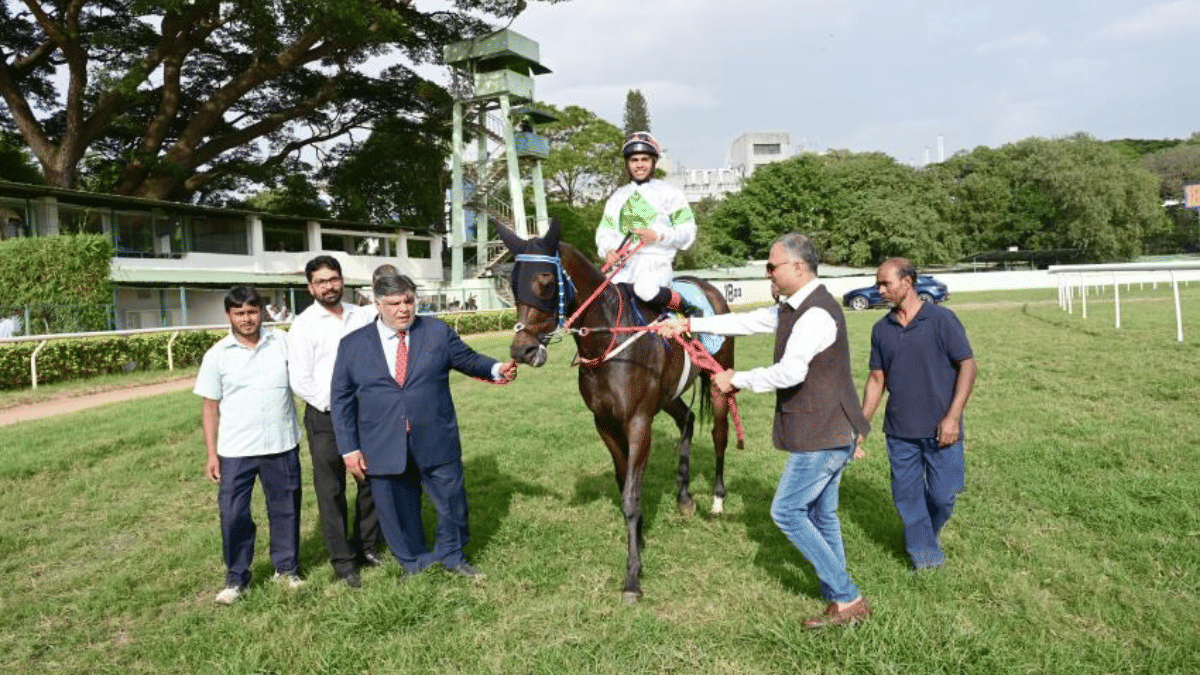
Critics argue that the BTC and similar clubs occupy vast urban spaces as exclusive property for the elite. Proponents of the status quo counter this, stating that if the land is ceded to the government, it risks becoming sites for more concrete structures or facilitating illegal encroachments.
Also Read: Vijay Mallya’s stud farm in Karnataka is selling horses to stay afloat
‘Betting on horses’
The latest move by Karnataka is not new as successive governments have followed a similar approach to acquire open spaces dedicated decades ago for the promotion of various sports.
There are ongoing efforts to acquire a portion of the iconic Bangalore Golf Club on the new airport road as well as the Palace Grounds, for road-widening purposes.
There have also been proposals by Deputy Chief Minister D.K. Shivakumar to acquire around six acres of Lalbagh, one of the few remaining lung spaces, to build a Rs 40,000-crore tunnel road.
An Indian Institute of Science (IISc) study shows that there has been nearly a 1000 percent increase in paved surfaces (built-up, roads, etc.) with the decline of 78 percent vegetation and 79 percent water bodies between 1973 and 2014.
Governments in other states have also followed similar patterns.
In July 2024, the Brihanmumbai Municipal Corporation (BMC) and the Royal Western India Turf Club signed an agreement which in effect would hand over the iconic Mahalakshmi Racecourse to the civic authorities.
The proposal is to develop the space along the lines of Central Park in New York.
In Kerala, the government has tried to take over the 25-acre Trivandrum golf club while similar attempts have been made in Tamil Nadu that wants to take over the golf course at Anna Salai.
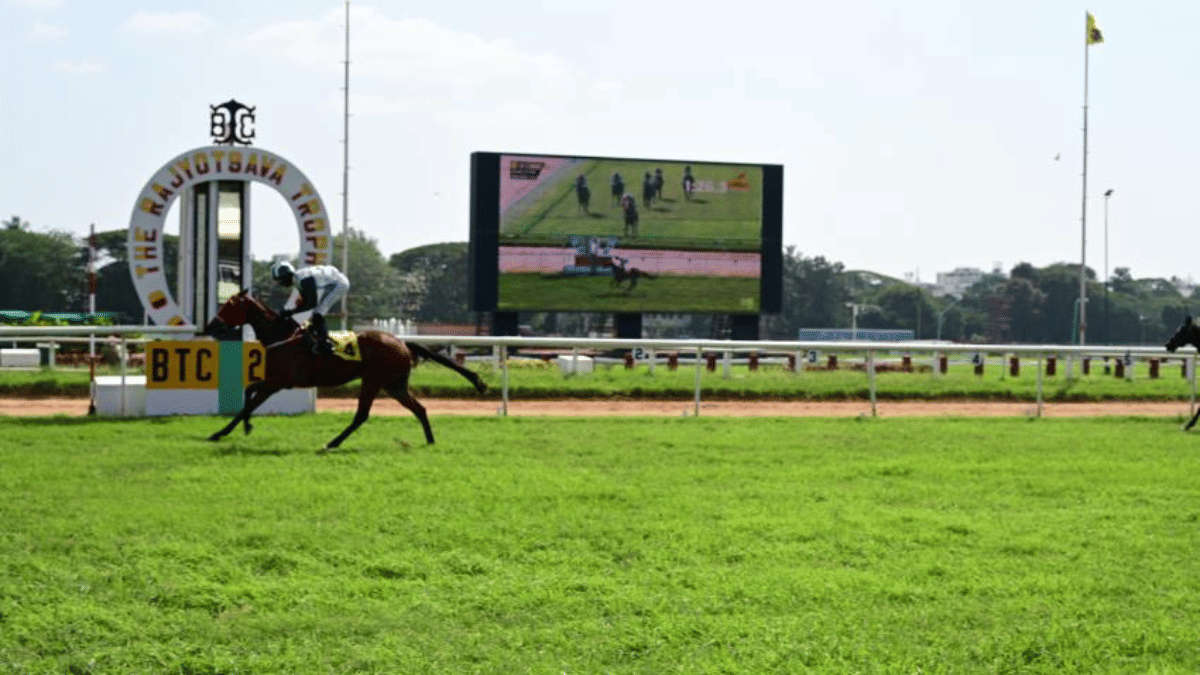
Patrons say that the BTC is a place that helps develop vaccines and anti-venom serum too.
“There are a lot of activities, people who supply manure…huge numbers of ancillary industries that racing takes care of. But unfortunately, people think of it as only gambling. Those seasoned punters are somebody as intelligent as those investing in stocks,” Ajit Saldhana, a steward at BTC said.
S.P. Muddahanumegowda, a former Congress MP from Tumakuru, had earlier written to the Union government that the Kunigal Stud Farm must be converted into an international centre for horse breeding.
Just over a decade ago, the BTC generated about Rs 2,000 crore in annual revenues. At the time, the state government, which was authorised to issue racing licences, was entitled to 4 percent taxes. But since the implementation of the Goods & Services Tax (GST), revenues have been “gutted”, patrons say, slashing incomes to just around Rs 500-600 crore.
This decline has significantly altered the government’s perspective on the BTC.
“There is a GST on the entire bet amount. But it should technically be on the winnings. Any successful punter had to pay income tax. Earlier, there was a TDS out there. It was fair and equitable. This double-dipping is what sounded the death knell of racing,” Saldhana says.
‘Curse of the horse’
Karnataka chief ministers have often exercised caution when it comes to shifting the BTC.
There is a belief—often fuelled by theories tailored to fit facts—that CMs lose power when they intervene in the BTC. Known as the “curse of the horse”, the superstition dates back to the early 1980s and is even cited as the reason for the fall of the then Ramakrisha Hegde government and many after him.
Even Yediyiyurappa, after initial plans to construct a high-rise on the BTC land, is said to have visited the temple inside the race course to seek forgiveness.
Siddaramaiah, who frequently juggles between his atheist, agnostic and believer identities, however, appears undeterred by these superstitions.
Patrons argue that they had requested alternative land to conduct their activities rather than seeing one of the oldest surviving stud farms destroyed. They also claim that it was an ‘error’ which gave government control of BTC.
“Around 2010, the then committee signed a lease agreement for a land that was granted in perpetuity, giving away the rights of the grant. This was the error,” said the patron cited above.
This gave the government the right to renew leases of the earlier grant land and claim it as its own. “This title case is currently being heard in the Supreme Court, but the government has already decided to force us out,” said one of them.
The land was given to the stewards after the 1916 agreement with the Maharaja of Mysore to hold races.
British officials posted in India during the period realised that country-bred horses were not suitable for horse racing in India. Bengaluru’s pleasant climatic conditions were particularly well-suited for rearing horses from Persia.
In December 1920, four stewards—Major R.H.O.D Paterson, Sir Leslie Miller, Major J.M Holmes and C.N Suryanarain Row—met at the grandstand of the Turf Club’s present location in High Grounds.
“The said lands will be held in the sole possession of the Race Club Committee so long as they are utilized for a Race Course,” according to the agreement signed then.
Their meeting ended with the decision to form a race club in Bengaluru. Soon rules were framed. There were 30 club members, with stewards being able to elect stand members.
The admission charge for both memberships was Rs 20. The rules of the Bangalore Race Club were framed, read, and passed on 13 March 1921 at the stewards meeting held at United Services Club. On 20 May 1921, the BTC was inaugurated at a general meeting. On 9 September 1923, the lands were granted to the Bangalore Turf Club by the Maharaja’s government.
Though the first attempt to shift the BTC was made as early as 1968 by the
B.D. Jatti government, the club was protected by its earlier agreement with the Maharaja.
The Kunigal history
The history of Kunigal Stud Farm is not so different.
The origins of this Stud Farm can be traced back to around 1780 when Tipu Sultan established it to breed horses for his cavalry to fight the British.
Post-Independence, the farm continued to be an equine breeding centre under the charge of the erstwhile Mysore State and subsequently the Government of Karnataka to breed horses for the Cavalry and Mounted Police.
In 1968, the Stud Farm was leased to the Bangalore Turf Club to promote breeding of horses for racing. In 1992, the Government of Karnataka leased the Stud Farm to the Vijay Mallya-owned entity United Racing & Bloodstock Breeders Ltd. In 2022, the 30-year-lease to United Racing expired, and in January 2023, tenders were floated to renew the contract.
The following month, Villoo Poonawalla Greenfield Farms emerged as the highest bidder at Rs 1.40 crore per annum as against the Reserve Price of Rs 1.16 crore. The bid was okayed and was awaiting final approval. Before it could be approved, assembly elections in the state were announced in March and the new Congress government recalled the tender that was earlier issued by the animal husbandry department.
There has been a cloud of uncertainty over the stud farm with proposals of an integrated township earlier, and now, the shifting of the entire race course.
(Edited by Ajeet Tiwari)
Also Read: Bengaluru has a difficult choice—save a 230-year-old stud farm or stay congested