





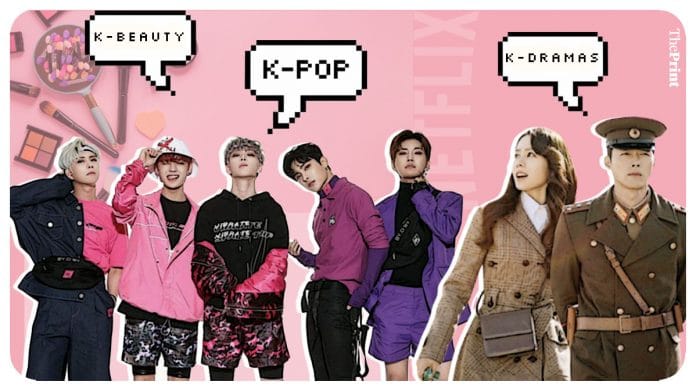



New Delhi: The deaths of three teen sisters in Ghaziabad on 3 February after their family alleged an obsessive attachment to a Korean romance game briefly pushed India’s booming Korean pop-culture fandom into a harsh, uncomfortable spotlight. But beyond the viral shock and speculation lies a much larger shift in Indian viewing habits: the steady, mainstreaming rise of Korean dramas and pop culture across age groups, languages, and platforms.
Indian cinema has been borrowing stories from Korean films for a few decades now, with and without acknowledgement. The Sidharth Malhotra-Sharddha Kapoor starrer Ek Villain (2014) was a remake of the Korean film I See The Devil, and John Abraham-Sanjay Dutt film Zinda (2006) was inspired by Oldboy (2003). But post 2020, the popularity of K-dramas reached its peak in India. In television and on over-the-top (OTT) platforms, dramas like Kaisi Yeh Yaariyaan and Duranga have been borrowed from popular Korean shows, Boys Over Flowers and Flower of Evil, respectively.
For years, however, such adaptations remained isolated industry exercises rather than signals of a mass audience’s appetite for Korean storytelling. That changed decisively after 2020.
Korean content, especially K-dramas, has found such deep resonance in India over the past five years because of its family-centric storytelling and softer ideas of romance and masculinity. K-dramas also fit easily into the Indian value system with shared ideas about family first, elders needing to be listened to and tropes of duty and sacrifice. There is also easy digital access through platforms such as Netflix and regional dubbing, allowing Indian audiences to broaden their content palates.
Though they often cover serious topics, K-dramas mostly avoid any foul language, extreme gore, and explicit sexual scenes. In recent years, K-dramas have started
“Korean society is workaholic, and Korean men are orthodox, especially with the mandatory two-year military training. The K-drama writers are essentially using them as an opportunity to redefine masculinity and manhood. These dramas also provide a respite in India from the hyper-masculine films and long-winded TV soaps. K-dramas focus on the period of romance between two characters, because life changes in real life, as well as in Korea post-marriage, and it is usually not the dreamy, romantic one,” said Rohini Kumari, Korean language translator and a professor at Delhi University’s Department of East Asian Studies.
Korean fandom in India is not necessarily restricted to Gen-Z or millennials. “I started watching because a few K-drama titles showed up on my Netflix. Then I got hooked because it showed the kind of romance I never really experienced in my 20s,” said 52-year-old Manali Dey.
The beginnings and explosion
The Korean wave, popularly called “Hallyu”, encompassed the global craze for all things South Korean. “Hallyu” is derived from the Chinese word “hanliu”, which means the popularity of Korean popular culture.
Korean entertainment was available in India for decades before Netflix came into the picture, especially in places like Manipur, where Hindi films were banned and have since evolved into strategic ties, like the recent discussion between Nagaland and South Korea. At a time when mainstream Indian media was hard to find, K-pop and K-dramas immediately filled the entertainment gap, but did not get a substantial fanbase until the 2010s.
But the catalyst was the 2012 song ‘Gangnam Style’ by singer-songwriter Park Jae-sang, better known as PSY.
The song opened India up to Korean culture, and soon other K-pop singers and artists found themselves a new audience.
“In the 2000s and 2010s, Japanese content (J-pop, anime, manga) was controlled by strict copyright laws and couldn’t be accessed easily. Whereas Korean content (K-dramas and K-pop) was easier to access in comparison. It was created as an export commodity. K-content circulated through CDs and pen drives. Later, the access got easier with the internet boom, especially in countries like India, and subsequently created fandoms,” said Monami Gogoi, a K-pop fan.
A Netflix study showed that the viewing of K-dramas on the platform in India increased by more than 370 per cent in 2020 over 2019.
“Some of the most popular K-titles in India included The King: Eternal Monarch, Kingdom (S2), It’s Okay to Not Be Okay, and Start-up,” read the study.
With easier access to Korean content, OTT platforms like Netflix, Amazon Prime Video India and Disney+ Hotstar are constantly updating its K-drama library. Rakuten Viki, a global OTT platform that also has operations in India, has drama content from Korea, Japan, Mainland China, Taiwan, and Thailand, with a few Asian American titles. The platform started a K-Drama Day in 2023 to bring together fans of the genre.
These dramas are now also being dubbed into regional languages, and being shown on hyperlocal streaming platforms.
In September 2024, Prime Video India signed a deal with CJ ENM, a South Korean entertainment conglomerate, to bring 18 drama series to Indian audiences through a gradual rollout. The shows are dubbed in Hindi, Tamil, and Telugu and are free to stream on Amazon Mx Player.
Also Read: What is the ‘Korean Love Game’ linked to the death of 3 Ghaziabad sisters?
Offshoots
Over the years, all things Korean have reached an all-time high with Korean-themed restaurants available in almost every major city in India and even tier 2-3 towns. In 2021, the Korean Culture Centre India (KCCI) in New Delhi increased its capacity for language classes from 300 seats in 2020 to 4,200 seats in 2021. In fact, 600 seats, which were the maximum capacity for 2021’s ‘Online Korean Language Hobby Classes’ got occupied in just two minutes of the opening of the registration.
“I took language classes so that I can watch and listen to Korean content without subtitles and translation. Almost 90 per cent of my classmates were also learning it for the same reason,” said Gogoi.
The classes at Sejong Institutes and the Korean Cultural Centre in India increased by 30 per cent in 2023 compared to 2021 and by 400 per cent compared to 2020.
Then there is the popularity of K-beauty. Every beauty website now has Korean beauty products, with influencers swe
(Edited by Insha Jalil Waziri)