





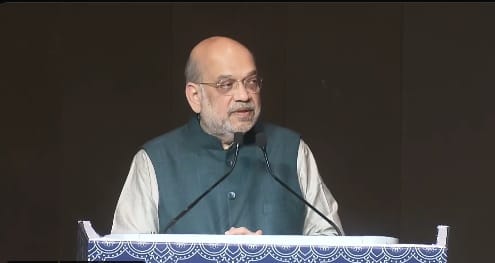



New Delhi: Reiterating the growing challenge of cybercrime in the country, Union Home Minister Amit Shah on Tuesday urged all state police forces to strengthen the ‘1930’ helpline mechanism to reduce response time.
He said all police forces should maintain a sufficient number of staff on the helpline so calls from victims are answered immediately, helping to put a freeze on fraudulent transfer of funds, which may lead to quick recovery.
The ‘1930’ helpline is a National Cybercrime Reporting Portal (NCRP) helpline created by the Indian Cybercrime Coordination Centre (I4C), a cybercrime watchdog under the Ministry of Home Affairs.
“1930…this has turned out to be an effective mechanism to protect consumers from cyber crimes. But I want to request that all state police forces, through this platform, deploy enough responders to 1930 call centres. If phones are not picked up despite several rings on the 1930 helpline, and by then people lose their money…it won’t bring a good name to the 1930 helpline platform,” Shah told a gathering of more than 500 delegates from various law enforcement and investigative agencies from across the country, at Delhi’s Bharat Mandapam.
Shah spoke after inaugurating the new cybercrime branch of the Central Bureau of Investigation (CBI) and the I4C State Cyber Crime Coordination Centre (S4C) Dashboard. Before him, CBI Director Praveen Sood addressed the delegates, saying the agency has filed charge sheets in 82 percent of cybercrime cases over the last few years and secured 90 percent convictions over the last decade.
According to the Union home minister, one person falls prey to cybercriminals every three and a half seconds and 97-100 people every hour in the country.
He urged investigators and other stakeholders, such as bank officials, to strengthen their prevention and policy measures amid the unprecedented rise in digital transactions.
“Our risk has increased proportionally to the progress of digital transactions. Although I believe our speed in mitigating the risk is not too slow; we need to increase it. Earlier, criminals carried out simple, manual hacking. Now, they are doing complex, automated hacking. Earlier, it was lone wolf attacks, but now they have come across as a well-organised crime (sic). Mule accounts have been sold and bought as a service in the world of cybercrime,” he further said.
Shah added: “Criminals are committing crimes with new techniques and hence we have to shed traditional techniques and make joint efforts to get two steps ahead of them.”
On the topic of mule accounts, the Union home minister urged bank delegates to adopt software developed jointly by the Ministry of Home Affairs and the Reserve Bank of India (RBI).
‘MuleHunter’ is an Artificial Intelligence (AI) based tool introduced by the RBI for the identification of mule accounts, which Shah advised banks and other financial institutions to use.
Without these measures, efforts to contain cybercrimes will not be complete, Shah said, adding that if adequate measures are not properly implemented, the issue of cybercrimes will become a “crisis” in five years’ time.
“We have to take responsibility to protect the country from this crisis. Identification of call centres, be it inside the country or outside, bringing awareness, making 1930 more effective, cutting down response time on the 1930 portal, strengthening coordination between I4C and banks…no one department of the government can do it alone,” Shah said.
(Edited by Gitanjali Das)
Also Read: 36-hr takedown window cut to 3 hrs: Centre notifies IT Rules amendment to tighten noose on deepfakes