





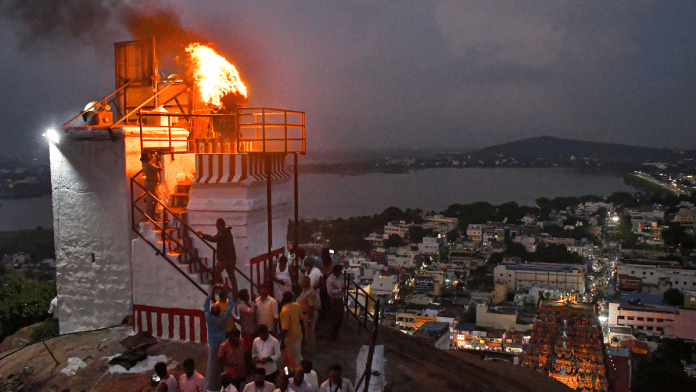



Chennai: A Madras High Court order permitting devotees to light a lamp for a Hindu ritual at a hilltop pillar in Madurai, instead of the temple below, has triggered a legal and political storm – with the state government challenging the directive while the district administration continues to block devotees from the site.
The standoff escalated Friday after the Tamil Nadu government filed a Supreme Court appeal against a contempt petition, and a separate appeal before the high court to challenge a single-judge order on the dispute.
The Supreme Court has admitted the state government’s plea and a division bench of the HC will hear the case next on 10 December.
The controversy erupted after Justice G Swaminathan – of Madurai bench of the Madras High Court – on 1 December took up a plea filed by Hindu Tamilar Katchi founder Rama Ravikumar and allowed devotees to light ‘Deepam’ at the ‘Deepathoon’ pillar on Thiruparankundram hill.
When this wasn’t allow during the ‘Karthigai Deepam’ festival, celebrated on 3 December, Ravikumar filed a contempt petition. The single-judge bench the same day allowed Ravikumar and 10 others to light the lamp at Deepathoon, and ordered that the group will be protected by CISF personnel. But police again stopped the group on the foothills, citing the government’s appeal in the contempt case.
Though the latest flashpoint is mired in political controversy, the hill and dispute over lighting the lamp isn’t new to Madurai.
Also Read: The Thevar factor in southern Tamil Nadu & how DMK, AIADMK have harnessed it for electoral gains
Origins of the dispute
Thiruparankundram hill is one of the Arupadai Veedu, the six sacred abodes of Lord Murugan. The hill houses an ancient rock-cut cave temple and has long been a pilgrimage site for devotees across Tamil Nadu. It also houses a dargah.
The existence of the temple and the dargah, just 3 km apart, sparked tensions between Hindus and Muslims over rights atop the hill. It was in 1920 that the legal foundation of the hill’s status was first contested by the temple and the dargah.
A civil court decree, later affirmed by the Privy Council, held that the hill belongs to the Subramaniaswamy Temple (Devasthanam), apart from a few areas associated with the dargah. This decree settled ownership of the hill, but it did not address rituals, customs or the Deepam tradition.
The Privy Council was a formal body of advisers to the British administration at the time.
When did Deepam become contentious?
The site of the Deepam ritual became contentious only in 1994, when a devotee approached the Madras High Court, seeking to shift the ceremony from the Uchipillar Kovil mandapam at the temple to Deepathoon, on the hilltop and close to the dargah.
The Madras High Court, in 1996, ordered that the Deepam be lit “ordinarily in the traditional place of the mandapam at Subramaniaswamy temple near Uchipillaiyar Kovil”.
The 1996 order remains the only court directive identifying a “traditional place” for the ritual.
But the ruling also allowed the temple management in the future to choose an alternative place for lighting the Deepam on the hill with permission from the Hindu Religious & Charitable Endowments (HR&CE) department of the state government, though it said the spot must be away from the dargah.
From a legal standpoint, the mandapam is the only location recognised by courts as the traditional spot for Karthigai Deepam on Thiruparankundram hill.
Those seeking to change the Deepam location argue that the current practice of lighting it at Uchipillaiyar Kovil violates agamic norms—traditional and historically followed rules by a temple, from rituals to priest appointments—and that the Deepathoon is the historically used place.
But the temple administration has consistently maintained that Uchipillaiyar Kovil mandapam is the traditional place for the ritual and the practice has been ongoing for a century, in line with its agamic norms.
21st century precedent
In 2014, another devotee approached the High Court, asking that the Deepam be lit at the Deepathoon.
Justice M Venugopal dismissed the plea on multiple grounds. The judge said that the petitioner lacked locus standi because he could not establish a legal right over temple rituals. The court reiterated that orders cannot be issued to enforce ritual preferences, as courts do not intervene in spiritual or optional practices unless statutory duties are breached. Further, the judge noted that the temple was continuing with procedures followed in previous years, and had shown no administrative failure.
The judgement explicitly held that devotees cannot enforce ritual preferences through writ petitions.
When the petitioner appealed, a division bench of the High Court in 2017 upheld the order and made three key observations. It said courts cannot dictate the precise location at which the Deepam must be lit, since such decisions fall within the temple administration’s exclusive domain. The petitioner, as a devotee, does not have a personal legal right to enforce lighting at any specific location; and as long as the temple performs its functions without violating its duties, courts must refrain from interfering in matters involving rituals, it said.
Temple autonomy under the HR&CE Act further strengthens administrative discretion, the court said.
The case, now
The petitioner Ravikumar made three main arguments in the latest petition: first, the 1920 decree establishes the temple’s ownership over the entire hill, meaning the Deepam can legally be lit anywhere within temple property; second, no judicial order has banned lighting the Deepam at the Deepathoon; third, the temple’s refusal to consider Deepathoon as the site of the ritual in 2025 lacks reasons and violates procedural fairness.
These arguments attempt to reopen the question of the ritual site.
The temple administration again maintained its stand that the lamp must be lit at the mandapam.
The political row
As the district administration on Thursday blocked a group of devotees from going up to the Deepathoon, despite the single-judge bench’s 1 December and 3 December orders, opposition parties in the state accused the DMK government of failing Hindus.
The DMK, on its part, said that the government was abiding by previous orders of the High Court. State ministers said the government has appealed the single judge’s order before a division bench, and approached the Supreme Court to quash contempt plea against its officials.
(Edited by Prerna Madan)
Also Read: Why DMK-led Tamil Nadu govt is at war with the Centre over NEP