





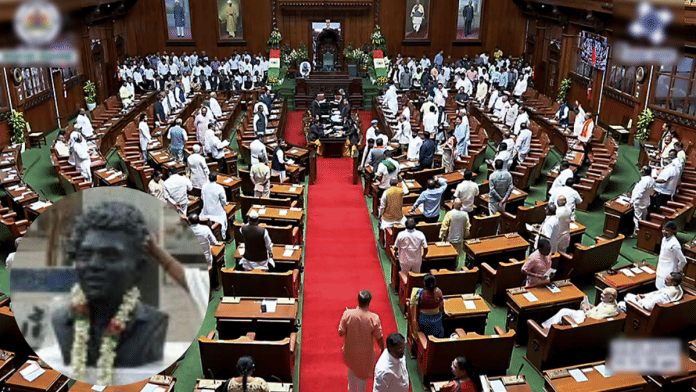


Bengaluru: Karnataka Chief Minister Siddaramaiah Friday said that the Rohit Vemula Bill, passed by his cabinet, was aimed at stopping caste-based injustice, inequalities and humiliation in educational institutions.
“Denying opportunity to conduct experiments in the laboratory, and deliberately awarding lower marks in viva voce and practical examinations to students who have excelled in written and physical tests, on the basis of caste, will be a punishable offense. Let caste discrimination be eradicated, let us build a society of fraternity and brotherhood…” Siddaramaiah said in a post Friday.
He said several lives across the country had been lost due to caste-based discrimination and harassment in educational institutions.
The state cabinet Thursday approved the Rohit Vemula (Prevention of Discrimination, Exclusion or Injustice) (Right to Education and Dignity) Bill 2026.
Siddaramaiah added that no one chooses to be born a particular caste, so birth should not determine an individual’s identity or social status.
“Our aspiration is to end the discrimination, pain, humiliation, and injustices faced by students from oppressed communities and to bring equality into the education system…” he added.
ದೇಶಾದ್ಯಂತ ಶಿಕ್ಷಣ ಸಂಸ್ಥೆಗಳಲ್ಲಿ ಜಾತಿಯ ಕಾರಣಕ್ಕಾಗಿ ಎದುರಾಗುವ ಅನ್ಯಾಯ, ಅಸಮಾನತೆ, ಅವಮಾನಗಳಿಂದಾಗಿ ಈಗಾಗಲೇ ಹಲವು ಜೀವಗಳು ಬಲಿಯಾಗಿದ್ದು, ರಾಜ್ಯದಲ್ಲಿ ಇಂತಹ ಸಾವುಗಳಿಗೆ ಕೊನೆಹಾಡಲು ನಮ್ಮ ಸರ್ಕಾರ ನಿರ್ಧರಿಸಿದೆ. ಈ ನಿಟ್ಟಿನಲ್ಲಿ ಗುರುವಾರ ನಡೆದ ರಾಜ್ಯ ಸಚಿವ ಸಂಪುಟ ಸಭೆಯಲ್ಲಿ "ಕರ್ನಾಟಕ ರೋಹಿತ್ ವೇಮುಲ (ಬಹಿಷ್ಕಾರ ಅಥವಾ ಅನ್ಯಾಯ… pic.twitter.com/MzhlMnW5pl
— Siddaramaiah (@siddaramaiah) April 17, 2026
The Bill provides for strict penalties on anyone indulging in discriminatory practices and harassment, including a fine of up to Rs 10 lakh for individuals found guilty of caste-based harassment or discrimination.
The Congress-led Karnataka government has repeatedly stressed on the need for the Bill, even though multiple agencies have said there was no “discrimination” angle that led to the Hyderabad Central University Ph.D. scholar Rohit Vemula dying by suicide in January 2016.
Rohit was part of a protest by five Dalit students against their expulsion from the university’s accommodation over allegations that they had attacked a member of the Akhil Bharatiya Vidyarthi Parishad (ABVP). Though an initial internal inquiry cleared them of the charges, it later reversed its decision.
Rohit Vemula later died by suicide, leaving behind a note which did not blame anyone in particular. But his suicide triggered protests over discrimination.
In May 2024, the Telangana Police closed its probe into the death of Rohit Vemula, claiming he was not a Dalit and died by suicide because he was afraid his “real caste identity” would be discovered.
The closure report explicitly stated that Rohit Vemula and his family, including his mother Radhika Vemula and brother Raja, are not Dalits.
Rohit Vemula’s death by suicide triggered nationwide protests and became the flashpoint of Dalit discrimination in Indian universities.
However, Congress leader Rahul Gandhi has urged Telangana and Karnataka to introduce Bills in the late PhD scholar’s name to curb discrimination.
‘Equity committee’
The Bill, a copy of which ThePrint has seen, states that it was introduced to prevent “exclusion or injustice and to safeguard the right to education and dignity for the students, teaching faculty and non teaching staff” who are from Scheduled Castes and Scheduled Tribes (SC/ST) as well as provide equal access and right to education in all public and private educational institutions.
One of the key provisions is for establishing an ‘equity committee’ in every institution to handle complaints of caste discrimination or harassment. These committees will be chaired by a member of the SC/ST community and not below the rank of assistant professor. The committee will also have six other members, with two SC/ST student representatives. The panel is mandated to have 80 percent SC/ST members.
It adds that if the ‘equity committee’ arrives at a conclusion that the allegation against the respondent has not been proved, it shall recommend the case to the higher educational institution that “no action to be taken in the matter”.
The committee may also recommend action against individuals if the complaint is found to be true.
Priyank Kharge, Karnataka’s minister for Information Technology and Biotechnology, Friday said the Rohit Vemula Bill, approved by the cabinet, is aimed at stemming the growing problem of students from marginalised communities dropping out midway through their education, especially due to discriminatory practices.
The Siddaramaiah-led cabinet approved the Karnataka Rohit Vemula (Prevention of Discrimination, Exclusion or Injustice) (Right to Education and Dignity) Bill 2026 Thursday, which it believes will address concerns of marginalised groups.
“Due to attacks from higher education institutions as well as from fellow students on the dignity, self-confidence, and personality of Dalit and Adivasi students, thousands of SC/ST students are dropping out midway through their education and continuing to remain deprived.
“With the aim of upholding the self-confidence and self-respect of students from oppressed communities and ensuring their right to education, in the name of Rohit Vemula, who became a martyr in an attack of exploitation, our government has formulated legal protection…” Kharge said in a social media post.
ಉನ್ನತ ಶಿಕ್ಷಣ ಸಂಸ್ಥೆಗಳು ದಲಿತ ಮತ್ತು ಆದಿವಾಸಿ ವಿದ್ಯಾರ್ಥಿಗಳ ಗೌರವ, ಆತ್ಮವಿಶ್ವಾಸ ಮತ್ತು ವ್ಯಕ್ತಿತ್ವದ ಮೇಲೆ ಉನ್ನತ ಶಿಕ್ಷಣದ ಸಂಸ್ಥೆಗಳಿಂದಲೂ ಹಾಗೂ ಸಹಪಾಠಿಗಳಿಂದಲೂ ದಾಳಿಗಳಾಗುವ ಪರಿಣಾಮವಾಗಿ ಸಾವಿರಾರು ಎಸ್ಸಿ/ಎಸ್ಟಿ ವಿದ್ಯಾರ್ಥಿಗಳು ಶಿಕ್ಷಣವನ್ನು ಮಧ್ಯದಲ್ಲೇ ನಿಲ್ಲಿಸಿ ವಂಚಿತರು ವಂಚಿತರಾಗಿಯೇ ಉಳಿಯುತ್ತಿದ್ದಾರೆ.
ಶೋಷಿತ… pic.twitter.com/ejz6xKg2fc
— Priyank Kharge / ಪ್ರಿಯಾಂಕ್ ಖರ್ಗೆ (@PriyankKharge) April 17, 2026
He added that the Bill will uphold “secular values and scientific temper”.
The Bill defines “atrocity” as an act described under the existing Scheduled Castes and Scheduled Tribes (Prevention of Atrocities) Act, 1989 (Central Act 33 of 1989).
Further, it states that “caste-based harassment” means any hostile or abusive behavior, or harmful interpersonal aggression expressed in any form that “humiliates, indignifies, demeans or threatens, a person or group of persons due to their caste status” as SC/ST.
The Bill also defines “discrimination” as any “intentional or unintentional action or omission” that has an “adverse effect” on an individual or a group of people belonging to SC/STs who are not treated at parity with others.
The Rohit Vemula Bill has multiple sections, dealing with various aspects of discrimination, even listing out scenarios involving students and faculty. This includes barring entry to the hostel or hostel campus, exams, cultural events, contesting elections of student bodies or even withholding results. Arbitrary withholding or undue delays in disbursement of scholarships, fellowships or financial aid earmarked for SC/ST communities “especially as retaliatory action” for lodging complaints will also attract action.
Even forced participation to attend religious or cultural events which are contrary to personal beliefs and practices of SC/STs will be dealt with strongly, the Bill states.
For non-students, the Rohit Vemula Bill provides protection, stating that they cannot be barred from holding administrative posts or official positions such as, a member of various committees and associations within the campus including but not limited to cultural clubs.
Furthermore, it states discriminatory actions like adverse remarks in appraisals or performance evaluation reports, barring from supervisory duties, denial of re-employment or contract renewal, withholding of promotion or salary increments, demotion, dismissal and even suspension during pendency of inquiry will attract action.
Clauses which specifically address “caste-based harassment” include implied or explicit threat of physical, mental or economic harm, derogatory remarks, interference of any kind, creating an intimidating or hostile environment.
There is also a clause that provides the “right to overcome caste prejudice”. This includes taking any lawful action, forming associations, promoting anti-caste discussions through reading clubs, refusing to participate in events, activities that reinforce caste prejudice.
(Edited by Viny Mishra)
Lower marks based on caste ? How are you gonna verify that ? How can a committee which has no judicial authority fine people ?
I hope it’s not some draconian thing because honestly I read about Rohit vemula and that whole controversy was very dodgy.