





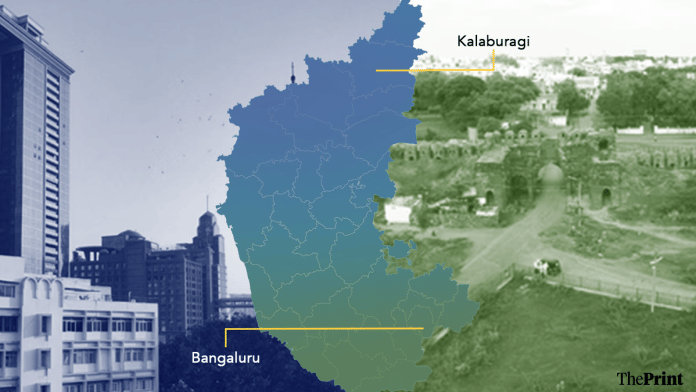



Bengaluru: How skewed is Karnataka’s regional imbalance? A look at its latest economic survey shows a nearly 500 percent gap between Kalaburagi, the district with the lowest per capita income, and the state’s growth engine Bengaluru.
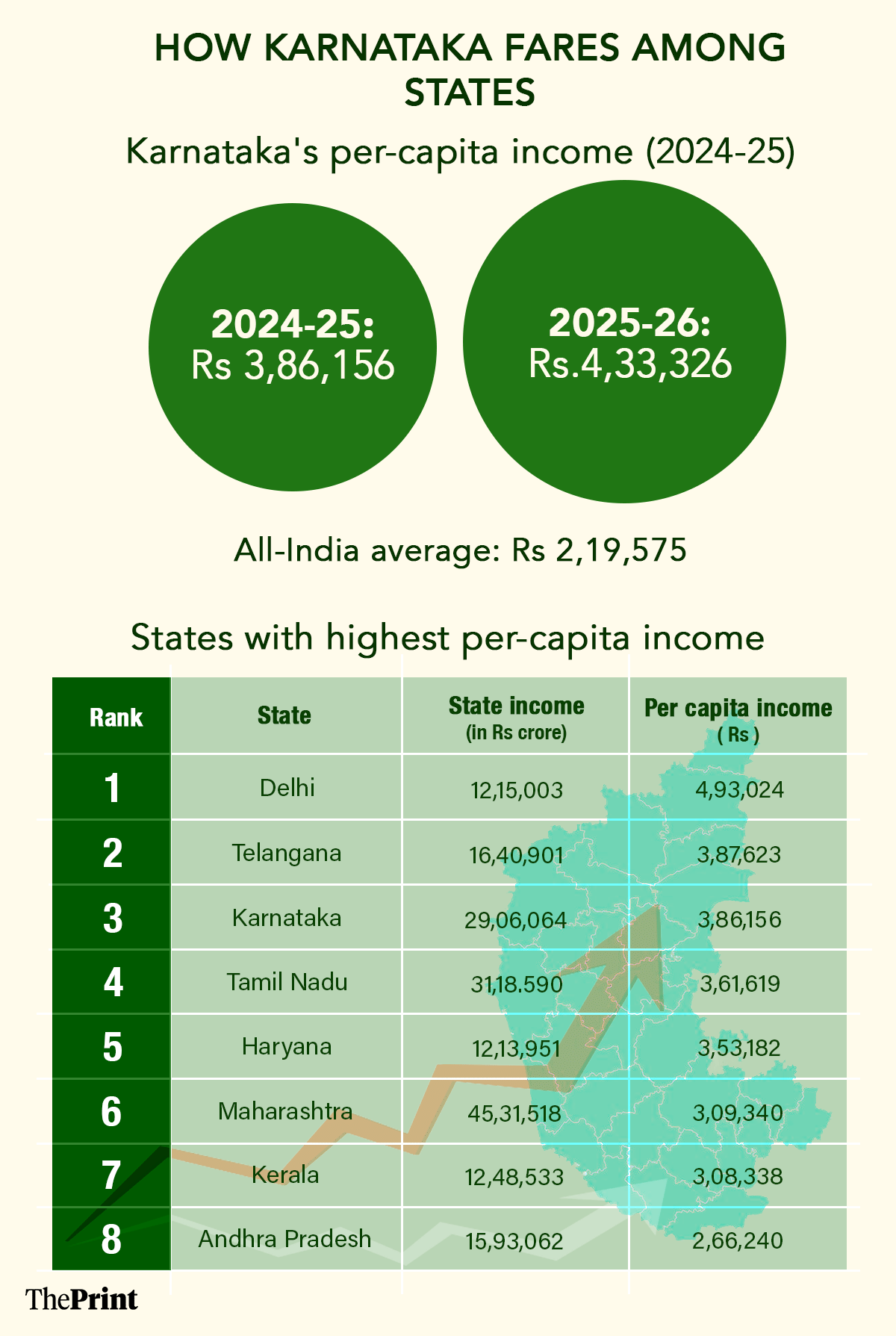
“For 2025-26, Karnataka’s per capita income is estimated at Rs 4,33,326 at current prices, registering a growth of 12.2 percent over Rs 3,86,156 in 2024-25,” according to the latest economic survey.
Though Karnataka’s per capita income is 97 percent higher than the national average of Rs 2,19,575, the data reveals a stark and growing imbalance in the southern state.
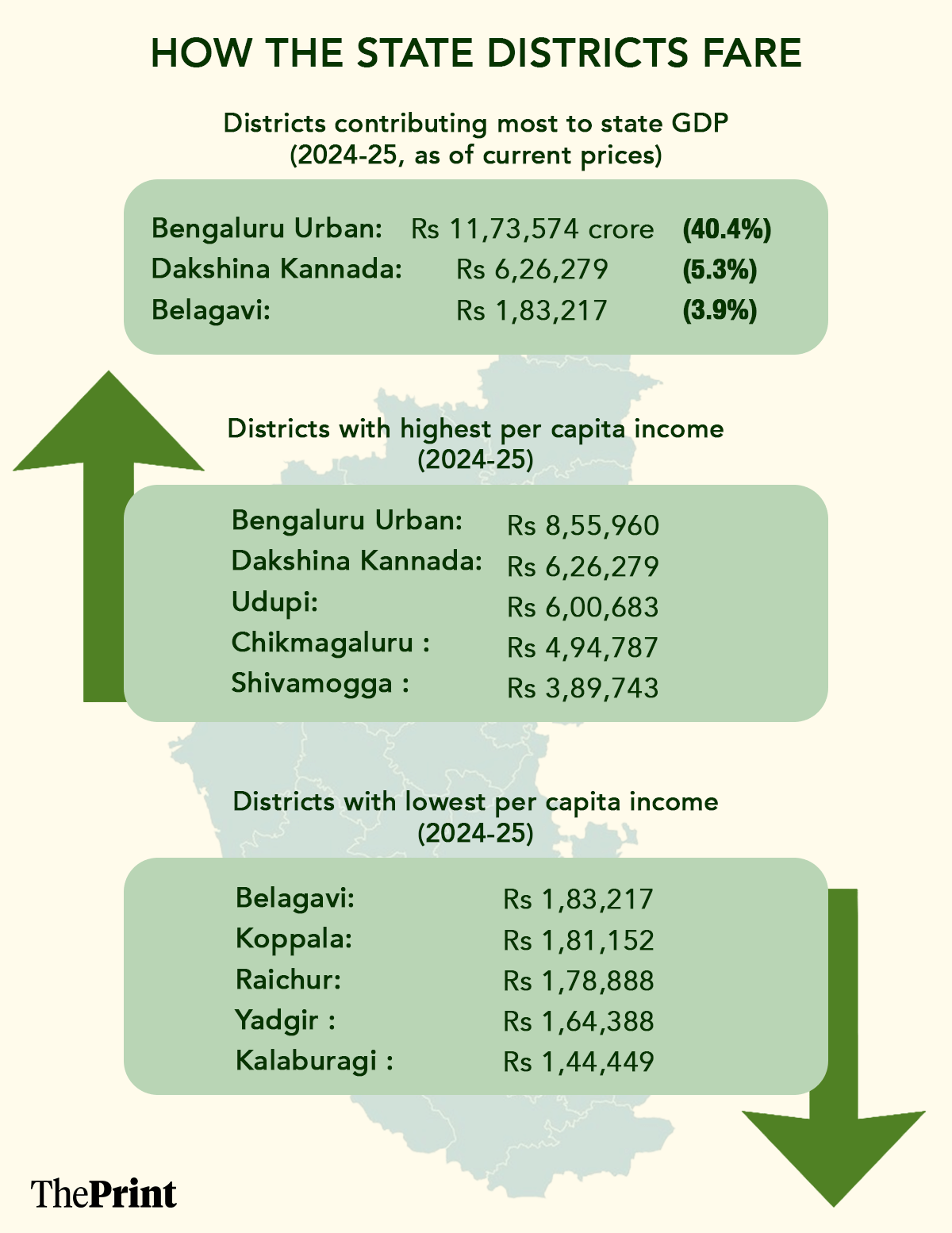
District-wise breakup for 2024-25 shows that Kalaburagi has per capita income of Rs 1,44,449 while Bengaluru stands at the top with Rs 8,55,960.
The situation is no better for other districts in the Kalyana-Karnataka region (formerly Hyderabad-Karnataka) that have faced poor economic growth despite special constitutional privileges and patronage.
The imbalance is so stark that out of 31 districts, only five are above the state average of Rs 3,86,156, data shows.
“It is especially worrying that the 5 districts of Kalyan Karnataka have taken the last place in this list, and the per capita income of these districts is less than half the state average…,” R. Ashoka, the Leader of the Opposition, said in a post Monday.
He went on to say that both Kharge and his cabinet minister son Priyank give speeches on geopolitics but have in reality forced the region into “economic slaves”.
Kalaburagi is the home district of Congress President Mallikarjuna Kharge, and his son Priyank has been elected thrice as a Member of the Legislative Assembly (MLA) representing Chittapur there.
In contrast, Bengaluru has become synonymous with Karnataka as successive governments persist on development around India’s IT capital and southern districts in its proximity, leaving the northern counterparts with little growth or attention.
Also Read: Karnataka’s welfare paradox? As scheme payouts rose, rural workforce shrunk
‘Few industries and services’
Data shows that in 1970-71, Kalaburagi’s per capita income was Rs 622 as against Rs 699 in Bengaluru Urban. But the divide continued to widen over the decades, with successive governments focusing on Bengaluru-centred development and the Kalyana-Karnataka region while northern districts took a backseat.
Eight of the top 10 districts with the highest per capita income are southern districts while two are from the coastal region. Kalyana-Karnataka comprises eight districts, including Kalaburagi, Yadgir, Koppala, Ballari, Vijayanagara, Bidar and Raichur.
Ajay Singh, the Congress MLA from Jewargi in Kalaburagi and chairperson of Kalyana-Karnataka Regional Development Board (KKRDB), said that the government and the budget have made provisions and drafting plans, policies to bridge the development gap.
“We are going to have an industrial policy, policy for tourism and other policies that favour north Karnataka. In the next five years, we want to increase the contribution of the Kalyana-Karnataka region from around 10 percent now to 12-14 percent,” Singh told ThePrint.
He added that a separate data analysis wing will be established in the region for domain experts to study various verticals like health, education, industries and others. This, he said, will help form region-specific policies to attract investments and funds.
Singh said there were renewed efforts to increase and sustain expenditure to bolster building road networks, and developing health, education and other sectors.
He added the budget mentions that in the last three years, Rs 13,000 crore worth of plans were formulated for KKRDB and for the upcoming fiscal, another Rs 5,000 crores has been set aside.
The Karnataka Region of Kalyana (Hyderabad) was under the rule of the Nizam of Hyderabad until 1948. After its merger with the Union of India on 17 September 1948, the region was identified as Hyderabad-Karnataka of Karnataka state.
These districts are among the most backward in India, and in 2012, the region was given special status under the Constitution. Under the erstwhile United Progressive Alliance 2 government, Article 371(J) was inserted in the Constitution to provide reservation in education and employment.
This region was later renamed Kalyana-Karnataka, but the name change has done little to improve the living conditions or economic growth in the region.
“The relatively lower income levels in these regions are largely due to the limited presence of industrial and services activities,” according to the economic survey.
The seven districts together contribute 10.8 percent to the Gross State Domestic Product (GSDP) in industry as against Bengaluru Urban’s 28.4 percent.
The divide is wider in services, with the Kalyana-Karnataka region together contributing 8.8 percent as against Bengaluru Urban’s 49.4 percent.
“Bengaluru Urban district accounted for 40.4 per cent of the State’s GSDP at current prices, followed by Dakshina Kannada (5.3 per cent) and Belagavi (3.8 per cent),” according to the economic survey.
Further, it added that the disparity is due to the “high concentration of major industries and well-developed infrastructure” in Bengaluru Urban.
The Human Development Index (HDI) has suffered on account of the growing regional disparity. “Yadgir, Kalaburagi and Raichur are the districts in the last three positions with HDI. (The) Value is 0.538, 0.539 & 0.562, respectively, which belongs to the category of low human development,” according to the economic survey.
The gender inequality index (GII) ranking also reflects low HDI. Kalaburagi ranks 17th in GII, while Koppala is at 25th, and Ballari stands at 20th rank respectively.
(Edited by Tony Rai)
Also Read: India’s Silicon Beach: As Bengaluru sputters, a new IT haven is taking shape on Karnataka’s coast