





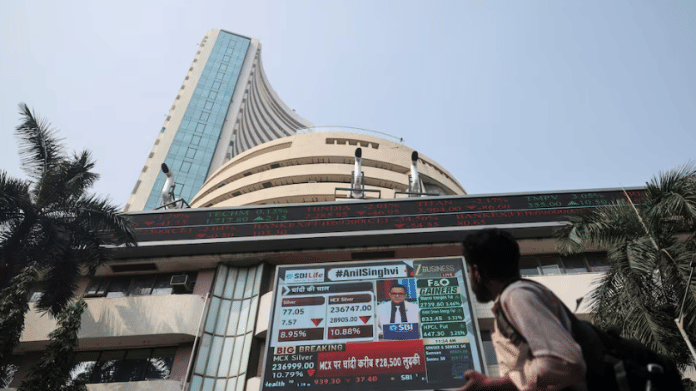



Washington: India’s benchmark indexes registered their weakest financial-year performance in six years on Monday, battered by a mix of geopolitical shocks, U.S. tariffs and record foreign investor outflows.
Trajectory of India’s Nifty 50 in financial year 2026
While supportive fiscal and monetary measures boosted the earnings outlook, market sentiment deteriorated sharply toward the fiscal year-end as the Middle East war sent crude prices surging, raising fears over energy supplies, growth and inflation in India, the world’s third-largest crude importer.
Get the latest news from India and how it matters to the world with the Reuters India File newsletter. Sign up here.
Benchmarks Nifty 50 (.NSEI), opens new tab and Sensex (.BSESN), opens new tab fell about 5.1% and 7.1%, respectively, in the fiscal, marking their worst showing since 2020, when the COVID-19 pandemic triggered a global equity rout.
India’s fiscal year runs April through March. Markets are on March 31, 2026, for a holiday, making Monday the final session of this fiscal year.
India’s Nifty 50 heads for worst annual performance in six years in financial year 2026
India’s Nifty 50 heads for worst annual performance in six years in financial year 2026
The Nifty and Sensex underperformed other Asian and emerging market peers in fiscal 2026 and settled at a a nearly one-year and two-year low levels, respectively, while the rupee slid to record lows and bonds fell on elevated crude.
The benchmark 10-year bond yield hit 6.97% on Monday, the highest since July 2024. Bond yields move inversely to prices.
“A prolonged Iran war is going to be a catastrophic event, because of India’s dependence on crude… that’s a real concern going into the new fiscal year,” said Vivek Shukla, regional head at Emkay Global Financial Services in Bengaluru.
Indian shares underperform EM, Asian peers in financial year 2026
Indian shares underperform EM, Asian peers in financial year 2026
IT stocks (.NIFTYIT), opens new tab, the second-heaviest sector on the benchmarks, tumbled 21.2%, pressured by concerns that artificial intelligence-led disruption could cap earnings growth, alongside softer U.S. client spending and record foreign selling.
Tata Consultancy Services (TCS.NS), opens new tab, Wipro (WIPR.NS), opens new tab and Infosys (INFY.NS), opens new tab ranked among the worst Nifty 50 fiscal-year performers.
Performance of India’s key stock indexes in financial year 2026
Performance of India’s key stock indexes in financial year 2026
“Gen AI differs from past tech transitions on two counts, one, it hits at (the) core of Indian IT and two, expands competition beyond IT services to software/Gen AI natives,” Ashwin Mehta of Ambit Institutional Equities said.
“A 15%-20% revenue deflation is quite possible over three-five years.”
Foreign portfolio investors offloaded, opens new tab a record $19.69 billion worth of Indian equities in the fiscal, with IT seeing the highest outflows among sectors.
Elevated U.S. bond yields, sustained pressure from high crude prices and more attractive valuations elsewhere could delay a revival in foreign interest, Emkay’s Shukla said.
A handful of stocks bucked the broader market gloom.
Bharat Electronics (BAJE.NS), opens new tab rose 33% on stronger earnings and the government’s defence indigenisation push, while Hindalco (HALC.NS), gained 30% on solid earnings and rising global metal prices.
This report is auto-generated from Reuters news service. ThePrint holds no responsibility for its content.