





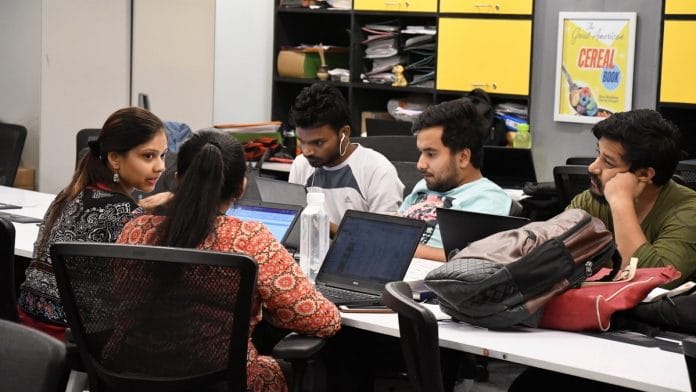



New Delhi: In the daily churn of India’s young workforce, two realities exist side-by-side. Some young adults spend hours travelling across cities to jobs that stretch into nine-hour workdays. While others work only a few hours, often in family enterprises that offer neither stability nor security.
In India, a recent study by the Great Lakes Institute of Management, found that only 47 per cent of adults aged 20-29 years are in paid employment. The figure masks sharp divides by gender and geography. Nearly 79 per cent of young men are in paid work, compared to about 18.2 per cent of young women. In Bihar and Uttar Pradesh, fewer than one in ten young women are employed. Employment rates are slightly higher in urban areas, where 48.8 per cent of young adults work, compared to 45.6 per cent in rural areas.
The study titled “Young Adults at Work in India,” examines how young Indians spend their working time. The report by the Chennai-based institute drops from the National Time Use Survey 2024 data to analyse paid work participation and daily work intensity among young adults. The findings reveal “a labour market that under-employs a large share of its youth, alongside excessive work burdens for many it does employ.”
The study argues that how young people spend their time provides an important window into India’s economic future. In recent years, young adults remain in the working age population for at least the next three decades, making their employment patterns central to a country’s demographic dividend.
What the research included
To assess youth labour market engagement, researchers examined two indicators: the share of young adults in paid employment and the time they spent working and commuting each day.
The study finds that informal employment remains the dominant pathway into work for most. Only 9.5 per cent of young adults work in formal enterprises, while 37.2 per cent are employed in informal enterprises. In rural India, about 85 per cent of working adults are in informal enterprises. The report also describes employment in informal enterprises as the “default form of paid work, both in rural and urban areas, for young Indians.”
The report defined formal enterprises as corporations, government bodies and non-governmental organisations, while informal enterprises largely consist of household-based economic activities such as farming, livestock rearing, construction work for the market, and other services.
According to the report, higher education qualification do no necessarily shift young worker to formal organisations. Among college graduates, slightly more young adults work in informal (23.9 per cent) enterprises than in formal (22.5 per cent) ones, suggesting limited nationwide expansion of the formal sector employment.
Access to formal jobs also varies sharply by gender and location. Nearly one in four young men in urban areas work in formal enterprises, compared to one in ten in rural areas. Among women, formal employment is even lower, with only 2.3 per cent of rural young women and 9.8 per cent of urban young women.
Also Read:How to create jobs for the world’s 1.2 billion new workers
An average workday
The study found that on average, majority of young workers spend six hours and 55 minutes per day in paid work, excluding breaks. Urban workdays are about an hour longer than rural ones, indicating greater work intensity in cities.
But averages conceal a dual reality. Around one quarter of young workers work more than eight hours a day in formal enterprises. At the other end, about one-third of workers in informal enterprises work fewer than six hours a day, suggesting irregular work availability and underemployment.
“More consistent worker hours often reflect better-quality jobs and stronger employer demand, while shorter or fragmented work time may indicate underemployment, informality, or precarious work,” the report stated.
The study also found that gender differences in working hours widen across the country in informal enterprise work, but are narrower in formal enterprises. Women’s work hours drop by nearly two hours when moving from formal to informal enterprises, while men’s hours barely change.
The study notes that paid work figures capture only part of young adults’ labour contributions, particularly for women. While young men spend about seven hours and 20 minutes a day in paid work, compared to five hours and 22 minutes for young women, the gap reverses when unpaid work is included. For unpaid domestic labour, young women work about nine hours and 31 minutes a day on average, compared to seven hours and 57 minutes for men. The report refers to this as a “dual burden” of paid and unpaid labour.
Commute time significantly increases the time burden, particularly for formal sector workers. When travel is included, more than one in three formal enterprise workers spend over nine hours a day on work-related activities. Notably, the share of formal enterprise workers exceeding eight hours more than doubles, from 26.7 per cent to 63.2 per cent, once commuting is included. According to the report, this reflects “a structural spatial mismatch between jobs and housing” along with traffic congestion and urban transport constraints that magnify time burdens for young workers.
State-based employment
Employment outcomes vary widely across states, reflecting differences in job creation and labour market structures. Youth employment ranges from 58.1 per cent in Gujarat to about 37.5 per cent in Bihar, indicating large differences in states’ ability to absorb young workers. Only eight states, including Gujarat, Maharashtra, Punjab, Karnataka, Delhi, Tamil Nadu, Telangana and Haryana, have more than half of young adults in paid work.
The report identifies women’s employment as the single most important factor shaping youth labour market outcomes. Differences in employment rates across states are driven largely by women’s access to work, suggesting that expanding opportunities for young women will be central to realising India’s demographic dividend.
However, barriers such as housing, transport and safety continue to limit women’s mobility for employment. The study recommends measures such as working women’s hostels in major urban centres to support young migrants entering the workforce.
The research team also called for targeted job creation in low employment states such as Bihar, Uttar Pradesh, and Odisha, alongside stronger education-to-employment pathways through apprenticeships and job-matching schemes. The report argues that expanding formal employment could improve productivity without necessarily increasing the number of jobs, while better urban transport and job-housing integration could reduce long commutes.
The report suggests that the experience of work for young Indians is deeply uneven. While some navigate long workdays stretched further by daily commutes, many others struggle to find steady employment at all. Together, these patterns point to a labour market still struggling to absorb a generation entering the workforce, one where the challenge is not only creating jobs, but creating enough stable work to sustain them.
(Edited by Insha Jalil Waziri)