








New Delhi: For years, India has ranked as the world’s fifth-largest economy, behind the US, China, Germany and Japan. Now it’s closing in on Japan, helped by its 1.4 billion-strong, relatively young population and by the shrinking size of Japan’s economy in dollar terms.
There’s a chance that we could get a sign as early as this week that India has overtaken Japan as the world’s fourth-largest economy. India will release new gross domestic product figures using an updated framework, revisions that could increase the measured size of the economy.
How is a country’s economy measured?
A country’s economic size is measured primarily by its GDP — the total value of all goods and services it produces in a year.
The most common way to compare GDP across countries is to look at nominal GDP. This is the measurement of the total value of goods and services produced in an economy at current prices, meaning it’s not adjusted for inflation. For international comparisons, economists convert the GDP from the local currency into US dollars using an average exchange rate over a given period, typically a year.
So, how does India’s economy compare with Japan’s?
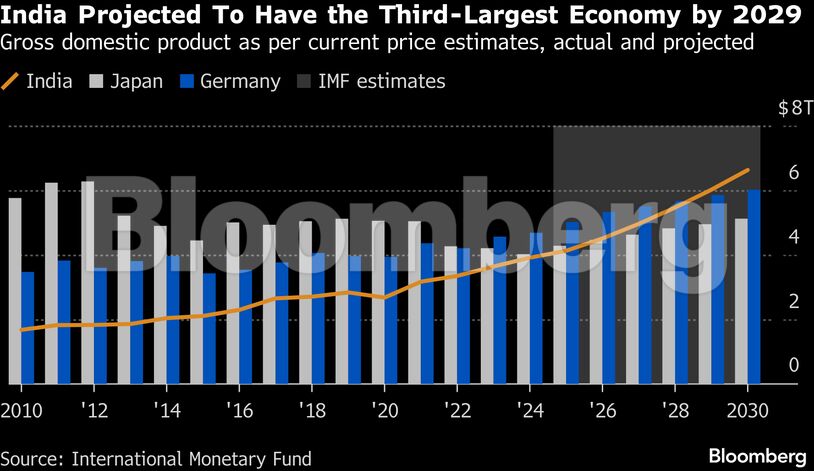
Based on nominal GDP, India’s government projects the economy will reach a little more than $4 trillion for the fiscal year ending March 2026, compared with official data from Japan showing its economy was about $4.4 trillion in calendar year 2025. The IMF had earlier forecast that India would overtake Japan in the 2025-26 financial year.
Why didn’t the IMF’s projections materialize?
Exchange rates were a major factor.
India’s currency depreciated about 5% in 2025, shaving off a significant portion of growth when converted into dollars. The yen, despite bouts of volatility, was stronger on average against the dollar than in the previous year, boosting Japan’s GDP in dollar terms.
India’s economy is still expanding much faster — it’s on track for growth of more than 7% this fiscal year and next, compared with roughly 1% for Japan. But as long as global rankings are measured in dollars, currency movements could delay the crossover.
How will India measure its GDP differently? Why does it matter?
On Feb. 27, India will shift its GDP base year to 2022-23 from 2011-12, updating the framework used to calculate economic output. Rebasing revises the relative weights assigned to different sectors so the data better reflect how the economy has evolved over the past decade.
Fast-growing areas such as the digital economy and gig work are likely to be added in the new series, while sectors such as agriculture and informal manufacturing could account for less.
A similar revision in 2015 boosted India’s GDP by about $120 billion and lifted the estimated growth rate for 2013-14 to 6.9% from 4.7%.
The impact of the latest revision remains uncertain as updated sector weights have not yet been released.
What’s driving India’s economic growth?
India’s population growth has become a powerful engine for its economic surge. Its population has grown from about 361 million at independence in 1947 to more than 1.4 billion today. This rapid expansion has helped swell the workforce: the median age of India’s 1.4 billion people was 28 in 2021, and about 65% of the population is projected to remain under 59 through 2036, according to the statistics ministry.
These younger, working-age households are driving strong consumption by spending on housing, cars, smartphones and other consumer goods.
Services remain the backbone of the economy. Cities have been transformed into hubs for information technology and business process outsourcing, financial services, tourism, healthcare and retail.
The government is investing record sums in infrastructure and seeking to attract foreign manufacturers by cutting red tape and offering tax breaks and production-linked subsidies. Companies including Samsung Electronics Co. and Apple iPhone maker Foxconn have set up large smartphone production units in India.
What would it mean for India to overtake Japan?
Given its population is about 10 times larger, India surpassing Japan in overall GDP would reflect scale rather than prosperity.
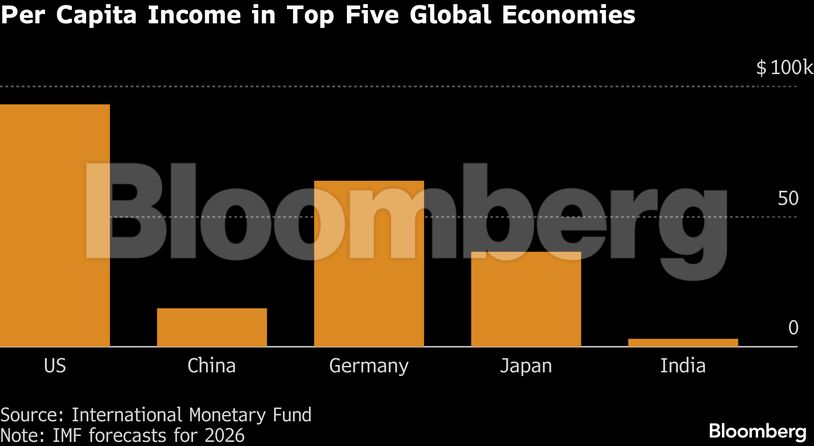
India’s income per person is a fraction of Japan’s — just above $3,000, compared with roughly $36,390, according to IMF estimates for 2026. By World Bank classifications, India would still rank as a lower-middle-income country.
Even so, the milestone would carry symbolic and geopolitical weight. It would reinforce India’s rise as a major economic power, enhance its appeal to investors and businesses seeking alternatives to China, and give India more influence on the global stage in discussions around issues like food security and climate policy.
For Prime Minister Narendra Modi, it would be a boost to his ambition for India to be a leader among developing economies. Domestically, it’s another step toward his goal of making India a developed nation by 2047, the centenary of independence from British colonial rule.
Yet developed status depends on living standards, not economic size. It implies high per capita income, world-class infrastructure, a well-educated and skilled workforce, plentiful quality employment, low youth joblessness and robust social safety nets. Japan meets many of those benchmarks, underscoring the gap India still needs to close.
Are there other ways to compare economies?
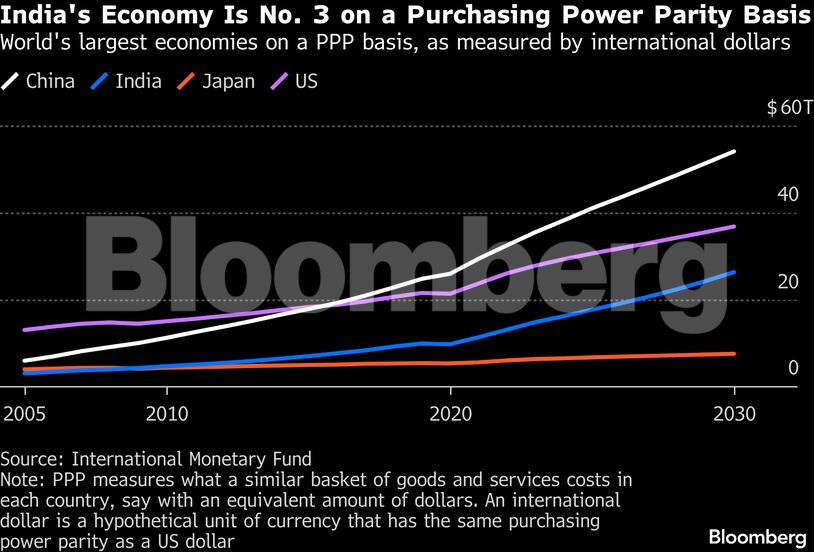
While comparing a country’s nominal GDP is the standard approach, another, albeit less widely used, method is to use purchasing power parity (PPP). This method adjusts for differences in price levels across countries. Rather than relying on market exchange rates, it compares what a similar basket of goods and services — such as food, clothing, rent, electricity and transport — costs in each country.
On a PPP basis, India is already the world’s third-largest economy, a position it has held since before 2010, according to the IMF. Using that yardstick, the IMF expects India’s economy to reach about $19.14 trillion in 2026, compared with roughly $6.92 trillion for Japan.
That gap reflects much lower prices in India. A kilogram of rice, for instance, costs about $0.67 in India versus $4.76 in Japan — roughly seven times as much.
This report is auto-generated from Bloomberg news service. ThePrint holds no responsibility for its content.
Also Read: How IMF’s routine data critique was spun to discredit India’s growth story